Interview with the cast of Cable Street at Marylebone Theatre
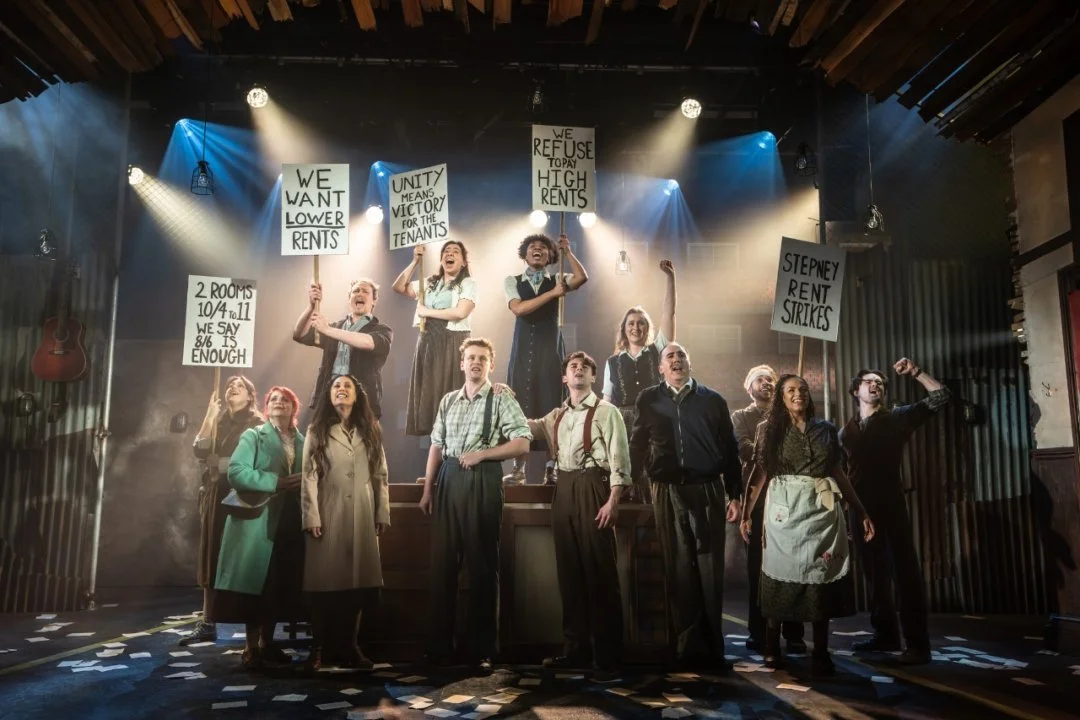
Cable Street at Marylebone Theatre
Written by Ziwen for Theatre & Tonic
Disclaimer: Gifted tickets in exchange for an honest review
On 4th October 1936, as the British Union of Fascists began their march through East London, people rose up and built barricades in the streets. Jewish youth Sammy, Mairead, an Irish Catholic, and British young man Ron, all find themselves facing crucial choices. This is the story told in the musical Cable Street. After two sold-out runs at the Southwark Playhouse last year, the show has returned to London once again. Receiving numerous four- and five-star reviews, the musical features Music and Lyrics by Tim Gilvin, Book by Alex Kanefsky, and is directed by Adam Lenson. This revival is not simply a restaging of the original production, but one that introduces many adjustments to both the narrative and the staging.
Before seeing the full production, I was fortunate enough to be invited to preview two songs from the show—Angel On My Shoulder and No Pasarán—and to listen to director Adam Lenson along with several of the lead performers, Max Alexander-Taylor, Jez Unwin, Lizzy-Rose Esin Kelly, and Natalie Elisha-Welsh, as they shared insights into their creative process and artistic intentions.
While Adam appears quite introverted, he lights up the moment he starts talking about the production.
“The first song written for this show was Only Words, And I remember Tim, the composer, singing it in a concert in 2018. He said, ‘I've had an idea for a show about Battle of Cable Street. I read this article in The Guardian, and it feels like this was 2018, Brexit, Trump. It feels like something's happening. And I want to start writing a musical about it’. So, he wrote the song Only Words and the video is still on YouTube. And it's the same song, it's still here. And I sometimes say the first song that's written in a musical isn't the opening number. It's almost one of the hearts of the story tends to come first, or that wound or that ache. So, I'll always have an appreciation for that song, because without that song, none of us would be where we are now. Go look up the video of Tim singing. It's pretty cool. He may not thank me for saying that, but yeah.”
After Adam, everyone else shared their favourite song, and none of them chose the same one.
Natalie: “I think my favourite is Shut Me Out, which is the kind of it's the last ballad. And it's beautiful, it makes me cry every time I'm in the wings waiting to come on stage, and I think about how these especially young men can be so easily radicalised by these terrible people. And we really see where Ron is just this vulnerable little boy, even though he's becoming a man and he's in his early 20s. He's lost, he needs guidance. He doesn't have any of that, he doesn't have a father figure, and it shows how he's really just needed somebody to hold his hand and guide him and put an arm around him and say, ‘look, things are going to be okay’.”
Barney: “Adam’s favourite song is first one that was written. Weirdly, mine is now the last one that was written, which is the mother's song. I remember being in workshops with Tim, and he was saying, ‘we're going to put in a mother's song’ and I went, ‘em, that won't work’, I know the producers were also like, ‘I don't think it would work’. And then, when we got into staging it in context, I looked over at someone else in the cast and went, ‘I'm so glad I was wrong.’ Because it really works, it's become a really powerful moment and one of my favourite moments in the show.”
Jez: “I'm going to say, What's Next? It's very uplifting. It goes from an Irish pub and then twists it around. I think it's an absolutely brilliant song, and it's the perfect number for you to just get really into the show, so I love it.”
Lizzy: “I actually really like Bread and Roses. At the start when I was learning it, I didn't know completely how to play. And it's basically about a song of saying in a world of chaos, yes, we need the essentials, but we also need and deserve beautiful things. And I think that's a really beautiful message to remind people that we don't need to just be like hanging on. We can actually have lovely lives.”
Because they are telling a story that truly happened, the process of creating the work carries a further layer of significance.
Adam: “I think it's really special to work on something that's based on something that happened. And we care about it a great deal. We want people to learn from this, and we don't want to get facts wrong. The fascist and the Communists never actually fought. They were kept aside from one another, and it was the police that fought with the Communists. You will see accurate representations of today, but actually way more important for that for me is like finding an emotional truth. Theatre is the most emotionally true form, I think, and it has to feel right. That has been what I've mostly been led by, and that's the kind of hard thing to go to sometimes.”
Barney: “Holding all the responsibility of what the show could do and means feels like quite a lot for an actor to do on that stage. So, I found that the best approach is letting the writing hold that responsibility, that my sole responsibility is honoring that writing. If you get that right, then the rest of it should carry. Because the work has already been done in the lines and in the music.”
Lizzy: “It's kind of like a blessing. I think with this kind of story, in the way the show works, anyone can be anything. I think it’s really important to show a multitude of different kinds of people coming together in difficult times. It's nothing like I've ever worked on ever before. It's a story about community and doing what's right and I think that's so important in the world today. And I feel quite lucky and blessed to be a part of it and take my own spin on it.”
The same story can have a very different impact when told as a musical rather than as a play. I really appreciate the director’s understanding of the musical theatre form.
Adam: “I think musical theatre as a form is so incredible in its ability to engage not only with the big ideas, but also emotions. It allows you to process things and experience them in a really unique way. I think what's really unique about this show is it's about something really important and that matters. I think too often musicals get cast as a kind of medium of where they're just entertainment. And we know that that isn't true. Musicals are not just entertainment. There are about so many different things, and I think this show really is emblematic of that, of saying things that are important and that matter and that need to be said. Some of these things are very political and they're also very ideas based. And if they were just said in a play, I think it would be quite a dry evening and maybe quite a depressing one. Whereas I think told in a musical form, it allows them to feel more multi-dimensional and more inspiring. And I think the message of this show is hopefully an inspiring one, and in some ways an optimistic one at a difficult time. I think during most difficult times it's good to have something that doesn't ignore that, but engages with that, and does so in a way that is really optimistic and hopefully gives us a map for what we should be doing.”
During this discussion, the actors also spoke about the personal significance their roles held for them.
Lizzy: “I think on a more person level, the character I play is like a revolutionary. She stands up for what right. And I think it's just nice for young black kids to see someone who is in the face of adversity doesn't shy away and is always trying to do the right thing no matter what the cost. You don't usually get to see ourselves played with such confidence and ferocity, not caring what other people think knowing that they can stand on our own two feet. I think everyone gets to do that in their own special way of making their own communities feel seen in this show just by being on stage, which is a very helpful thing. You only believe you could be something if you see it. And I think theatre is so good and it's becoming better at showing different types of people creating stories. And hopefully the next generation will get to see something like this and see how many different people are involved and feel like they can get involved later down the line.”
Jez: “I'll run on a personal level as well, so I played three roles. One of them is the patriarch of a Jewish family, the other one is the head of a fascist group, and the other one is a tour guide. And that's the part that's interesting for me. I mean, they're all interesting, but as an older member of the cast and someone who has recently lost someone in the family which obviously I'm not going to go into, it's very interesting for me to play someone who is dealing with the ghosts of the past and connecting to who they are, who their family are, and the importance of that. The way different people find their way through grief or history, their own history, becomes much more important when you have a less family left. So as the older one, the oldest person probably in the cast. I find that particularly poignant for me in this iteration of the show.”
I was very curious about what changes had been made in this version. Barney mentioned, in particular, that the character of Ron had been developed in greater depth.
Barney: “The exploration of the character Ron has been clarified in this version even further. He is the young working in class lad, who is seduced by fascism. Finding empathy for that character, and finding understanding of why that happened and how that happened, is incredibly useful for us to connect with the shared humanity of people whose views are incredibly different to ours. Because it's very easy to just go, “oh, enemy, villain”, as opposed to understand the shared humanity that we have, and this is a musical that's so wonderfully looks into that, and isn't overtly kind about it, but tries to understand and empathise with the position that person was in before they made the decisions that took them to fascism. And that feels really, really important to look at.”
Finally, there is no better way to close this article than with Adam’s own words.
Adam: “What I love about the show is it's a show about community coming together, and that's what we're doing, too. It's all of these people caring a great deal about what they're here to do and also caring about the people they're here to do it with and drawing that all together. So, it's almost like the show and its content, and the form and the process are all kind of lined up. And that feels rare and nice, because when you see people dragging furniture onto the stage, it's very similar to I imagine to how it would be to drag furniture onto the street. It's the same muscle, it's the same people. I feel like the first and the second time of Cable Street were both quite near to one another and they sort of felt like version one and version 1.4, and this is version four. Sometimes I think in musical theatre we get used to this kind of like repetition of an existing show that people are stepping into. That is not the case this time. This is new scripts, new design, new costumes, brilliant new songs and brilliant new people, like a real evolution.”
Even in such a brief event, I could already sense that they are a passionate and thoughtful group. I believe this production of Cable Street will be even more mature than before. While I would have loved to hear more songs during the event, such as Only Words, Bread and Roses, and What’s Next, I suppose that experience will have to be left for the theatre itself.
Cable Street runs at Marylebone Theatre from 16th January 2026 until 28th February 2026. Find out more and book tickets here.