
Dark of the Moon at Charing Cross Theatre Review
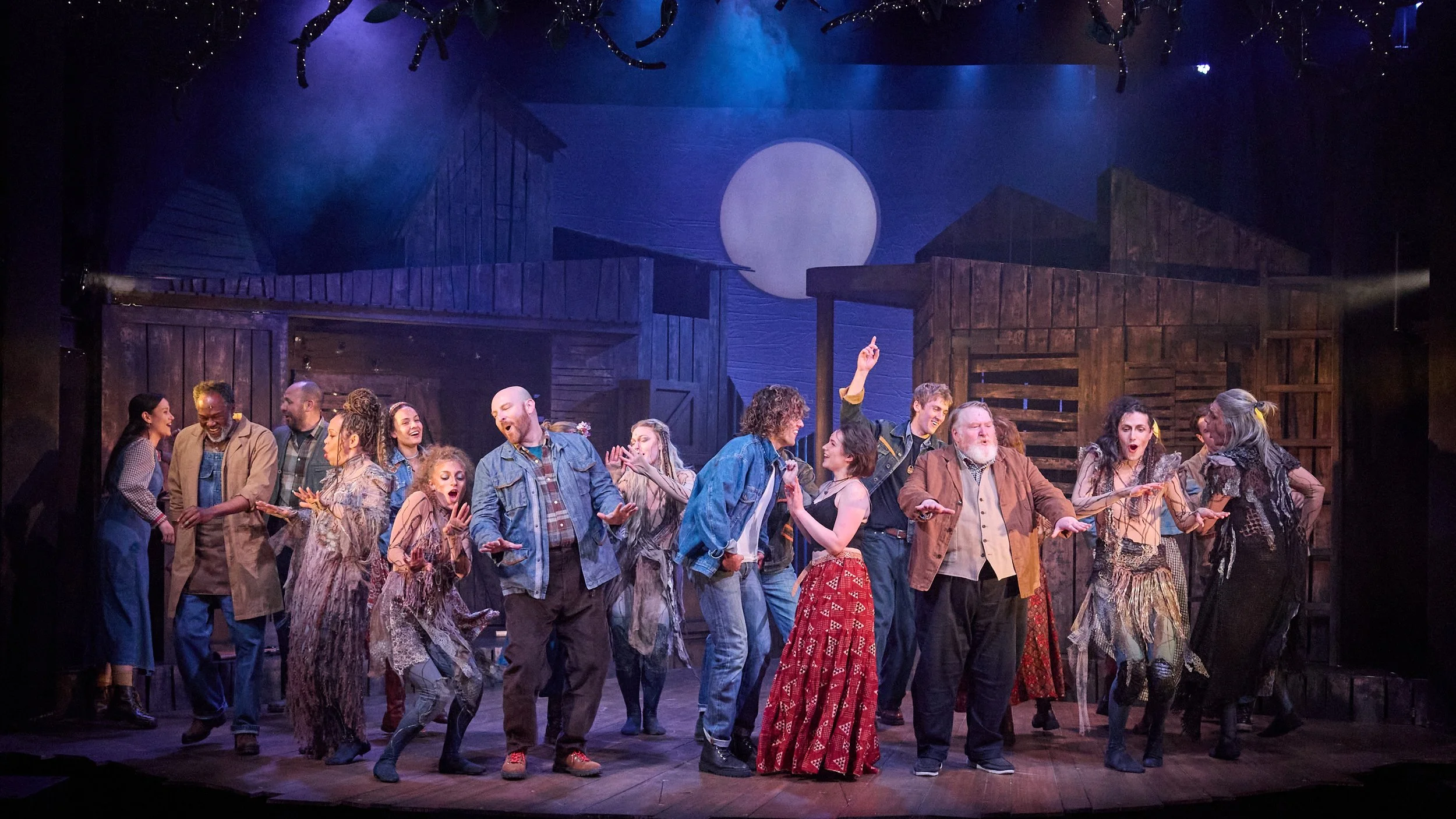
Photo: Tom Bowles
Written by Penny for Theatre and Tonic
Disclaimer: Gifted tickets in exchange for an honest review. All views are our own
Based on a 1939 play by Howard Richardson, which in turn was inspired by English/Scottish folklore and a centuries-old ballad, this new musical tells the story of Barbara Allen, a young girl living in the Appalachian mountains, and her love affair with the warlock John. Its score includes a mix of country/bluegrass and rock tunes to represent the conflicting worlds of its human and supernatural characters. It promises “a supernatural tale of witchcraft, small-town prejudices, forbidden romance and the power of faith”.
The story is an obvious choice for adaptation. The recent success of The Curious Case of Benjamin Button musical, itself based on an unlikely fable, and the huge popularity of “romantasy” as a genre makes it clear that there’s a clear appetite for love stories that transcend time and see different worlds merge and collide, full of yearning and seemingly impossible barriers to be overcome.
In this story, John the Witch Boy loves human Barbara Allen. She can’t see him in his witchy form but their connection is so strong that she can sense him. Yearning ensues. John begs the powerful Conjur Woman to make him human so that they can be together. She grants his wish with the warning that Barbara must stay true to him for a year, after which he will become human. If she does not, he will return to immortality and to his coven but with a memory of his broken heart that he will carry with him for eternity.
The show’s tagline, “Being human is heartbreak” hammers this message home – humans experience grief and loss but given our mortality, there will be an end to the suffering. Not so for an immortal. Jonathan Prince’s book does well to weave this message into the story. We meet the coven of witches, devoid of feelings and living only for their own hedonistic pleasures. We meet a grieving widower for whom the local community comes together in support as he buries his beloved wife. And we meet Barbara Allen – the archetypal feisty heroine who wants more than small town life and refuses to settle for anything other than her one true love. As well as her big dreams, she has a bit of a reputation amongst the locals for being a little loose with her morals – a mix of Beauty and the Beast’s Belle and Rizzo from Grease then. The scene is then set for a love triangle with Barbara, John and local heartthrob Marvin Hudgens – who manages to avoid going full Gaston by having some redeeming features, making his character arc more interesting than it would be with a stereotype bullyboy villain.
As the story unfolds, the angst is satisfying, the romance tender and the jeopardy heightened by the supernatural element and intensified by the community’s superstitions. Less successful is a comic subplot that see’s Barbara’s brother Floyd (Wills Mercado) in a sweet but irrelevant romance with local girl Ella (Sophia Duncan), accompanied by bad guitar playing and comedy lyrics that don’t amuse. It’s a waste of two talented actors and this area of the book needs work.
The use of different musical genres to reflect the two “worlds” is a clever device and generally effective. The strongest music and lyrics, from Lindy Robbins, Dave Bassett and Steve Robson, come in the human songs with fantastic orchestration from Dillon Kondor. The rockier numbers are a little less successful – often vocals are so loud that lyrics get lost. Individually, the singers are great but when singing together, the harsher tone is jarring and a little discordant. Whilst this is probably intentional to stress the contrast between the two groups, it is a bit of an assault on the senses and doesn’t do much to move the story along. The live band, under the direction of Matthew Herbert, deftly jumps between musical styles but at times feels as if it is fighting against the singers. These are minor issues that could easily be ironed out – overall it’s a promising score that definitely calls for a second listen.
Libby Todd’s set instantly draws us into this small town community – wooden facades reveal simple dwellings and a general store, the mountains in the background are depicted with corrugated iron and the large full moon is always visible. The witches stand out in their otherworldly costumes – bodysuits with tatty embellishments in neutral colours that should blend into the background but manage to have the opposite effect against the simple clothing of the humans.
Lighting and sound design from Jonathan Chan and Andrew Johnson add to the atmosphere, with dramatic effects that lift the veil to show us the supernatural world living in tandem with these simple American folk.
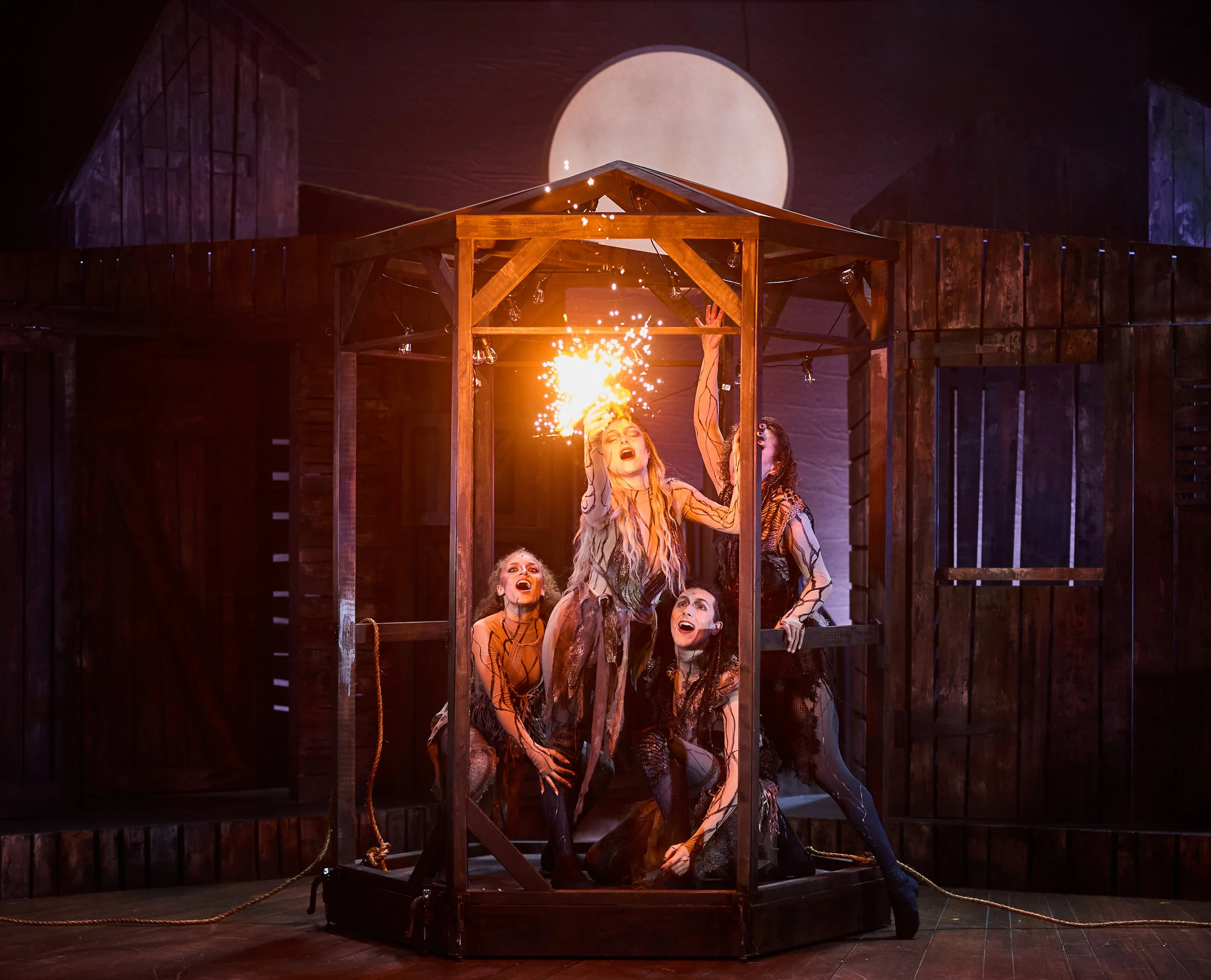
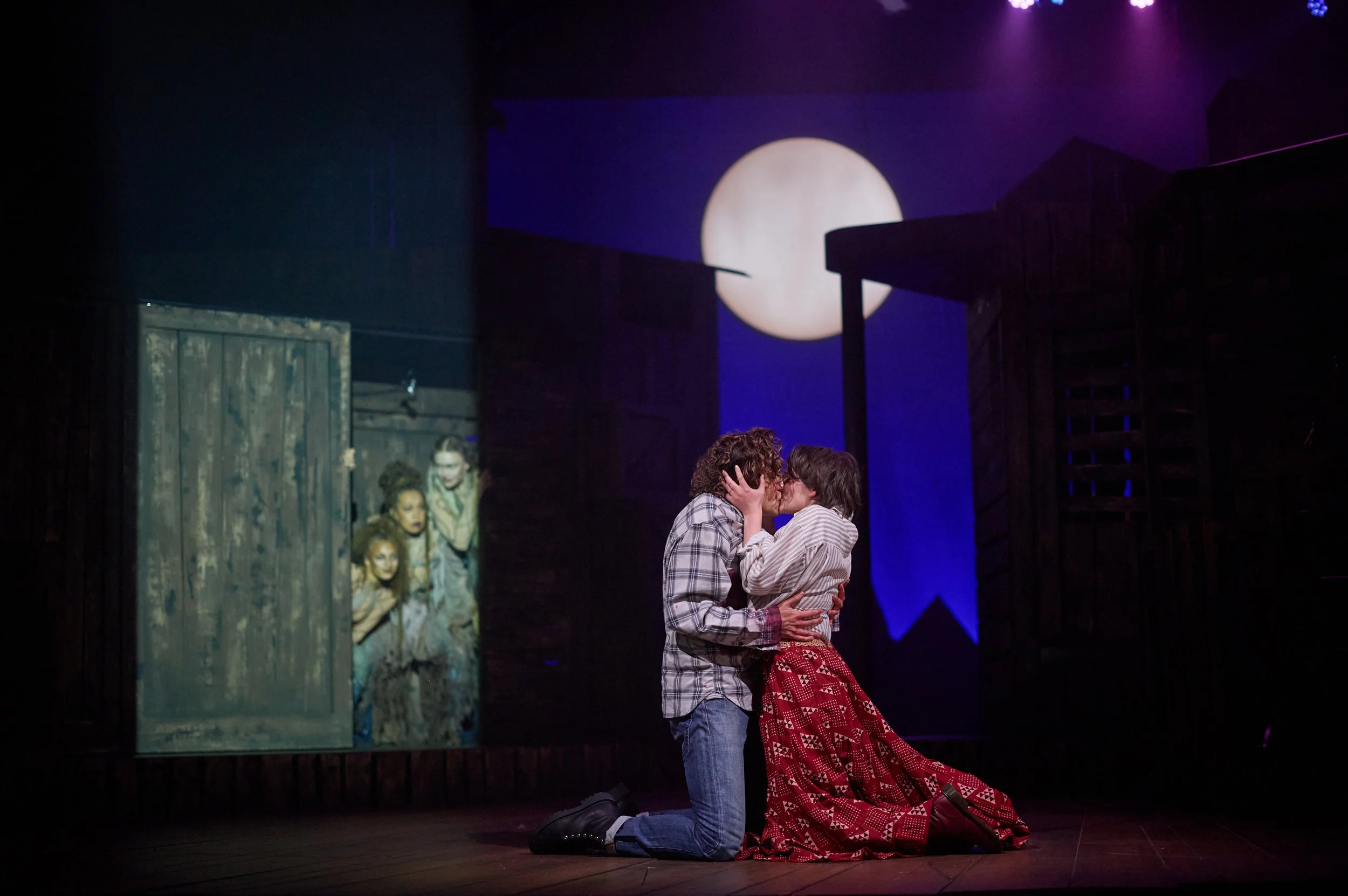
Director Georgie Rankcom has done a good job in showing us these parallel worlds. As the townspeople go about their business, the witches prowl across the rooftops, spying, judging and even walking through the action as an unseen presence that still visibly unsettles the town’s residents. But not all of the directorial choices land as intended. For example, in his human form, the character of John can be a little frustrating. With his lack of knowledge of “the human condition” making it difficult for him to blend in as a man, he can appear a little foolish at times, when surely the intention is just to highlight his “otherness”. His confusion every time he’s offered a handshake may draw a laugh from the audience but doesn’t ring true. Having watched over the humans from their mountain home for years and years, one would expect a better understanding of their ways.
The cast members offer some excellent performances. Josie Benson has a powerful presence matched by absolute powerhouse vocals as the Conjur Woman. Jordan Broatch is endlessly watchable as warlock Devin, making the most of every line spoken or sung and prowling around the stage with an almost feline intensity. David-Michael Johnson offers a perfect representation of the heartbreak that’s at the heart of the story – a stoic presence, defined by his grief. And Kiah Lindsay’s ballads to set the scene are hauntingly beautiful.
As John the Witch Boy and Barbara Allen, Glenn Adamson and Lauren Jones have a great chemistry and their voices blend beautifully. Adamson’s emotions are clear and John’s growing understanding of humanity’s capacity for heartbreak is very well conveyed. His vocals are incredible, brilliantly showcased when he lets his warlock side dominate in ‘Certified Rockstar’. As Barbara Allen, Jones is sensational, a great storyteller. She is likeable, relatable and full of passion and vitality. Vocally, she steals the show – equally at home with the melodious ‘Wildflower’ or the rocky defiance of ‘Unthinkable’ – a desperate battle cry that is utterly heartbreaking.
Dark of the Moon is not perfect in its current form. It needs more light to balance the shade, improving the comic relief. The rockier numbers also need attention, to make the lyrics stronger and clearer so as to give a better insight into the coven members and their intentions. But, there are plenty of positives. The fusion of rock and country music fits well with the narrative, this production offers some great performances and technical content that enhances the atmosphere. It’s a highly entertaining evening and an absorbing slice of Americana that breathes new life into an old story.
Dark of the Moon runs until 8th August at Charing Cross Theatre.
★ ★ ★