
Edward II at Jack Studio Theatre Review
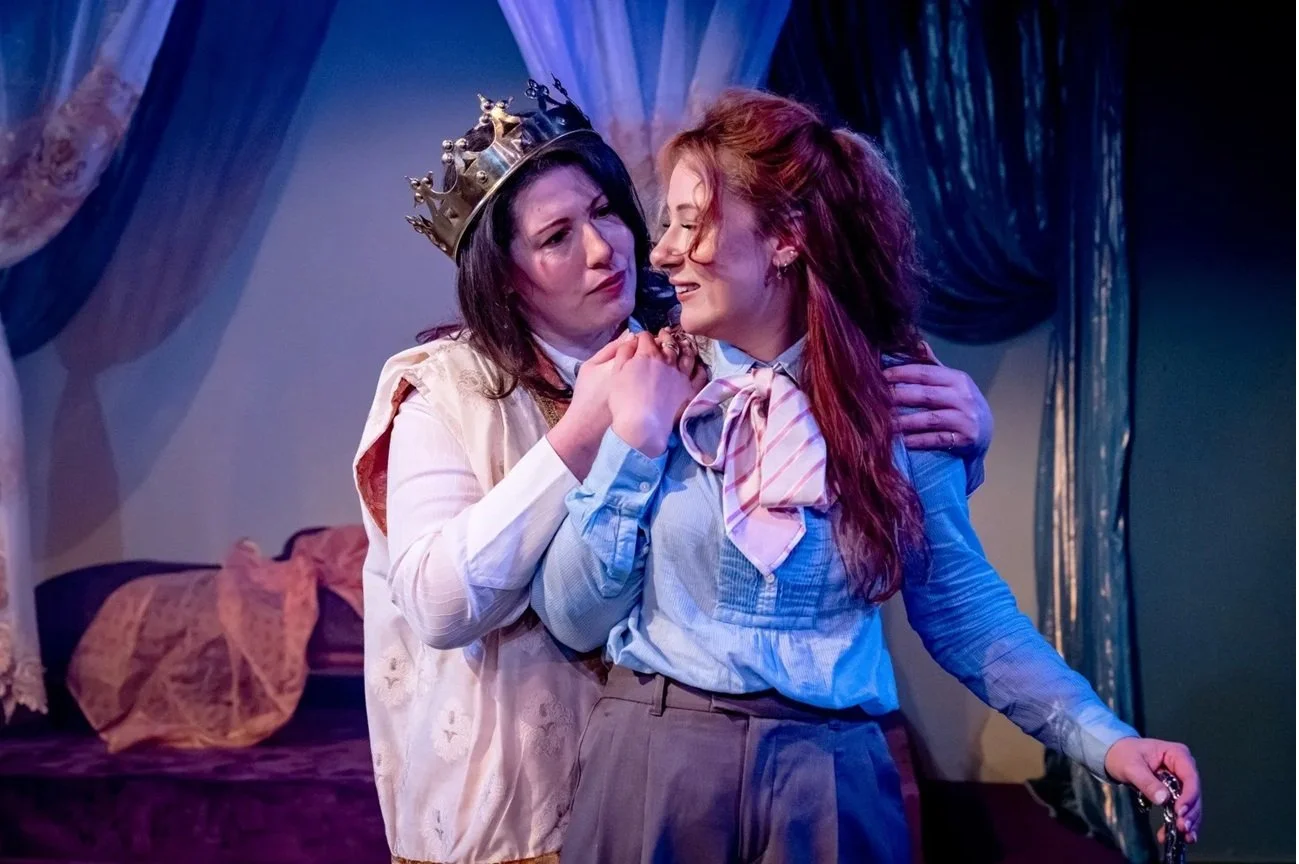
Natalie Harper and Elinor Machen-Fortune
Written by Penny for Theatre and Tonic
Disclaimer: Tickets were gifted in return for an honest review. All views are our own
Written by Shakespeare’s contemporary, Christopher Marlowe, Edward II largely focuses on the King’s close friendship with Piers Gaveston, one that threatened the very foundations of England. It is alleged that the two men had a homosexual relationship, something that was a serious crime in devoutly Catholic 14th Century England, but interestingly Marlowe’s play focuses more on the nobility’s resentment at Gaveston’s social elevation and influence on the King.
Alex Pearson Productions, in association with Glass Splinters, offers a fresh take on this story of love, plotting and violence, aiming to make it accessible to modern audiences. It’s a fitting production for South East London’s Jack Studio Theatre, as Edward II was the first King to officially reside at Eltham Palace, just four miles away from our venue.
With so much educational and cultural emphasis on the lives of monarchs like Henry VIII, Elizabeth I and Victoria, the troubled reign of Edward II (1307-1327) is not one that is at the top of a history syllabus, but it certainly includes plenty of drama. This production retains the 16th Century language in Marlowe’s play but gives it a more contemporary setting, which makes it easier for the audience to engage with the story, bearing in mind many of them will be hearing this story for the first time, some 700 years after Edward’s death.
The set, designed by Eve Oakley, is simple – a chaise longue sits on a rostrum, serving as everything from royal castle to prison cell, with curtains draped in front of it and to the side of the stage. A footstall serves as a seat and then a podium for a few of the more dramatic speeches. Its simplicity allows us to focus on the story, creating an atmosphere but not overwhelming. Oakley is also responsible for the costumes – dressing the multi-tasking cast in suits for the nobility and rough workwear when they play minor commoner roles. Edward has his crown, elevating him above his courtiers, and the clergy have appropriate head gear, helpfully branded with initials to remind us who they are (ABC = Archbishop of Canterbury!).
The sound, designed by Hannah Clancy, helps to draw us into the action – a simple drop of water or drumbeat takes us into a prison cell or to the battlefield. Lighting from Steve Lowe is equally effective, subtle until there’s some serious violence – shown by bold red lighting at the rear of the stage, letting us know exactly what’s going on, without the need for it to play out on stage.
This largely female creative team is mirrored in the all-female cast of six who, between them, take on all of the roles. In a play full of male characters, set in a period in which women had very little power, it’s a casting choice that highlights the gender disparity in political and social power. There were a few fluffed lines at the start of some speeches, but this is a wordy piece, and everybody recovered so quickly that it didn’t interrupt the flow or our enjoyment. Most of the actors play multiple parts– with a main character and then taking on supporting roles. This could potentially be confusing, particularly as two of the actors, Elinor Machen-Fortune and Alison Young have quite a similar look, but they all create individual characters. The actors move from nobility to a clergyman to a messenger or a child – achieved with a minor change of costume, posture and accent. Without being hugely familiar with Edward and his contemporaries, there were times when I missed a character’s name, but as there was a clear distinction between nobility and lowly commoners, the story was still easy to follow and the main players soon established themselves.
Pearson’s strong direction means that the play has a very good pace, the 16th century dialogue is very clear in its delivery and the plot is easy to follow. She has a clear understanding of drama from this period but makes it feel very modern, bringing out all the plotting and political machinations that are still all too familiar in modern Britain. The main difference is that in Edward II’s England, political rivals would literally stab each other in the back. It’s like a medieval “The Thick of It”!
The actors manage to say as much with a look or a reaction as they do with the spoken words. It’s always clear what they’re thinking. Although the play is a tragedy, Pearson still manages to inject some humour into the action, through little gestures and expressions and a young Prince in a onesie! There are a few fight scenes, choreographed by Scott Howland. They are more a representation of battle than a prolonged demonstration of swordsmanship, which fits well with the overall direction, which has a clear focus on character.
As Piers Gaveston, the King’s close friend, confidant and alleged lover, Elinor Machen-Fortune stands out from her first entrance. She has a foppish affectation and presents a character whose confidence borders on arrogance, she is manipulative and cocky and oozes charisma, whether she’s taunting her rivals or more tender when alone with Edward. Later on in the play she takes on the part of the King’s son (in aforementioned onesie), presenting a much more serious young man, dutiful and decisive.
As the King, Natalie Harper also gives a very strong performance, a conflicted character who despite royal status, is subject to the will of the Church when it comes to making decisions. As the pressure mounts, she has a very visible sense of despair in the face of plotting and betrayal.
The play’s only female character, the French Queen Consort Isabella, has a great character arc and Alison Young does very well to show her journey and development. Her accent does go back and forth across the Channel a little and I’m not sure she really needs to deliver those few lines with a French articulation. She tells Isabella’s story well so this isn’t really needed and on occasion it was a little distracting from what she was saying.
Running at around an hour and 45 minutes, it’s a testament to the quality of the direction and performances that the play doesn’t drag. In an ideal world, perhaps 10-15 minutes could be shaved off the running time, but this is a minor quibble. The Jack Studio Theatre is a real gem, programming a diverse mix of productions, with a lot of new work. The inclusion of Edward II, a classic but rather overlooked piece written by a celebrated playwright, is a strong choice, putting the spotlight on a period in history and a King that may not get the same attention as other times and rulers. It still tells a powerful and relatable story. So whether you are a history buff, a Shakespeare afficionado (many academics believe that Marlowe collaborated with him on history plays) or just appreciate good theatre, this is an excellent addition to the Jack’s calendar.
Edward II runs at the Jack Studio Theatre until Saturday 18th April (performances Tuesday to Saturday). Find out more and book here.
★★★★