Henry V at RSC Stratford-Upon-Avon Review
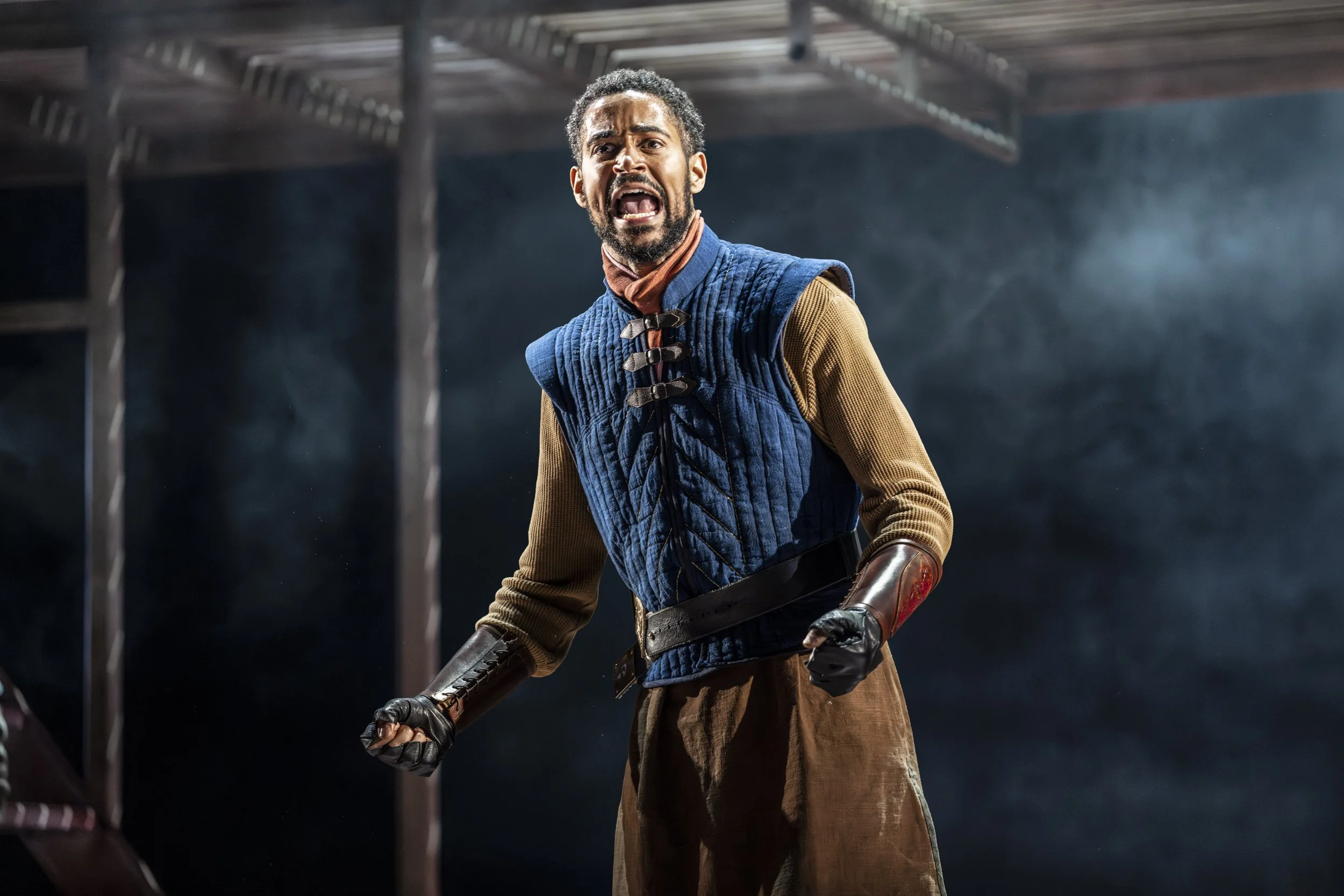
Photo by Johan Persson
Written by Roni for Theatre and Tonic.
Disclaimer: Tickets were gifted in return for an honest review. All views are my own
As their 2025/2026 season draws to a close, Stratford-Upon-Avon’s RSC is still committed to providing some blockbuster pieces, both classic and brand new. Henry V is the latest offering to grace their main stage, bringing together an experienced cast and creative team to deliver one of Shakespeare’s more factual works. Will this be considered a triumph, or is this one play that is fighting a losing battle?
Henry V is Shakespeare’s retelling of the initial phase of the Lancastrian war, part of the Hundred Years war in which Henry V invaded and conquered a large portion of France. Following his father’s death and his own subsequent ascension to the throne, Henry V begins to question whether he should make a claim on France, which is met with mockery and insult from the French Dauphin. A now incensed Henry declares he will invade France, and begins to prepare his troops, whilst the French also rally theirs for what they believe will be an easy fight. What ensues is a brutal battle for King and country – and only the King can answer as to whether a victory is worth the bloodshed.


The RSC are of course renowned for breathing contemporary life into some of Shakespeare’s best-known works, making them more palatable and relatable for a modern audience. The material here is, sadly, a bit monotone for the RSC’s usual standards. This is certainly not one of Shakespeare’s more exciting plays, nor does it lend itself well to any kind of vibrant adaptation (thinking, of course, of the gem that was last years version of Much Ado About Nothing). The team behind this production have made attempts to combat this in various ways, which are appreciated. There is a significant amount of comic relief provided by the character of Pistol, played brilliantly by Paul Hunter, that is lapped up by the audience amidst the slightly depressing tale of war. The staging has also been employed as a method for injecting more life into the show, as the action revolves around a wooden, minimal, rotating structure upstage that acts mostly as both balcony and battleground climbed by the cast. At one point, a bar of red LED lighting descends towards the floor, backlighting the main structure and giving a staging set up reminiscent of the recent works of Jamie Lloyd. However, the minimalistic approach does sometimes make for a confusing story, as the cast doubling up on roles often perish, come back to life, then perish again as someone else. There is also a slight issue of somewhat of a language barrier: attempting to remain authentic by having Katherine and Alice converse almost exclusively in French in some scenes could be applauded, but it does feel rather exclusionary for those in the audience who are not fluent, and are therefore missing important context and attempting to glean jokes from tone alone. If we are attempting to make sure Shakespeare is accessible to those from all walks of life, this may be pertinent to consider so as not to create a slightly uncomfortable division.
That being said, the cast are invariably doing their best with the material at hand, spearheaded by the incredible Alfred Enoch. Having performed Pericles here in the summer of 2024, Enoch is no stranger to the RSC stage, and indeed he feels very much at home. He devours Henry’s lengthy, rousing monologues, stirring up characters and audience alike, and conveying all their emotion and meaning with ease. He is nimble across the stage, but switches quickly to a stance with more gravitas as the king angers and seeks vengeance. Enoch is a versatile actor capable of providing a beautiful nuance to his characters, and his fellow actors gain their own chances to shine around him, which is lovely to watch.
Overall, whilst this cast and creative team are exquisite in their crafts and have made several attempts to give this play some traction for its audience to grip on to, the material sadly does not provide enough for anyone to really sink their teeth into. This doesn’t feel like a reflection of the usual standard of work at the RSC, and audiences can be assured that even a monotonous play still has its spectacular parts that make it worthwhile.
Plays until 25 April 2026.
★★★★