
Les Liaisons Dangereuses, NT Live Review

Aidan Turner and Lesley Manville. Photo: Sarah Lee
Written by Ziwen for Theatre and Tonic.
Disclaimer: Gifted tickets in return for an honest review. All opinions are our own.
Les Liaisons Dangereuses began life as Pierre Choderlos de Laclos’s 1782 epistolary novel, set among the French aristocracy on the eve of the Revolution. In 1985, Christopher Hampton adapted the novel for the stage, and three years later the acclaimed film version was based largely on his play. Recently, the work returned to the stage once again. This time, Lesley Manville, who played Cécile in the original production, takes on the role of the Marquise de Merteuil. This new production places a strong emphasis on physical storytelling. Elegant and visually sumptuous, the production captures the fading grandeur and decadence of the world of Versailles with remarkable clarity. Having seen the production live before watching the NT Live recording, I was struck by how much of its dramatic force remains intact on screen.
The story itself is deceptively simple. The Marquise de Merteuil (Lesley Manville) and the Vicomte de Valmont (Aidan Turner) were once lovers, but they are also intellectual equals, united by their shared delight in manipulating the emotions of others. Seeking revenge on a former lover, Merteuil persuades Valmont to seduce the young Cécile de Volanges (Hannah van der Westhuysen), who is soon to be married. At the same time, Valmont sets his sights on Madame de Tourvel (Monica Barbaro), a woman renowned for her virtue and piety, treating her seduction as his greatest challenge. Yet what begins as a game gradually spirals beyond their control. Valmont unexpectedly falls in love with Tourvel, whilst the struggle for power between him and Merteuil becomes increasingly destructive. In the end, lies, jealousy and revenge consume everyone involved, culminating in tragedy.
A story this heightened requires actors capable of grounding its extremes, and the cast rises to the challenge superbly. Manville’s Merteuil is intelligent, sophisticated and fiercely proud. Beneath her apparently cold, rational exterior lies a woman of deep feeling and vulnerability. Whenever Valmont wounds her pride, one can sense the intensity of emotion she works so hard to conceal. Their conflict is not merely a personal battle for dominance but also a contest shaped by gender and power. Turner, meanwhile, embodies the very definition of a libertine. He narrows his eyes and flashes a sly smile at the women he targets, regarding them with the casual confidence of a predator toying with its prey. Precisely because he begins with such effortless control, it becomes all the more fascinating to watch his composure unravel once events begin slipping beyond his grasp. Even when he discovers genuine love, there remains something fundamentally cruel about the way he loves.
Following a successful screen career, this production marks Barbaro’s stage debut. She captures Tourvel’s innocence, uncertainty and anguish with great sensitivity. From her very first encounter with Valmont, she appears intensely drawn to him. While this interpretation somewhat weakens the character’s moral defences, it also reinforces one of the production’s central concerns: the struggle to contain forbidden desire. Westhuysen’s Cécile is perhaps the evening’s most striking transformation. In her first appearance, she is a sweet, naïve young girl, charmingly indecisive and prone to bursts of bright, bell-like laughter. By the play’s conclusion, however, she has become calculating, hardened and self-possessed, uncannily reminiscent of the younger Merteuil. Costume designer Natalie Roar underscores this evolution beautifully: the white dresses of Cécile’s innocence gradually give way to Merteuil’s signature red.
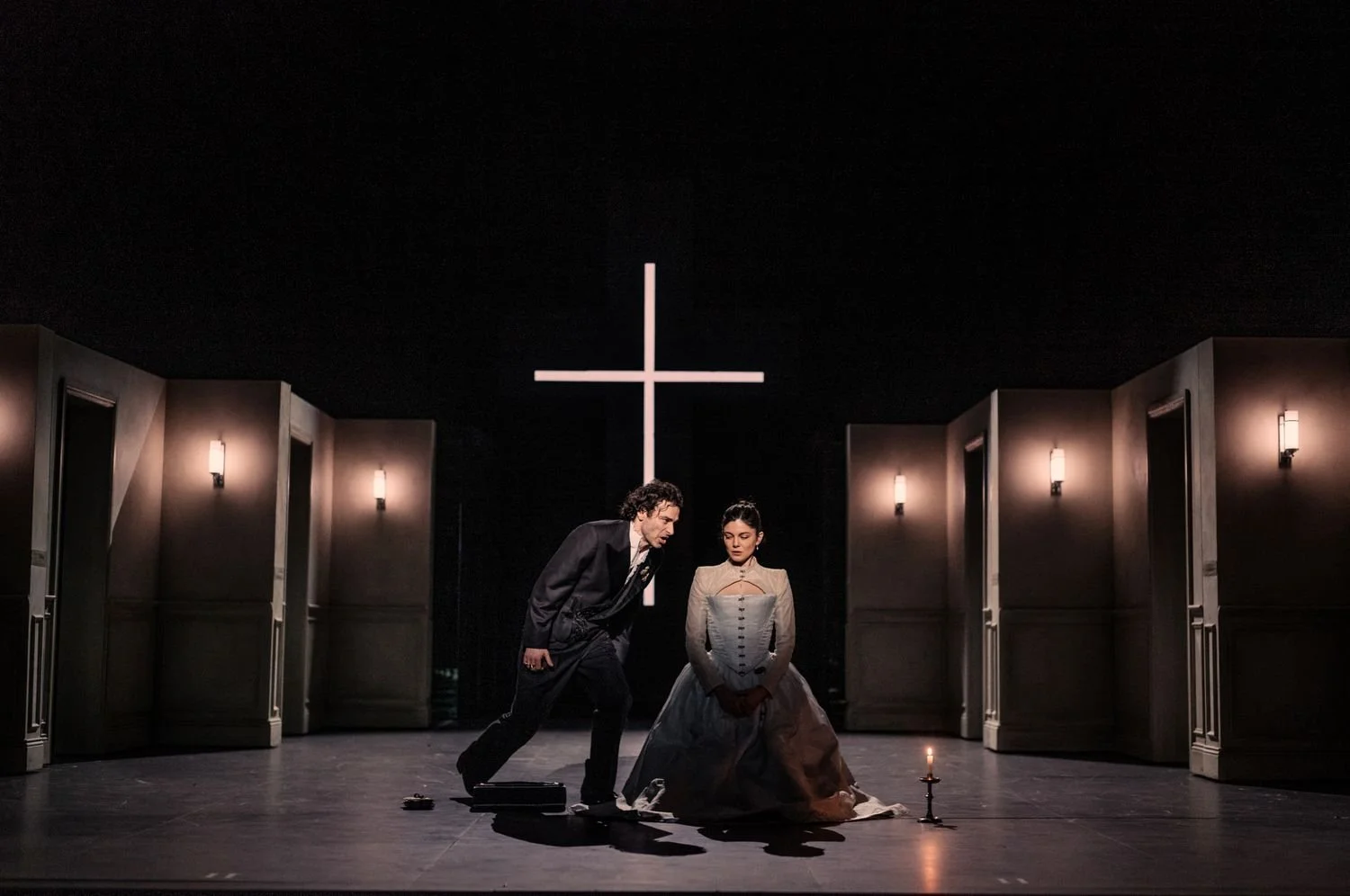

Rosanna Vize’s set design is equally imaginative. The stage is enclosed by three towering mirrors and crowned by a mural depicting female nudes. Suspended above the centre of the stage hangs an enormous mirrored chandelier fitted with 144 electronic candles, resembling an extravagant disco ball. In eighteenth-century France, mirrors were symbols of immense wealth, and Versailles’ Hall of Mirrors remains one of the defining images of the age. Here, the mirrors evoke a society obsessed with self-image, surveillance and mutual scrutiny. Together, these visual elements create a world that is both exquisite and deeply repellent. One scene stands in stark contrast to this atmosphere. When Valmont encounters Tourvel at prayer, the movable walls form a long, narrow corridor terminating in a vast cross. A single candle burns beside her. The image is quiet, sacred and intimate, offering a rare glimpse of genuine spirituality amid a world dominated by vanity and performance.
The ballroom scenes recur throughout the production, functioning not only as aristocratic social gatherings but also as arenas of seduction, competition and disguise. One image in particular is unforgettable: Cécile’s dress is stained with blood because of her miscarriage, yet Valmont continues to spin her around the dance floor, forcing her to smile, to dance, to keep up appearances. It is both devastating and powerful.
Tom Jackson Greaves’s choreography elevates the emotional intensity even further. Through movement, desire becomes tangible, while emotional conflict acquires a visceral physical form. In one particularly striking sequence, Valmont dictates a letter to Tourvel filled with declarations of tenderness while simultaneously enjoying the company of another woman. As he speaks, Tourvel is physically drawn into the embrace of the two lovers, as though his words themselves were exerting a seductive force upon her.
I was also impressed by the way costume and movement are used to externalise the characters’ inner lives. No matter how fervently Tourvel recites her prayers, men dressed in Valmont’s fur coat continue to enter through the doorway, disturbing her thoughts and leaving her overwhelmed. Later, during the duel with Danceny, Valmont repeatedly sees women in white dresses resembling Tourvel, visions that prevent him from striking the fatal blow.
The NT Live recording, captured with seven cameras, is exceptionally detailed, yet it cannot fully reproduce the immediacy of the live theatrical experience. Because the camera must frequently focus on one or two performers, viewers inevitably miss the reactions unfolding elsewhere on stage. More importantly, the production’s pervasive sense of surveillance is diminished on screen. Wherever conversations take place—even in bedrooms—black-veiled attendants are present, silently observing. The characters are almost never truly alone. When the camera isolates a principal actor, this subtle but persistent atmosphere of scrutiny is often lost.
And then there is the simple physical presence of the theatre itself. Sitting in the auditorium and watching waves of sumptuous skirts sweep across the stage creates a sensation that no recording can fully replicate. Nevertheless, it is difficult to overstate the value of preserving a production as memorable and thought-provoking as this one. If the live experience remains irreplaceable, the existence of such a beautifully filmed record is surely the next best thing.
National Theatre Live: Les Liaisons Dangereuses (2026) opens in cinemas on 25th June 2026.
★★★★★