
Man to Man at Royal Court Theatre Review
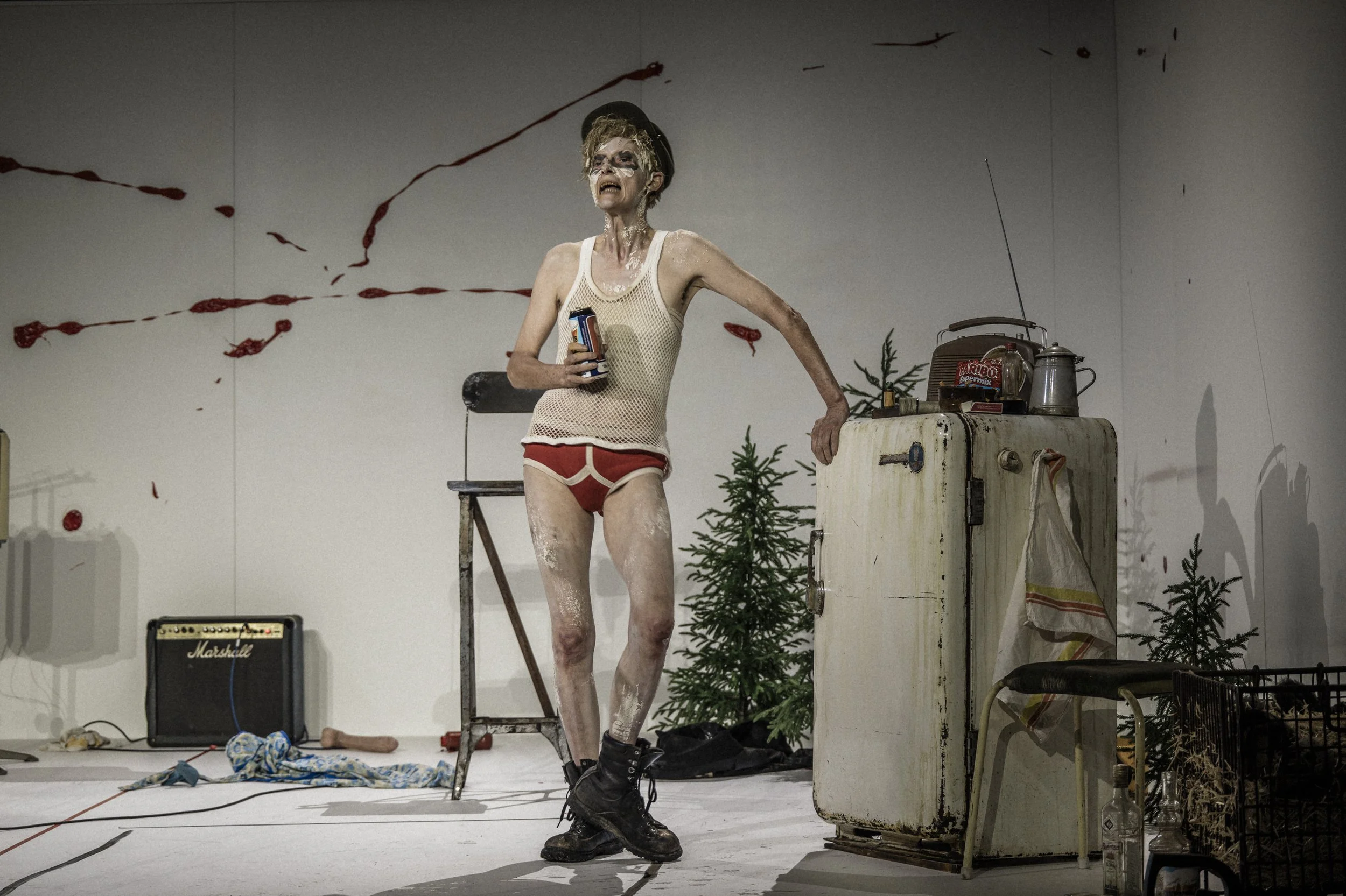
Tilda Swinton in Man to Man. Photo: Ruediger Glatz
Nearly four decades after Man to Man first passed through the Royal Court, Tilda Swinton returns to the same role, with much of the same creative team, in a production that now feels less like a revival than a loop closing in on itself.
Manfred Karge’s play has always been concerned with what happens when history refuses to stay in the past. Ella Gericke, a working-class German woman, assumes the identity of her dead husband Max in order to keep his job and survive. What begins as an act of necessity stretches across fascism, war, division, reconstruction and the fall of the Berlin Wall. In this version, Karge’s newer material carries the story further still, towards the re-emergence of the German far right.
That Swinton first inhabited Ella/Max as a young actor in the 1980s, and now returns to the role having lived through nearly 40 more years of European history herself, gives the production an extraordinary additional charge. The body on stage is no longer simply carrying Ella through time; it is carrying the history of the production too.
Swinton is remarkable. Gruff, coarse, wiry and perpetually alert, she strips away the otherworldly elegance that has become so associated with her screen work. Max is not performed as a disguise laid over Ella, but as something that has gradually consumed her. The transformation begins as survival and becomes something more complicated: identity as habit, armour and eventually perhaps home.
She moves between vulgarity, humour, fear and sudden flashes of tenderness with astonishing control. Yet what makes the performance so compelling is how little it asks to be liked. Ella/Max can be cruel, contradictory and blinkered. Survival has not made her noble; it has merely kept her alive.
Karge’s text is deliberately unstable. Anthony Vivis’s translation moves between prose, verse, song, memory and blunt working-class speech, creating a history that arrives in fragments rather than neat chronology. At times that density becomes a weakness. Certain passages feel so linguistically and politically loaded that the emotional thread momentarily disappears beneath them, and the play can become intellectually exhausting.
But Stephen Unwin’s production understands that Man to Man is as much about space as it is about language.
Bunny Christie’s stark white set is divided by a thin red line, its scattered furniture and outdated technology resembling the remains of several different decades deposited in the same room. The Royal Court itself becomes part of this architecture. Its industrial interior — concrete, steel, exposed structure — feels less like a neutral container for the production than another working device within it. The theatre becomes a machine for examining history: hard-edged, practical and deliberately unromantic.
That quality is especially effective when the production allows simple theatrical gestures to carry enormous historical weight. When Swinton tears the red tape from the floor to mark the collapse of the Berlin Wall, theatre and history momentarily become the same physical action.
And this is where the full-circle nature of the revival becomes most affecting. A play once performed by a young Swinton at the beginning of her career now returns with an older Swinton confronting a world in which some of its warnings feel newly urgent. The production has aged; the artist has aged; Europe has changed. Yet the forces Karge writes about — nationalism, division, economic desperation, the policing of identity — stubbornly remain.
Man to Man is not always an easy piece to penetrate, and its fragmentation can occasionally distance rather than illuminate. But perhaps neatness would be dishonest. This is a play about a person fractured by a fractured century.
Nearly 40 years later, Swinton has come back to where she began, only to find the play waiting for her.
Man to Man plays a sold out run at Royal Court Theatre until 24th October.
★★★★
Written by Liam A for Theatre and Tonic, September 2026.