
Orwell: The Road to 1984 at Jack Studio Theatre Review
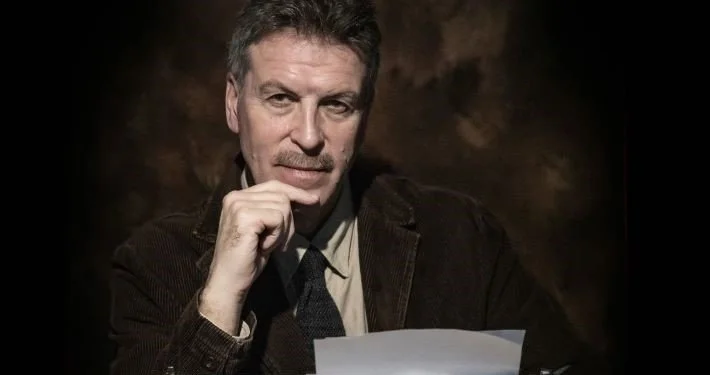
Mark Stratford as George Orwell. Photo: Martin Smith (origin8photography)
This solo play tells the story of one of the most impactful writers of the twentieth century and the personal experiences that inspired his writing. The dystopian nightmares described in his novels like 1984 and Animal Farm are increasingly and alarmingly recognisable, with the spread of disinformation and propaganda on the rise in our modern society. A very timely production then.
It has been adapted from Orwell’s own material, including essays and books, by Guy Smith, who also directs. It’s a well structured and engaging piece, extremely well performed by Mark Stratford. Over the course 80 minutes, his focus and character does not drop, he’s a very engaging presence.
On a bare black box stage, the scene is set with furniture – we’re in an old-fashioned hospital room, a desk with a typewriter is situated downstage and a coat stand holds various bits of simple costume and props that will come into play as the action progresses. As the lights come up Stratford, as Orwell, is in the bed wearing an oxygen mask. He tells us the year (1950) and location, from his words and demeanour we know he’s at the end of his life. With an upbeat tune coming from a radio, he’s a genial presence and not one you’d associate with his creative output. We soon learn that George Orwell is as fictional as this output, a pen name chosen by Eric Arthur Blair at the start of his writing career.
We are then taken into the life experiences that inspired his work – opting to show us these as memories rather than flashbacks and although Stratford does take us through some physical representation of his past, he’s at least initially narrating his story rather than reliving it. He looks back on painful experiences at boarding school, and whilst he understandably develops an early distaste for authority figures, the rather detatched narration does serve to rather lessen the impact of this on the young lad. But emotions are much clearer when we move on to detailed memories of his time as a police officer in Burma. The experiences recounted in this segment are prime examples of the human capacity for cruelty. Witnessing an execution is somehow given extra poignancy with the memory of a stray dog running to the condemned man. And the killing of a rogue elephant, witnessing its agony as he fails to quickly achieve a fatal shot, is horrible to witness – even through the lens of a memory. It’s powerfully staged and one of the strongest parts of the play.
Touching on Orwell’s experiences in the Spanish Civil War, we learn the origins of his hatred of totalitarianism, but without going into too much detail. This pivotal experience is rather over-shadowed by a fairly long reference to The Road to Wigan Pier which, although still very well performed , is not a sympathetic portrayal of Orwell – his RP delivery and snobbish observations on the cleanliness and behaviour of his hosts is a little at odds with the champion of the common man we assume him to be. He becomes less and less likeable as his story progresses – remarrying after the death of his supposedly beloved wife (with admissions of cheating thrown in as a bit of an irrelevant aside) seemingly to have somebody to look after him. It’s certainly honest, but does little to charm his audience in the way that his earlier self-effacing delivery managed.
We reach a strong conclusion as Stratford embodies some of the Animal Farm characters – a swift change of tone and posture to take on the honourable workhorse Boxer or authoritarian Napoleon. We see something of Orwell’s process as he writes the powerful opening paragraph to 1984 – the book from which so many lines and ideas have entered the public consciousness, and one of the most prescient pieces of writing in English literature.
Orwell: The Road to 1984 gives an interesting insight into the man behind the dystopia, and an exploration of what led him to create a world that includes nightmare institutions like the Ministry of Truth and Room 101. He is not necessarily a likeable man but is very much a product of his time, unable to shake off his relatively comfortable social status but still able and determined to question and challenge ideas and actions that show the very worst of man’s inhumanity towards man. It’s well put together, directed and performed with a confident and engaging delivery, an entertaining and thought-provoking piece of theatre.
Orwell: The Road to 1984 is at the Jack Studio Theatre in Brockley until 10th October 2026.
If, like me, you leave the theatre wanting to find out more about Eric Arthur Blair, aka George Orwell, the programme directs us to the Orwell Society where you can jump down your own dystopian rabbit hole.
★★★★
Written by Penny for Theatre and Tonic, October 2026.