
The Last Black Messiah at Jack Studio Theatre Review
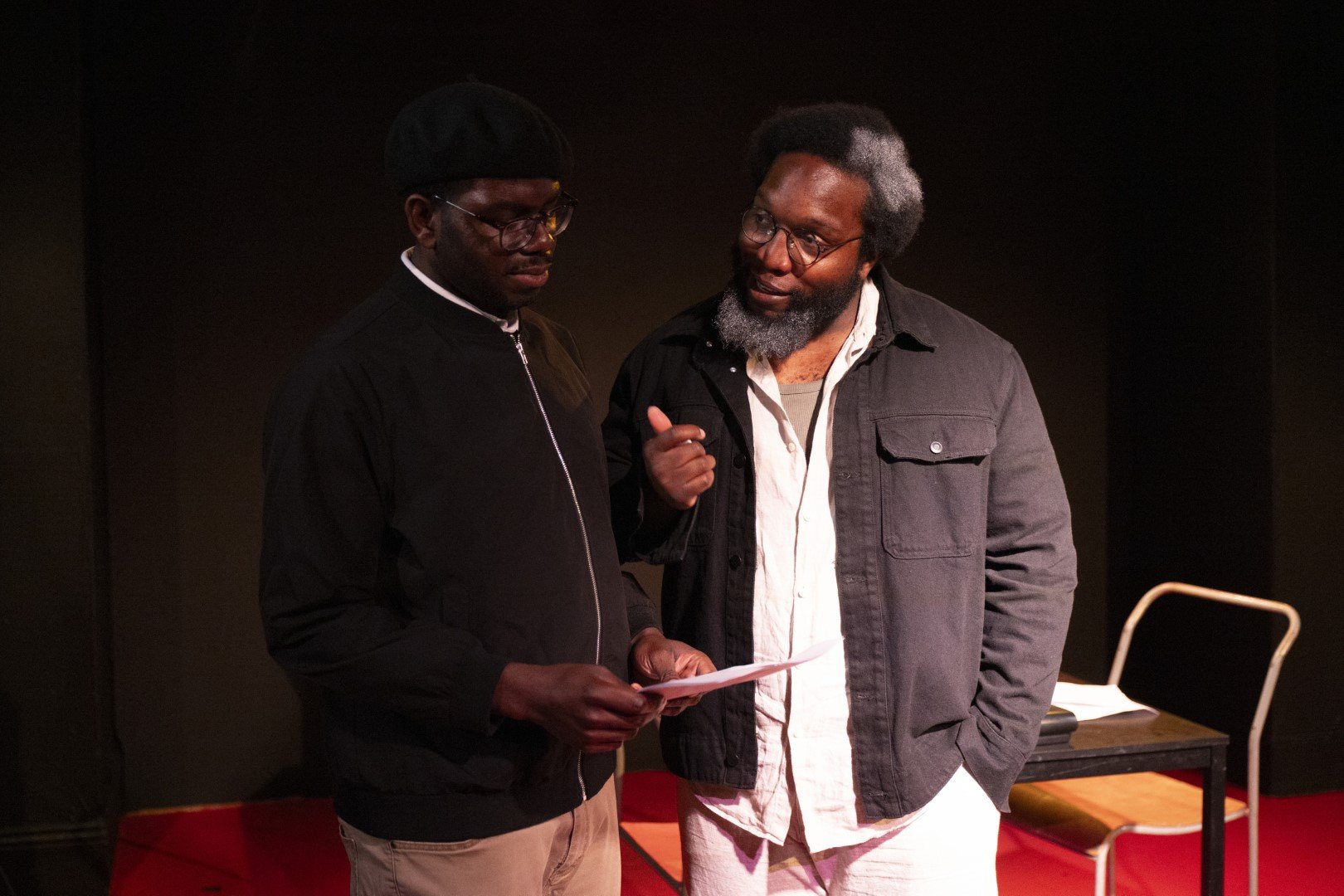
Kenneth Butler and Emeka Agada
Written by Penny for Theatre & Tonic
Disclaimer: Gifted tickets in exchange for an honest review. All views are our own
The Last Black Messiah is a new play from Emeka Agada, which premiered last year. It tackles Black identity, activism, revolution, politics and justice. It’s a two-hander set in America in the early 1990s. A former University professor, Dr Oko, is awaiting execution and is visited by one of his ex-students, Asante, who is now a journalist and wants to tell Oko’s story to preserve his legacy and, highly probably, to make a name for himself with an impressive scoop.
It’s an intense and challenging piece of theatre, jumping between scenes in the prison and flashbacks to Oko’s days as a political activist and earlier classroom encounters between the two men. There’s a lot to unpack. Having established the two characters in the first part of the play, which could probably be done a little more quickly, the pace and narrative are much more gripping in its second half, the stakes are higher, the tension is growing and it’s hard to predict where everything is leading.
It’s established that Dr Oko has always been very politically minded, he’s the “Black Messiah” of the title, inspirational to his students and a charismatic figure with a colourful past. We don’t learn why he is facing execution. We do learn he’s suspected of plotting to kill the President. This lack of backstory is a little frustrating but there is plenty going on that perhaps more detail would be too much. We also learn that Oko feels violence can be justified if the occasion calls for it, so he’s definitely not a typical mild-mannered academic. We see Oko’s absolute belief in fighting for his cause, something that has been his priority above anything else in his life Experiences referenced from Oko’s past round out his character but this added layer means there is a lot to take in.
There’s a lot of discussion around politics and the experience of Black people in the US. At times the political posturing becomes a little self-indulgent, more an academic debate than a conversation, and it seems that the men are a little too impressed with their intellect and opinions. There are plenty of bold statements. We find out the most about them in sections that flash back to Oko’s revolutionary past and when the men reflect on their loved ones. A recording of his wife softly singing seems to bring Oko to a pause, a reflection. It’s a small moment but incredibly powerful and emotional.
The set is very simple – a basic black box with a table and two chairs, there’s a video camera to the side. The lighting is subtle but effective – fading when the intensity builds, with the harsh, flickering light above the centre of the stage a constant reminder that we’re in an institution. The sound is not quite as effective as it could be, slightly too low and some of the phone calls delivered as voice-overs seem a bit muffled in contrast to the clear diction of the actors on stage.
The two actors are well matched and very credible. Writer Emeka Agada plays Dr Oko and his performance is outstanding. He moves from seeming defeated and resigned to his fate to showing us his life as a bold revolutionary leader, he’s very human in his regrets about being parted from his family but absolutely steadfast in his convictions. He is expressive and extremely watchable. It’s easy to imagine him inspiring a generation of activists.
As Asante, Kenneth Butler has a challenging and complex role. To start with, his interactions with his old professor feel a little stilted and almost performative, but this hesitancy makes perfect sense as the action unfolds. He gives us a family man but one who clearly has ambition and it appears his identity as a Black man is rather taking second place to conforming to societal expectations. His story arc is just as gripping as the reminiscences of his former mentor and we clearly see his own struggles and conflicted feelings as the play progresses.
Director Nathaniel Brimmer-Beller has the action running at quite a fast pace, so the more personal reflections have a good impact with a slower and softer delivery. Hailing from Washington DC it’s a story that clearly resonates with him – but occasionally the delivery doesn’t hit as much it should when this is not the lived experience for a lot of the audience. But if some of the references are unfamiliar, the meaning and intention is always obvious through the physical performances. The flashback sequences are not always clear – there’s no dramatic lighting change and the actors largely have the same tone and posture – the transition into Oko’s activist scenes is more effective than to the student/teacher interactions, possibly down to the staging as in these sections the two do not really move away from the table that represents the prison meeting room.
The Last Black Messiah does perhaps raise more questions than it answers, which I won’t go into here (because spoilers!). It’s very intense and has very few lighter moments, which is, of course, to be expected with such a serious subject matter but it does make it a rather heavy watch. But, it’s a very timely piece. Although set in the 90s, the challenges faced by these Black men are still depressingly relevant today, in the wake of George Floyd’s murder and the rise of the BLM movement, Black voices are still fighting to be heard. It’s maybe not quite the powerful drama that it wants to be but is still thought-provoking and tells a compelling story whilst tackling important themes, with excellent performances that will stay with me for some time.
The Last Black Messiah runs at Jack Studio Theatre until Saturday 16th May. Find out more and book here.
★ ★ ★ ★