
The Village Where No One Suffers at Jack Studio Theatre Review
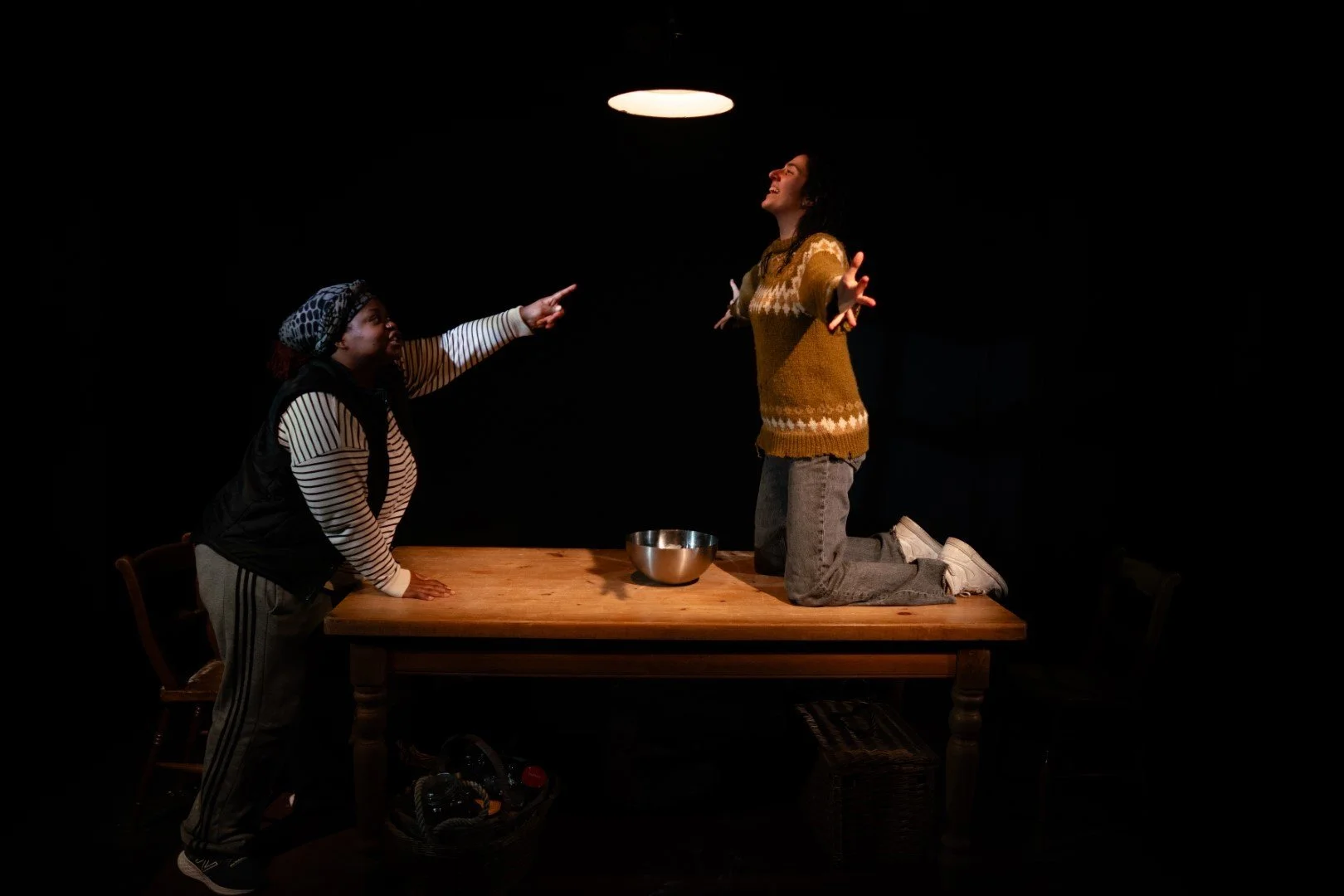
Nailah S Cumberbatch and Sofia Natoli. Photo: Abbey Sage
Written by Penny for Theatre & Tonic
Disclaimer: Gifted tickets in exchange for an honest review
The timing for this run of London-based Ukranian playwright Polina Polozhentseva’s play is apt – coming as we mark the fourth anniversary of the full-scale invasion of Ukraine. It follows the fortunes of Lukyana, who has returned to the the house of her recently-deceased Grandmother in an isolated village in war-torn Ukraine. It explores her conflicted feelings over what is happening both in her personal life and in her native land.
The staging is very simple but very effective because of it – a black box stage with subtle lighting from designer Abbie Sage and just a table and chairs as a centrepiece. Scene changes are accompanied by suitably folky music (recorded by Mariia Petrovska) helping to draw us into the atmosphere of this small village that seems to be existing off the grid, a throwback to a much simpler way of life. It’s isolated, the nearest shop is miles away, transport options are limited – this is established at the very start, as our central character Lukyana is given a very basic tour off the very basic property by an unnamed woman who then confiscates her phone – is this a wellbeing retreat with no contact with the outside world? It’s not immediately clear. But it is clear that Lukyana isn’t going to follow the rules– as soon as the other woman leaves, she fishes another phone out of her pocket and starts texting her Polish fiancé, the beep of the message tone jarring with the old-fashioned world we’ve stepped into.
This initial lack of clarity in Polozhentseva’s script is a bit of a frustrating and recurring issue, often giving more questions than answers. We’re thrown straight into the story and some of the geographical and cultural references go over the head of this South London audience member. There’s no real comment on the war, this feels like a much more personal story for much of the play. Lukyana’s own story is drip-fed – we know she lives in Poland now and is planning her wedding and it is a little frustrating not knowing the back story to her arrival in the village. We do learn about her grandparents but no real mention of her parents. We do however see there’s a big contrast between her new life away from the conflict and her grandmother’s world, firmly rooted in superstition and tradition. We can also see this clash of old and new represented in the arrival of old flame, Pasha – is his role just that of a booty call or is he a sign that Lukyana needs to properly reconnect with her past? Pasha feels under-developed and something of a plot device, I would have liked to find out more about his history with Lukyana.
We learn that ‘Aunt’ Valya is the next door neighbour and Lukyana is spending a month at her late grandmother’s house on her request, no phone allowed, also a request – not a requirement. As the play unfolds we learn more about the grandmother’s life and her gifts – going from healing hands to an ability to “whisper” over the village so that it is undetectable – think a modern day Brigadoon – meaning no bombs fall, no warning sirens are needed and none of the young men are drafted into the army. As Lukyana’s stay continues, the “spell” breaks, there’s a bombing raid and the first draft papers arrive. Is this because the grandmother’s no longer whispering or just a coincidence? It’s never made explicitly clear what the reason is, or whether we are even supposed to look for a rational rather than supernatural explanation. Perhaps leaving it open to interpretation is a deliberate choice, depending on how much we are prepared to suspend disbelief and believe the magical elements.
Director Valery Reva does an excellent job in drawing us into this isolated little corner of Ukraine – creating memorable images with simple ideas, notably a bowl of flour makes an impact both in disturbing the rather blank canvas of the set and also giving us a visible account of an intimate scene that takes place in blackout! The central table gives us the kitchen, the bedroom, the cellar and the bus. The actors move around the set with an easy intimacy in both new and rekindled relationships. Over time, subtle costume changes for Lukyana see her taking on her grandmother’s legacy as she swaps her bright red coat for something more practical, puts on an old moth-eaten jumper and eventually even colours her hair black, fully taking on the family resemblance and fitting into her grandmother’s world.
The three actors are all very well cast and convince as their characters, even when touching on the more supernatural elements of the script. Sofia Natoli (Lukyana), Christopher Watson (Pasha) and Nailah S Cumberbatch (Aunt Valya) all give confident and natural performances, their reactions, expressions and physicality telling us just as much as we get from the dialogue. Cumberbatch is particularly impressive, bringing warmth and humour to her role, with very expressive reactions.
The Village Where No One Suffers tells an intriguing tale, its supernatural elements are not overplayed and reinforce the sense of a community more focused on old traditions than modern technology and progress that has led to invasion and war. It has strong direction, design and acting that more than compensates for the elements of the script that feel a little vague or underwritten. Whilst the conflict does feel ever-present in the background, this play is not so much a comment on the war as it is about the importance of belonging to and caring for your community.
The Village Where No One Suffers runs until Saturday 28th February. Find out more and book here.
★★★★