
Until Proven Human at Barons Court Theatre Review
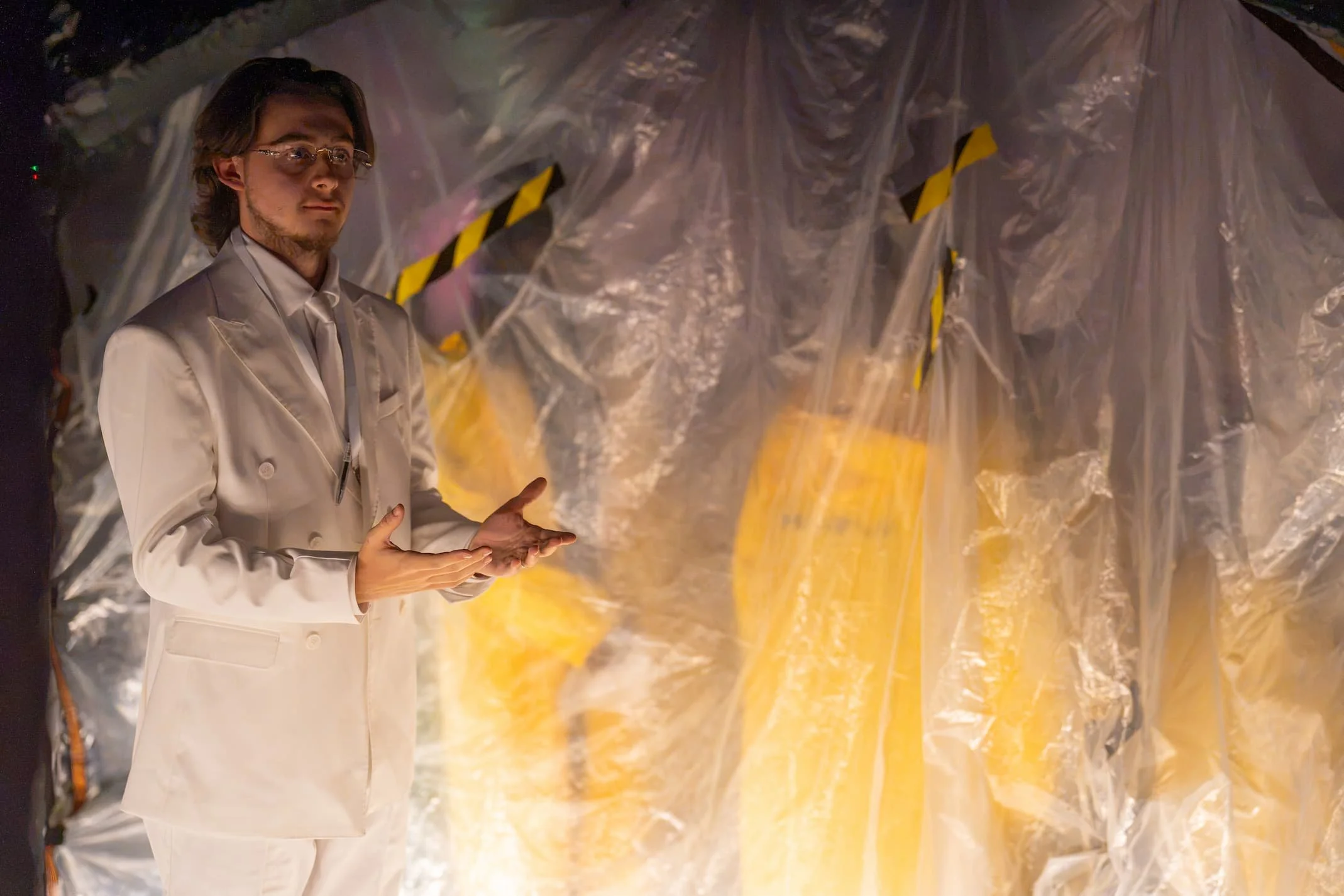
A citizens’ assembly is about to convene in the dimly lit, intimate space of Barons Court Theatre. Following a series of disturbing incidents across the city over the past few months, rumours have begun to circulate that monsters are hiding among us. The purpose of this emergency assembly is to screen the population for signs of monstrosity. Created by Xiaomin Fan, written by Edylan Liu, and directed and produced by Jingwen Lu, Until Proven Human is an interactive theatre piece that transforms a small space into an immersive 60-minute experience.
The walls are covered with crumpled missing-person posters and torn newspaper clippings. By the time the audience descends the stairs into the theatre, we have already entered the world of the story. A masked security officer, played by Theodore Henshaw, hands each audience member an intact newspaper and a small pouch containing a ballot card and various items needed for the emergency screening, along with a number. Once inside, that number is about to become our identity.
Led by Silas Venn (Anthony de Jesus), a government official dressed in white, the audience begins to vote. At first, we are simply asked to choose between “tea or coffee” and “left-handed or right-handed”. But it soon becomes clear that something is amiss. Silas begins writing the numbers of suspected individuals on the wall, simply because they have chosen differently from the majority. At other times, even when it is clear that one option has received more votes, Silas announces an entirely different result to suit his own agenda. Some audience members are inexplicably accused of being monsters. They are forced to put on yellow raincoats and escorted into compartments separated from the rest of the room by plastic sheeting. Those left behind have no way of knowing what is happening inside. We can only hear faint sounds from beyond the plastic and catch glimpses of yellow shadows.
This environment succeeds remarkably well in amplifying the psychology of conformity. As the questions progress to “Is human nature inherently good or evil?” and “Do monsters exist?”, I find myself watching which answer is receiving more votes, considering whether to change my own choice in order to avoid becoming a prime suspect. Meanwhile, small notes campaigning for particular options are passed around the crowd, influencing people’s final decisions.
However, because much of the performance is devoted to audience discussion and voting, the time available for the actors to develop their characters becomes rather limited. Although Ruiying Bai and Hui Chen convey fear, frustration, and anger, and Anthony de Jesus captures Silas’s detached composure and quietly unhinged demeanour, the dialogue lacks a certain depth of information. As a result, their exchanges can feel somewhat formulaic, and the characters remain underdeveloped. Theodore Henshaw, meanwhile, serves primarily as a calm overseer, with little further opportunity for performance. Consequently, while the voting process encourages the audience to reflect, we may still leave without a clear understanding of the full picture, somewhat bewildered by what we have witnessed.
After the performance, I went inside the compartment behind the plastic sheeting to take a closer look. Scattered around were crumpled files, fragments of diaries, and audio tapes. It is clear that this is a work made with considerable care and filled with thoughtful details. However, props alone struggle to convey much of the information, which needs to be communicated more fully through the characters’ dialogue and actions. If more of the information embedded in the design of Until Proven Human could be brought directly to the audience, while the characters were given greater definition and individuality, the play could undoubtedly inspire much deeper reflection.
★★★
Written by Ziwen for Theatre and Tonic, September 2026.