
A Life in Four Seasons at Regents Park Open Air Theatre Review
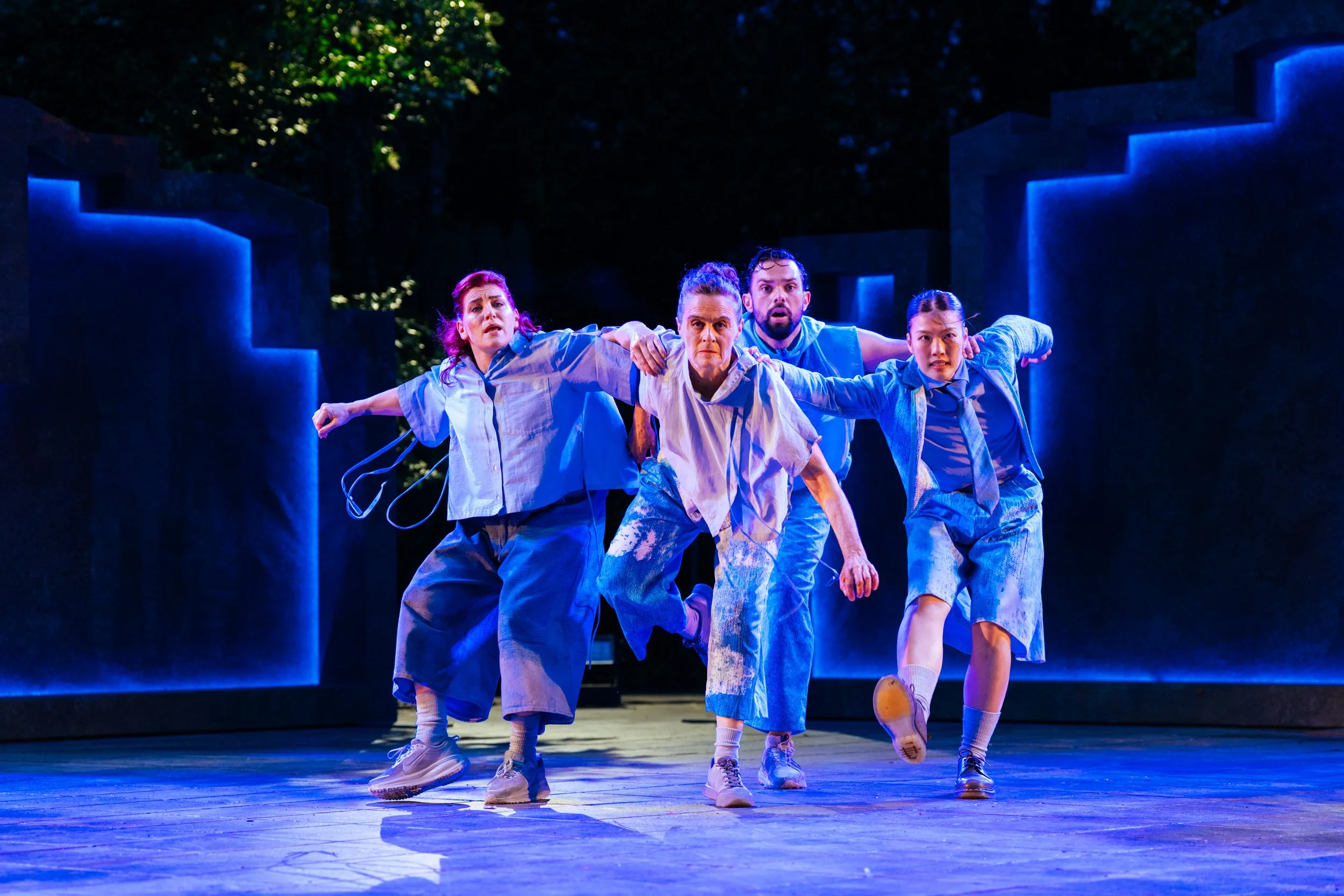
Carrie-Anne Ingrouille, Susan Kempster, Louis Mackrodt & Beryl Tay. Photo: Helen Murray
Written by Ziwen for Theatre and Tonic
Disclaimer: Gifted tickets in exchange for an honest review. All views are our own
Before Vivaldi, most instrumental music was not conceived as narrative in nature. His Four Seasons stands in striking contrast. Across its four violin concertos, sound itself paints vivid seasonal landscapes. Vivaldi famously went so far as to annotate his score with specific references to birdsong, barking dogs and rolling thunder, making the music one of the earliest and most compelling examples of musical storytelling. At Regent’s Park Open Air Theatre, A Life in Four Seasons takes this idea in a fresh direction. Featuring electronic reworkings by DJ Walde, directed by Tinuke Craig and choreographed by Alexzandra Sarmiento, this new interpretation relocates Vivaldi’s world to the rhythms and relationships of contemporary urban life.
The stage is dominated by four irregular grey-black structures resembling fragments of stone (Ryan Dawson Laight). As dancers emerge in muted grey costumes and the opening notes arrive in fragmented bursts, the story begins. At its centre are three friends, distinguished by pink, blue and orange costumes that share a common design whilst remaining visually distinct. Spring, summer, autumn and winter correspond to four stages of life—youth, young adulthood, middle age and old age—and the sixteen-member ensemble encompasses a wide range of ages, genders and ethnic backgrounds.


With each seasonal transition, a new trio of performers assumes the roles of the three friends at the next stage of life. Their predecessors remove their colourful costumes and are gradually absorbed into the surrounding grey collective. Although the colours associated with each friend remain constant throughout the production, the costume designs subtly evolve with age. Each performer brings a distinctive physical quality to the choreography: some dance with force, expansiveness and intensity, while others move with clarity, softness and grace. Among the cast, Beryl Tay and Nadia Sohawon are particularly compelling presences. Musically, the familiar lyricism of Vivaldi’s violin lines is interwoven with ringing telephones and the ambient noise of urban life, creating an intriguing collision between beauty and everyday busyness.


Beyond the screens, three small wooden boxes labelled “Head”, “Heart” and “Gut” also appear onstage. These seem intended to represent the identities of the three friends, yet this symbolism never becomes fully legible within the choreography. While the movement vocabulary is energetic and expressive, it tends to communicate broad emotional states rather than sharply defined characters. Spring evokes youthful vitality and exuberance; summer suggests pleasure and disorientation; autumn brings reconciliation and tenderness; winter conveys maturity and reflection. Yet the production stops short of establishing clear individual traits or meaningful relationships between the three protagonists. Whether they are meant to represent three aspects of a single self or three separate individuals, a stronger sense of characterisation would be essential.
Similarly, if the performers at different ages are intended to embody the same characters, a greater sense of continuity is needed. Age may change, but some core element of identity remains. The audience should be able to recognise this continuity without relying solely on costume colour as a visual cue. The transitions between seasons and life stages could also be given more space and development. At present, these transformations often feel fleeting, whereas richer transitional moments could help reinforce the characters’ coherence across time.
By the end of the performance, I was left with the strong impression that the open-air setting itself had not contributed significantly to the production’s impact. This feels like a missed opportunity. The Four Seasons is intrinsically connected to the natural world, and a more deliberate integration of the theatre’s outdoor environment could have given this interpretation an even more distinctive identity.
One of the production’s most affecting moments arrives during winter, when the three youthful friends return to the stage and dance alongside their older counterparts. It is as though the young selves still reside within the ageing bodies before us. The image is both poignant and alive with possibility. For all the ambiguities that remain within A Life in Four Seasons, it is nevertheless a work that possesses genuine emotional resonance.
A Life in Four Seasons runs at Regent’s Park Open Air Theatre until 14th June 2026.
★★★