Rat Rat Rat at The Old Operating Theatre Museum Review
Written by Ziwen for Theatre and Tonic
Steadying myself against the white walls, I climbed a narrow staircase barely wide enough for one person. It seemed endless. After countless turns, I finally emerged into The Old Operating Theatre Museum and Herb Garret. This small timber-framed space houses one of the oldest surviving surgical theatres in Britain. Built in 1822, it predates the widespread adoption of both anaesthesia and antiseptic surgery. In its day, operations were conducted as public demonstrations and teaching exercises. Patients lay at the centre while students gathered around to witness what was often a bloody and painful ritual. I can hardly imagine a more fitting venue for Rat Rat Rat, presented by EggGen and Selene Mingyue Hu. Drawing on the history of animal experimentation and the atrocities committed by Unit 731 during the Second World War, the piece combines puppetry and physical theatre to explore how violence becomes normalised when it is embedded within systems, routines, and orders.
The wooden floorboards, the wooden operating table, and the tiered wooden seating all contribute to the sensation of stepping back into the nineteenth century. Hanging on one wall is a rules board dating from 1822. At its top is the Latin motto Miseratione Non Mercede—roughly, “For compassion, not for reward”—while beneath it are detailed instructions governing where observers should stand during operations.
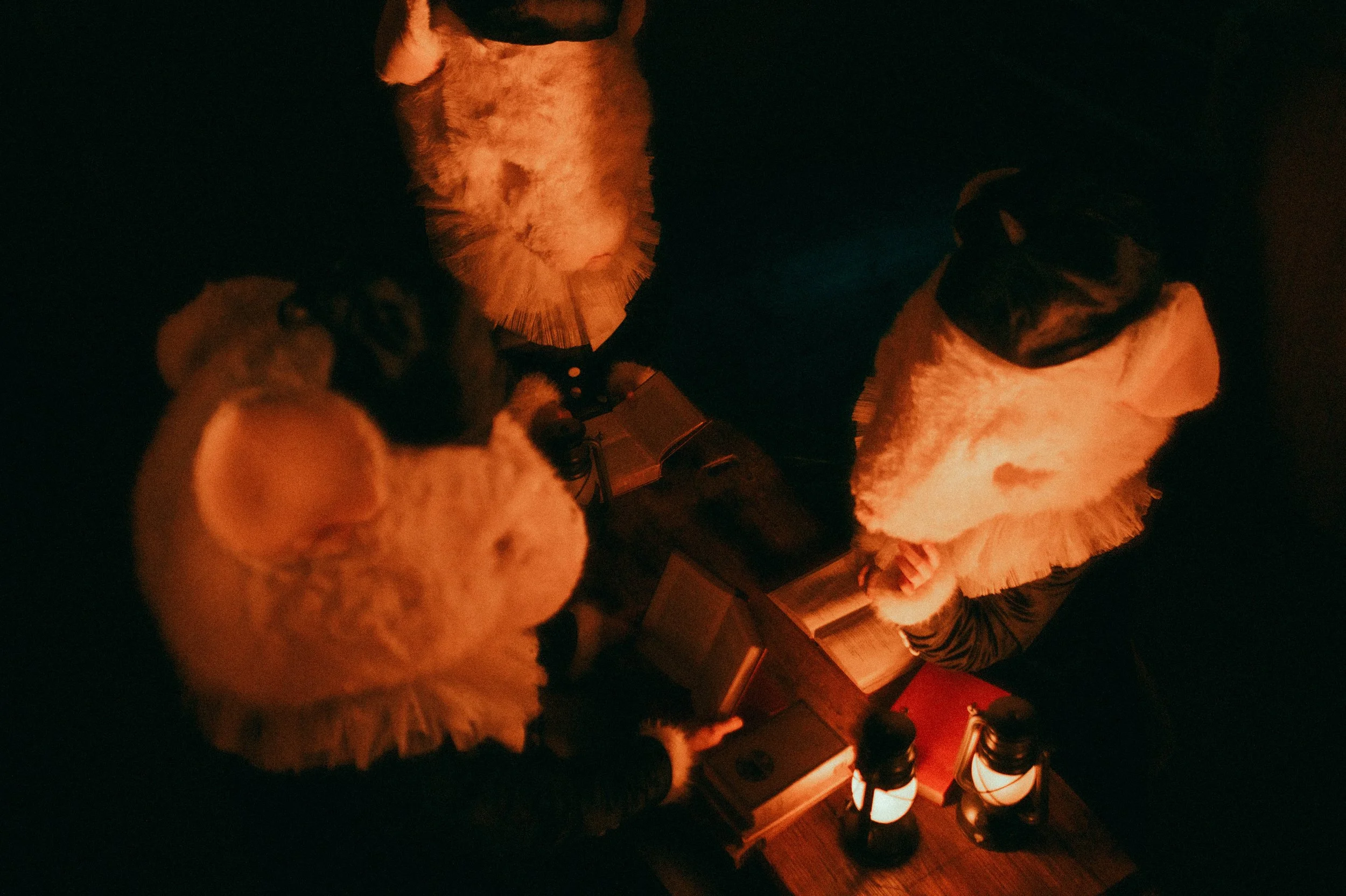
As the performance began, the blinds over the skylight slowly closed, shutting out the daylight that had been flooding the theatre. Three performers, dressed in adorable plush rat costumes designed by Freya Yuejie Li, began to dance a ballet. Against a backdrop of harmonious music, occasional sharp and jarring sounds punctuated the atmosphere (Mira Yihang Zhang). Brief moments of disruption would pass, and the little rats would resume their dance.
Throughout the thirty-minute performance, every emotion is communicated through movement, directed by Jonathan Layton. No spoken language is used at all. The three performers—Xintian Zhao, Huang-Shu-Yi, and Caiqi Yang—move with remarkable charm, like toys that have somehow come to life. They hold their tails, smooth their whiskers, tuck their paws close to their chests, and sometimes cover their round ears with their hands.
After the ballet, the rats don navy-blue student uniforms and small caps. Producing book after book, they begin reading beneath dim lighting. A gentle hymn fills the space, lending the scene a quality that is at once sacred and unsettling. One rat, however, struggles to concentrate. Soon afterwards, the experiments begin. A newborn rat pup—represented by a well-crafted model—becomes their first test subject. The distracted rat attempts to protect it, only to be repeatedly stopped by the other two. Small patches of orange-red light (Yaqi Sun) fall across their heads and bodies, casting enormous rat-shaped shadows on the walls.
As the piece progresses, the space transforms ever more fully into a theatre of cruelty. As the piece progresses, its atmosphere of cruelty grows increasingly pronounced. This time, the outsider rat becomes the experimental subject herself. The other two strip away her student uniform and bind her to the operating table. One performs the dissection while the other carefully records observations with a quill pen. From her abdomen they extract, one after another, a heart, intestines, and various organs made of silk and cotton, continuing until there is seemingly nothing left to remove. They even place a candle in the hands of the rat lying on the table while tossing lengths of intestine back and forth as though engaged in a game. The occasional piercing squeals that echo through the theatre heighten the audience’s discomfort considerably.
Yet the production could become even more powerful. At present, the connection to Unit 731 remains somewhat indistinct. Unit 731 was a secret research organisation established by the Imperial Japanese Army during the Second World War. Ostensibly dedicated to disease prevention and water purification, one of its principal functions was in fact the development of biological weapons, which were tested through live human experimentation. As currently staged, the performance contains little direct information that points specifically towards Unit 731, which feels like a missed opportunity. Hints embedded in the books the rats are reading, reports displayed on the walls, or references to the historical period might encourage audiences to engage more deeply with the work’s historical implications. Likewise, the personalities of the three rats remain somewhat underdeveloped. Their costumes are identical, and I often found it difficult to distinguish one from another. Combined with the fact that certain actions are repeated at length, some sequences begin to feel repetitive.
The decision to avoid language altogether is intriguing, but it also sacrifices opportunities to communicate more specific details. Occasionally use of a non-verbal vocal language or gibberish—accompanied by surtitles—might enrich the world of the piece and provide greater context. If the characters’ human identities could be suggested more clearly, then their endearing rat-like gestures and mannerisms would become even more disturbing. This contrast between action and identity would sharpen the production’s sense of horror and grotesquerie.
Nevertheless, Rat Rat Rat remains an imaginative and distinctive work. Even the roughness of its stagecraft feels intentional, as though it were striving to evoke something raw and primordial. Its greatest strength lies in the tension between form and content: using an irresistibly cute exterior to examine profoundly dark subject matter. That contrast lends the production much of its emotional force. Moreover, wandering through the garret's collection of medicinal herbs and pathological specimens before stepping into the operating theatre itself is already an experience in its own right.
Rat Rat Rat played at the The Old Operating Theatre Museum until 15 June.
★★★★