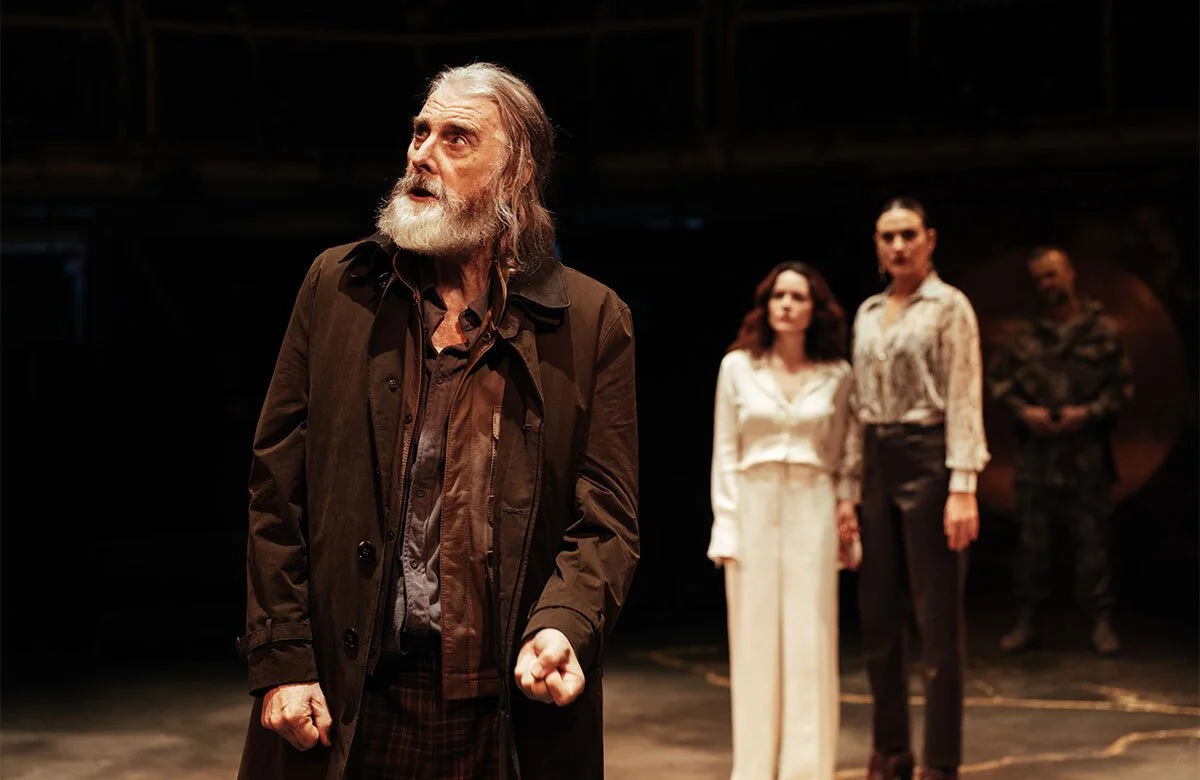
Blink at King’s Head Theatre Review

Written by Ziwen for Theatre & Tonic
Disclaimer: Gifted tickets in exchange for an honest review
How far can a relationship built on watching and being watched go? That is the central question explored in Blink, written by Phil Porter. In an age when social media permeates everyday life, the play feels even more relevant than it did at its 2012 premiere. Now directed by Simon Paris and staged at King’s Head Theatre, this revival, unfortunately, still stops short of its enormous potential.
“This is a love story,” says Jonah (Joe Pitts), one of the protagonists, as he sits among the audience when the lights come up, addressing the person beside him. Jonah and Sophie (Abigail Thorn) have much in common. They have both lost a parent, both inherited a considerable sum of money, happen to live in the same apartment building in Leytonstone, and are both lonely. In order to feel that she truly exists, one day Sophie sends Jonah a small monitoring device through which he can see, in real time, everything she does in her living room. Watching the girl in the monitor slowly eating an apple, seemingly absentmindedly tucking her hair behind her ear, Jonah develops a strange fascination. Then, through this small screen, they begin to read together and watch television series together. Jonah becomes increasingly unable to extricate himself, while Sophie rekindles her interest in life. One day, Sophie suddenly discovers that he has started following her, yet he has no idea that she has been fully aware of his actions from beginning to end. The two thus begin a peculiar kind of dating, until she believes she has seen her father, who was supposed to be dead.
The first thing that stands out upon entering the theatre is the arrangement of ten screens in various sizes (designed by Matt Powell). As the characters narrate events, corresponding images appear across the screens. When Jonah watches Sophie, her face and subtle gestures are projected above. Beneath the screens sits a transparent sofa (Emily Bestow), accompanied by a transparent table and photo frame. While these clear furnishings suggest vulnerability and a lack of privacy, they feel somewhat detached from the digital imagery above. The stage also features numerous movable black boxes that serve multiple purposes: the actors sit on them and retrieve costumes from within. When the sound effects (Sam Glossop) suddenly come in, the audience’s attention is immediately drawn over.
Joe Pitts and Abigail Thorn perform very naturally, and there are many lovely moments between them that the audience can genuinely feel. When they play other characters in the story, they also adopt different physical states and speaking styles according to each role, making the distinctions between characters very clear. If they were able to show more of the characters’ lack of social ease, their loneliness and even their small eccentricities, their images would become more distinctive. The story would also become more thought-provoking, slightly uncomfortable yet irresistibly compelling. Although there is quite a bit of interaction between the actors and the audience, it remains merely simple communication and does not generate deeper meaning. In the current production, we are just ordinary spectators, invited as a matter of course to watch this story like any other. For a work themed around voyeurism, making use of the audience’s position as watchers to create a sense that we too are part of the act of watching might have been a good choice.
The play begins with an intriguing premise—one that easily sparks interest. Yet although it contains humorous elements and sweetness between characters, it abandons the core of its own discussion midway. The voyeurism that occupies nearly half of the play gradually becomes merely a vehicle for romance. In addition, although the characters’ backgrounds are important, the play spends a long time at the beginning having the characters recount their experiences. This not only slows down the central theme, but much of the monologue material does not have particularly striking importance and can easily cause the audience to lose focus. Going straight to the point and revealing the characters’ personalities and histories through the unfolding of the story might have been a more intelligent approach. As the male protagonist says at the beginning, the current Blink is indeed a love story. But beyond love, it holds many more profound possibilities.
Blink plays at King’s Head Theatre until 22nd March 2026
★★★