
Counterattack: Youth at Bread and Roses Theatre London Review
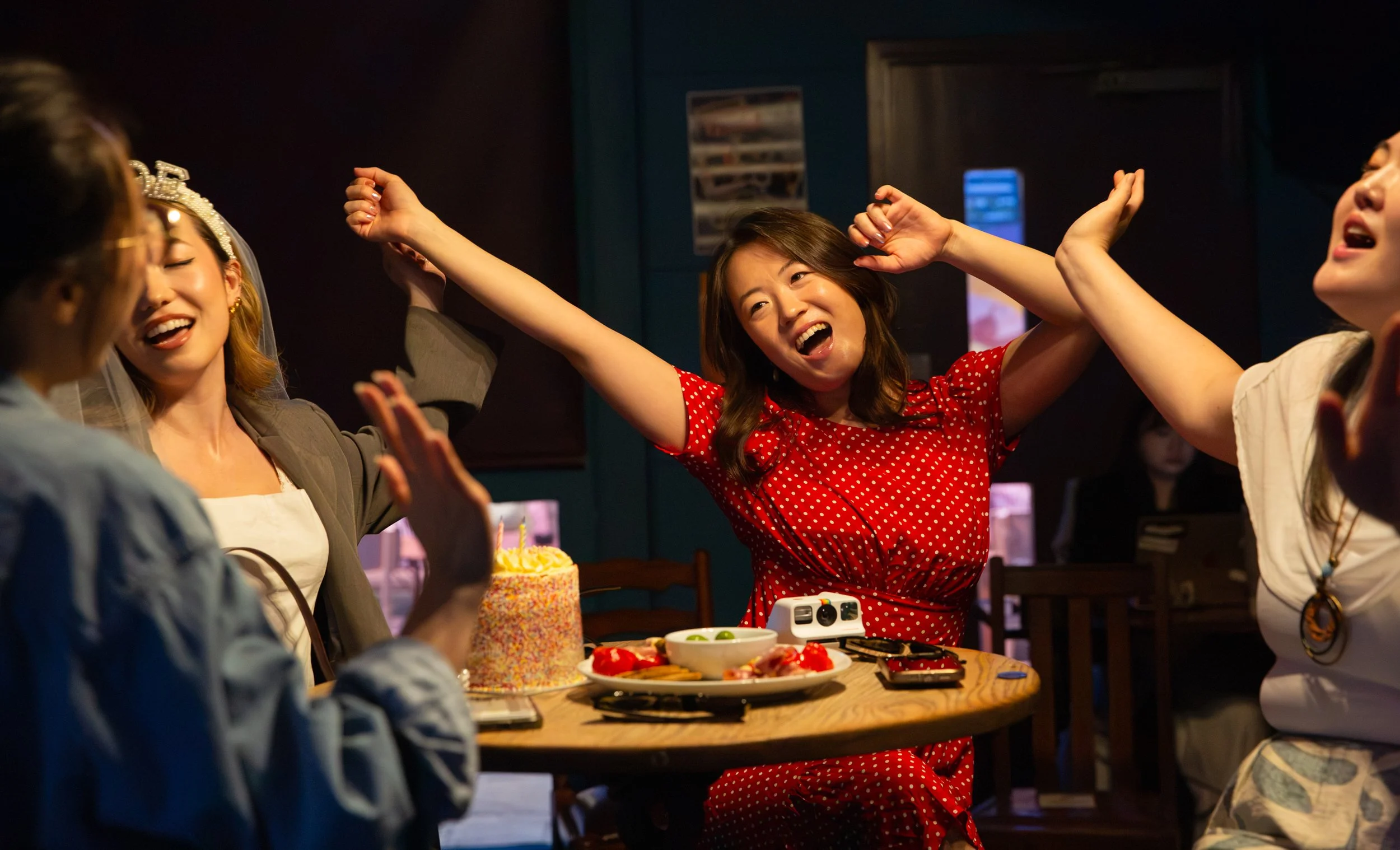
Photo: Yusuf Bhaimia
One evening, four young women of Korean heritage gather in a bar to celebrate the upcoming wedding of one of them. Written and directed by Gain Amy Park and co-produced by Jaemin Yu and Euna Ko, Counterattack: Youth premiered at Brighton Fringe in May 2026 before making its London debut at the 2026 Lambeth Fringe Festival. Even after spending just a little time with these characters, one can sense that the production has considerable untapped potential.
All four women are approaching their thirties, yet each is at a different stage of life, with her own outlook on the future. Yuna (Mireia Espluga) is preparing for her wedding. Ella (Hazel Oh) is in a stable relationship that seems to be going nowhere and has begun to wonder whether she should look for someone else. Having gone through a divorce, Hannah (Siyun Leem) has come to focus much of her energy on work. Sarah (Lia Lee), meanwhile, is worn down by her job and longs to embark on a journey of self-discovery. Gathered around a table in a bar, the four women talk about everyday matters, shared memories and their respective views on love.
As a piece of theatre, however, the conversations lack dramatic tension and distinct characterisation. The character descriptions in the programme suggest more vivid and individual personalities, whilst the women’s different styles of dress (Yunhye Choi) offer glimpses of their contrasting lifestyles. Yet these distinctions remain somewhat blurred in performance. Their interactions also lack the ease and familiarity one might expect from friends who have known one another for years, making it difficult to gauge how long it has been since they last met. It would also be fascinating to explore the subtle differences in the dynamics between each pair within the group. The play does introduce some intriguing conversational topics, such as a competition among the women over who was the last to receive a text message. Yet, as with many other details in the story, these moments are not given enough time to develop, and the individual exchanges rarely build towards a meaningful emotional crescendo.
The physical layout of the venue also has a significant impact on the production. The four performers sit on high stools around a bar table, facing one another as they converse, while the audience sits in a circle on standard chairs. The difference in seating height, combined with the performers’ bodies obstructing one another, creates significant blind spots for audience members. From where I was sitting, I could see only one performer’s facial expressions for much of the performance. Noise from the bar outside the performance space also frequently carried into the room. Although the sustained background music suited the setting and helped establish the mood, it made the performers’ dialogue even harder to hear.
The production could also give more thought to how it creates a sense of immersion. As mentioned above, the atmosphere of a noisy bar is present, but the audience’s role within this environment remains unclear. At certain moments, the performers turn directly towards the audience, make eye contact and ask for their opinions. However, these interactions do not feel entirely natural. By addressing the audience in this way whilst seeming to assume that we have been listening to their conversation all along, it makes it difficult for us to feel like ordinary patrons who simply happen to be sitting nearby. I particularly enjoyed the moments when the women sang and danced together. Yet, given the bar setting, their apparent indifference to the other people in the room as they danced around it felt somewhat implausible. Similarly, the cake brought out at the beginning of the play is never tasted by anyone. Left to one side as though it had been forgotten, it feels conspicuously like a stage prop rather than a natural part of the setting.
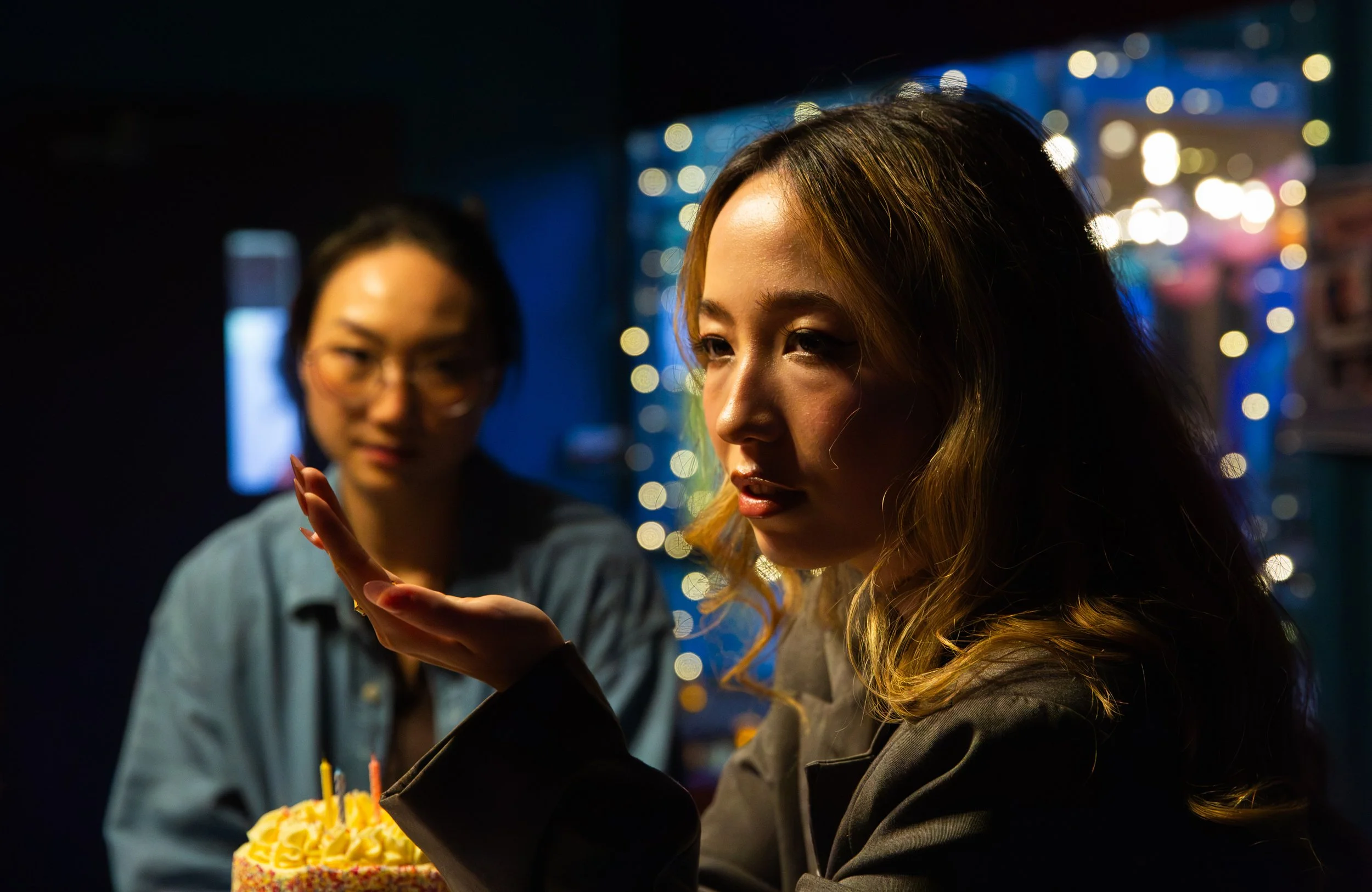
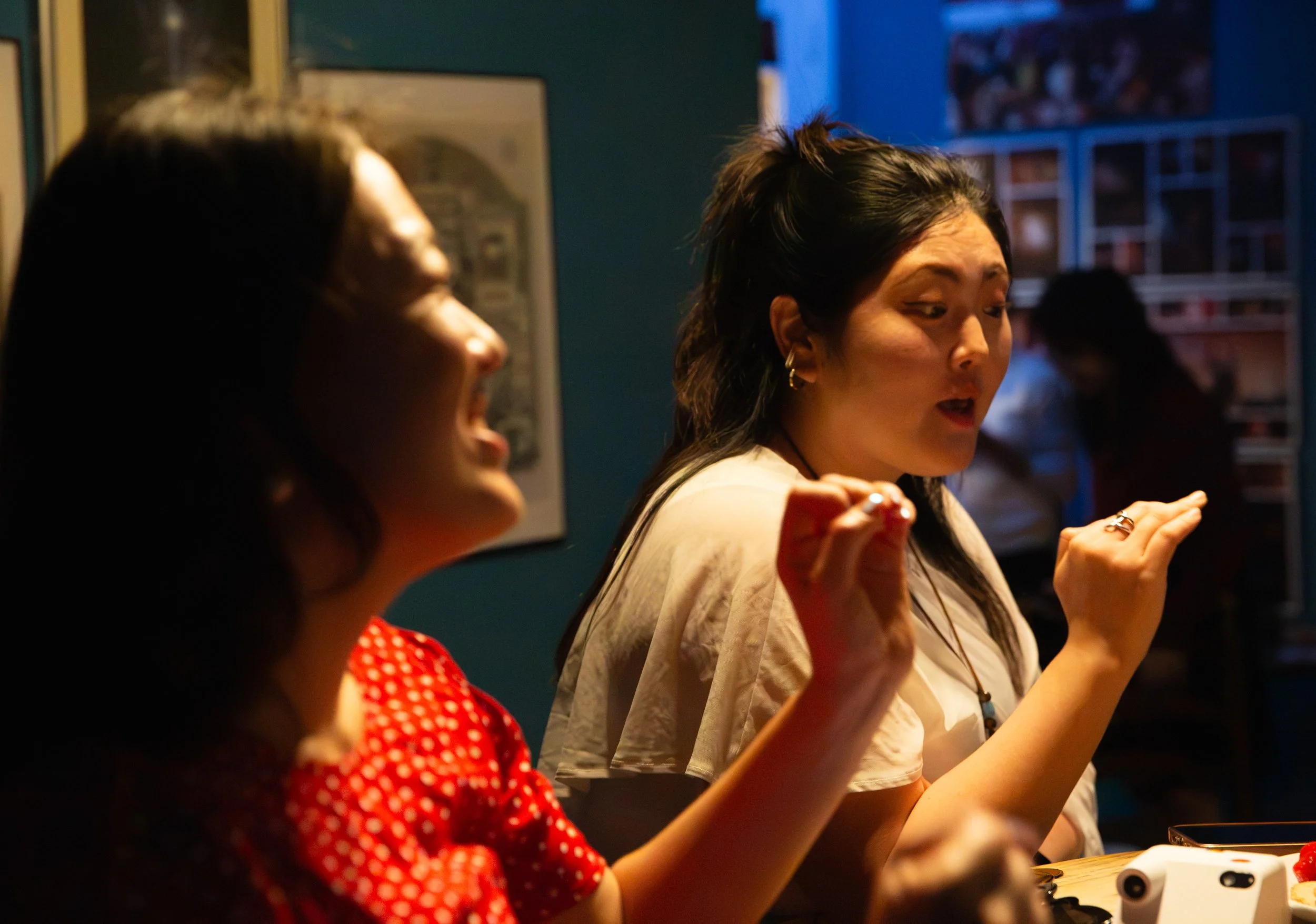
There are, nevertheless, promising elements in this production, and moments when the performers’ emotions shine through with genuine sincerity. Leem’s performance is particularly striking, although this impression may partly reflect the fact that, for much of the performance, I could see only this one performer’s facial expressions and had to experience the others largely through their voices. The awkward silences between the women, along with the meaningful glances they exchange in the hope that someone else will break the impasse, are also rather amusing. I particularly appreciated the moments when simple Korean expressions found their way into the dialogue. A stronger sense of how the characters’ Korean heritage shapes their lives could lend the production greater cultural specificity and make their experiences feel more grounded and authentic.
Bringing everyday conversations in a bar onto the stage is an astute idea, grounded in the familiar rhythms of daily life and full of potential for audiences to connect with. I genuinely want to know more about these four young women and the stories they have to tell. The uncertainties of youth and the confusion that accompanies growing up are themes that many people can relate to. The questions of identity and belonging faced by those living in countries whose cultures differ considerably from their own heritage are equally worthy of exploration. Counterattack: Youth has the potential to be far more playful, spirited and full of life. I look forward to seeing the production realise that potential more fully.
★ ★
Written by Ziwen for Theatre and Tonic, October 2026.