
Ghosts at Jermyn Street Theatre Review

Flora Montgomery (Helene Alving) and Oliver Alvin-Wilson (Pastor Manders). Photo: David Monteith-Hodge.
When it was first published in 1881, Henrik Ibsen ’s Ghosts was considered to be so controversial that booksellers banned it and Norwegian theatres refused to stage it. But although it was written nearly 150 years ago, it explores themes that are very relevant today, offering complex characters, moral dilemmas and, in this 2013 adaptation by Richard Eyre, language that feels fresh and accessible to modern audiences.
The story centres around a rich widow Helene Alving, who is trying to make amends for the behaviour of her late husband, a man who hid his true cruelty and immorality behind an outwardly charming personality. Determined to escape the ghosts of her past she plans to tell her son, Oswald, the truth about his father. But Oswald has already inherited his legacy.
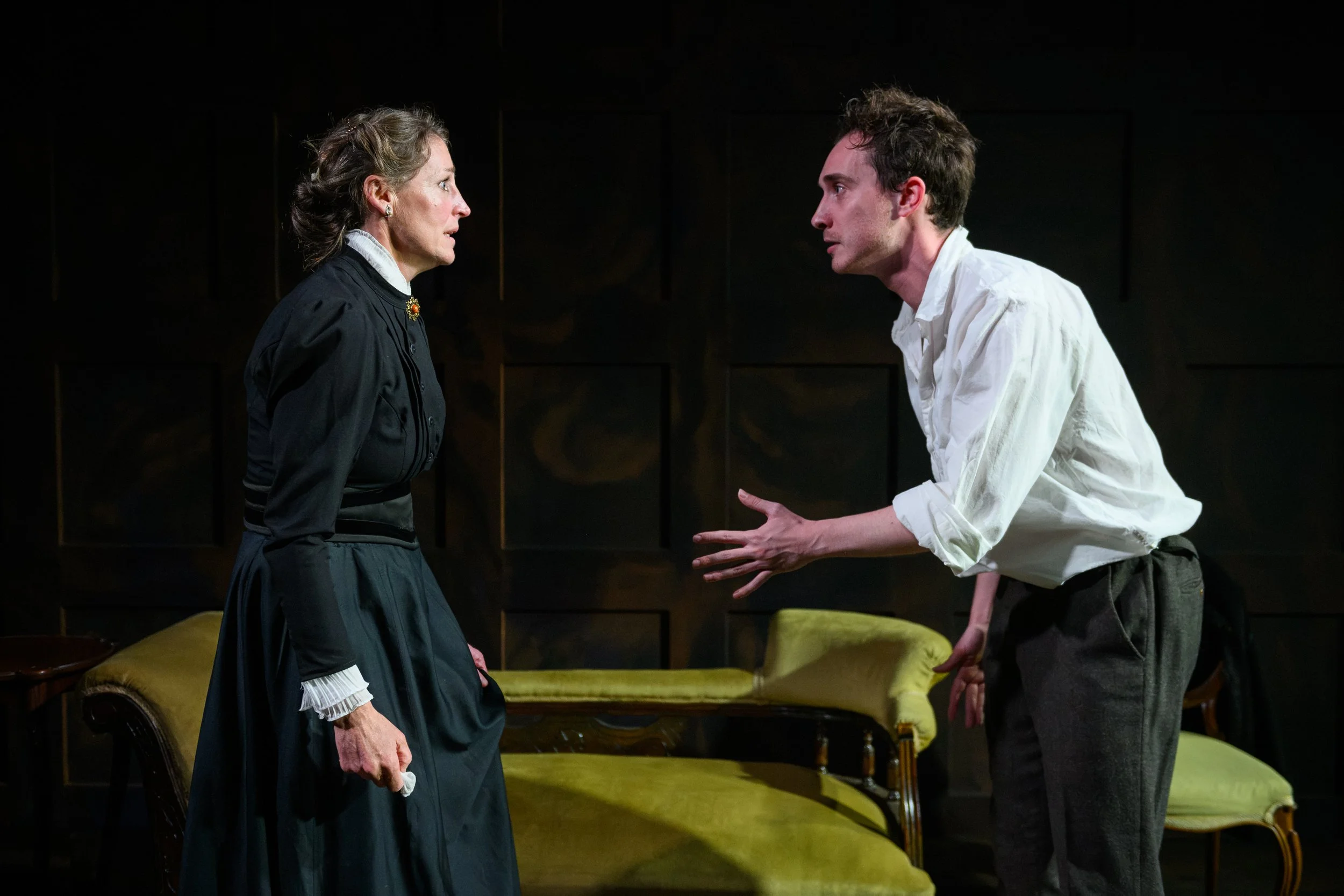
The play is well suited to the intimate space of the Jermyn Street Theatre, with just 70 seats around the performance area, immediately drawing us into the Alving drawing room. The set is simple with some decent quality furniture positioned in front of wood-panelled walls without any paintings, ornaments or other fripperies. It’s a little cold and austere, not a warm family home.
The simplicity of the set allows us to focus on the characters and the story that unfolds. When the action requires us to look beyond this domestic setting, it’s achieved with sound and lighting – leaving the actors’ reactions to convey what’s going on.
Whilst a modern audience may not be as scandalised as those experiencing Ibsen’s play in the late nineteenth century, it contains themes that can still shock, as relationships and behaviours are revealed that threaten personal bonds and public perceptions. Eyre’s adaptation retains challenging content from the original text – including references to sexually transmitted diseases, incest and euthanasia – and also explores ideas around religion and feminism. Director Kwame Owusu has not attempted to stage his production in a modern setting, but thanks to the strength of the adaptation and performances of the five actors, it does not feel like a period piece. The character interactions feel very natural, dialogue is well-paced and, although a lot of key moments are delivered with a controlled and relatively quiet tone, every word and intention is clear, the reserved and controlled delivery more impactful than shouting and raging would have been. There’s a very powerful moment when Helene and Manders freeze, allowing the focus to move to the characters of Oswald and Regina. Their brief interaction is choreographed to give it an almost dreamlike state, its meaning immediately clear within the context of the piece.
There is one significant character in the play that we do not meet – the late Captain Alving. But his presence is at the heart of the story and his actions affect everybody. Initially presented as a charming and upstanding member of the community, as the truth of his debauchery is revealed, it’s hard not to make comparisons with populist figures in modern public life selling a false image to cover their corruption.
It is the “sins of the father” then that lead to the chain of events and consequences that are to unfold. The most obvious manifestation of this is in his son, Oswald, played with great conviction by Joe Pitts. When we first meet him as he returns to the family home, he’s all about “the joy of being alive”. But as we get to know him, this young bohemian drops his carefree persona. With the burden of the secrets being revealed, Pitts gives a powerful and heartbreaking portrayal of the young man’s increasing mental and physical pain.
The drama’s main characters, the widowed Helene Alving (Flora Montgomery) and morally upstanding Pastor Manders (Oliver Alvin-Wilson). are a formidable pair, with the two actors giving very nuanced and compelling performances.
Montgomery’s Helene is clearly a woman who has supressed her feelings and passions for far too long, frustrated by society’s expectations and with a deep sense of guilt over past actions or lack of action. Once the floodgates are opened and the truth starts to come out, Montgomery gives a devastating performance as the full tragedy of her husband’s legacy is revealed.
By contrast Alvin-Wilson remains rather aloof and uptight, very conscious of his position and the need to appear beyond reproach. He appears morally incorruptible and rather judgemental. He is the one character who feels very much a man of the period setting and as Alvin-Wilson lets us glimpse beneath the public image, his self-control becomes more chilling than commendable.
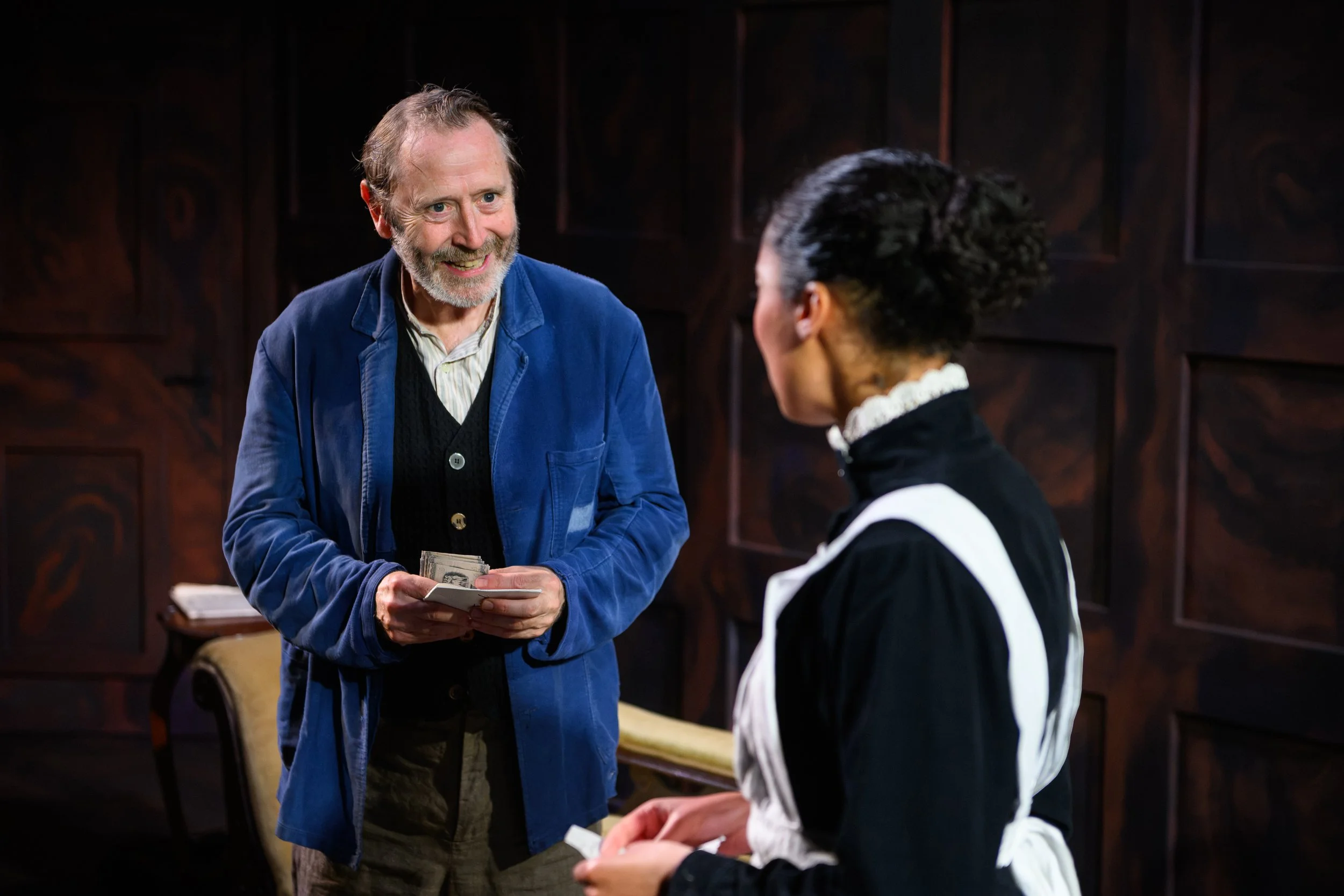
The “working class” characters of maid Regina (Cecilia Appiah) and her father Jacob (Peter F. Gardiner) are differentiated from the others with Scottish accents against the more received pronunciation delivery from Manders and the Alvings. Both are portrayed as manipulative schemers, presenting suitably subservient facades whilst their true intentions are very clear to the audience. Initially they are perhaps the obvious villains of the piece. But, as we learn, nothing and nobody are as they first appear. The actors pitch this perfectly – no twirling moustaches from him or coquettish flirtation from her, their scheming is much more subtle than that.
This adaptation of Ghosts offers a compelling drama about family relationships, secrets and skeletons tumbling out of closets. Despite its shocking subject matter, there is some humour coaxed out of the script to offset its much darker themes. Although leaning into the societal expectations of the late 19th century, it remains a very human story with characters whose actions and consequences would easily fit into a contemporary drama. Running for 90 minutes without an interval, the complex characters and their relationships along with a building tension make for a gripping and compelling theatre.
Ghosts is at the Jermyn Street Theatre until Saturday 14th November.
★ ★★ ★
Written by Penny for Theatre and Tonic, October 2026.