
Custard Tarts at Riverside Studios Review
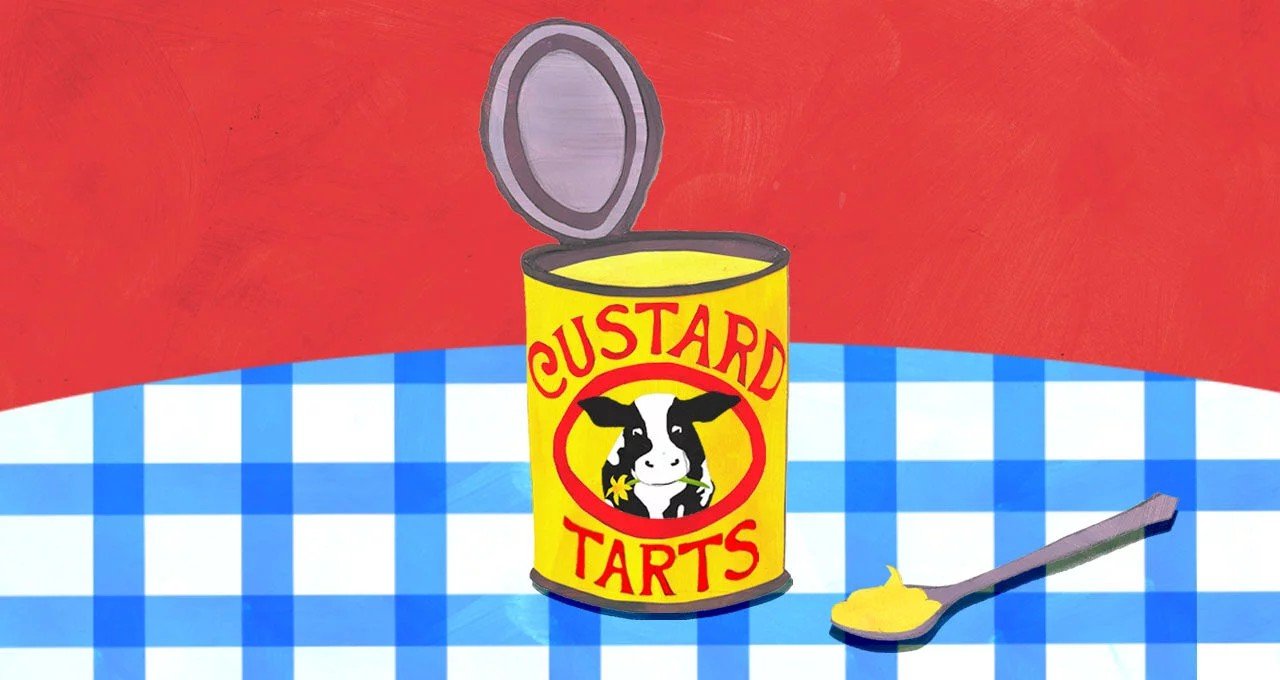
An hour-long inquisition into sexuality, lesbian coding and archetypes. Following its previous run at Lantern Theatre as part of Brighton Fringe in May 2026 and nominations for both the best new writing award at Chichester Festival Theatre as well as the international touring award 2026 in association with the Pebble Trust, Alice Harris-Dean’s Custard Tarts makes its London debut at Riverside Studio’s Bitesize Festival.
Presented by Whole Headache Productions, Custard Tarts explores a disillusioned queer, Nancy, portrayed by the playwright-actor herself Alice Harris-Dean, as she navigates the difficult road towards self-acceptance through the help of four lesbians from across the twentieth century.
At the beginning of the play, while the rest of the ensemble are kitted in Spice Girls attire, Nancy’s costume is coupled with her crush Sasha’s neanderthal suit, immediately making her feel othered amongst this circle of socially acceptable friends and positioning Nancy to the audience as the group’s outsider. The complexity of social conditioning within the dynamics of female friendship prevails as the group perceives Nancy’s gushing excitement over homoerotic band mates like Mel B and Geri as weird ‘gay stuff’ that infiltrates their circle of fun, all while simultaneously taking body shots at costume parties. So long as their homoeroticism achieves the eyes of the male gaze it can be moulded perfectly inside their clean-cut heterosexual cookie cutter, and they get to uphold their positions within the hierarchy.
Nancy’s initial friend group widely juxtaposes the play’s later ensemble of guests, who embark on a joyful adventure of queer expression by exchanging tales of self-discovery, friendship and girlhood, though both are portrayed by the same cast.
Eventually we learn that it wasn’t quite love at first bite for custard tin business owner Les and her forbidden lover Katie, whose egg intolerance luckily inspired a new business venture. Lucy Miller’s transformation from rigidly enforcing how Nancy can retain her social footing to this Bristolian laxed, yet self-made custard tin entrepreneur is particularly worth noting. Among this shift in setting, Nancy’s character also evolves from a lightning rod for the guilt and shame that accompanies breaking society’s mould towards a guiding light for 1950s housewife Betty-Lou’s complex discovery of an intense desire she has long been repressing.
In a heartfelt conclusion, Betty-Lou is forced to return to the 1950s and subsequently her compulsory heterosexuality, an idea which was coined by Adrienne Rich in an essay from the 1980s. However, for Nancy breaking through this space-time continuum to post out anonymous dinner party invites helped her to courageously break through the shackles of social conformity forced upon her by her previous unsupportive cohort so she could finally and unashamedly get the girl.
Custard Tarts oozes with hilarious originality, sapphic tension and queer culture with the ensemble’s wardrobe spanning across many different lesbian archetypes.
Elizabeth Harrison explored a hilarious portrayal of sexually charged lady-farmer Hilda while kitted in slogan tees and side kicked by Chris, portrayed by Esther Wellbrock, equipped with car keys attached by a carabiner. Meanwhile the slightly more repressed lipstick lesbian Betty-Lou, portrayed by Alix Addinall, sported her stylised 1950s housewife swing skirt to portray a more hyper feminine archetype.
Strict censorship during old Hollywood cinema meant that homosexuality was banned by the Hay’s Production Code under the dysphemistic ‘sex perversion’. Pre-code cinema overcame such hurdles by portraying queer desire through the lens of emotionally focused female friendships that lived amongst one another purely because they shared accommodation. This is perhaps why history, or at least Alix Addinall’s depiction of it within the character of Betty-Lou, may have called Chris and Hilda best friends or perhaps even ‘family business partners.’ However, as the dinner guests dress down into their drawers, or respective petticoats, they begin to break away from the stereotypes and break down each of their own rocky journeys towards embracing their true selves, queerness and all.
Overall, Alice Harris-Deans is an energetic storyteller who manages to bend the rules of reality in order to pack campness, heartfelt emotion and custard-fuelled fights into sixty minutes of queer joy.
One of London’s most accessible arts festivals is back, with tickets priced at £12 (and £8 for concessions). Spanning across five weeks and fifty shows for its seventh edition, Bitesize Festival 50 returns with its biggest festival yet to celebrate Riverside Studio’s 50th year of championing creativity. The Hammersmith theatre will display a run of the custard-themed romp until August 23rd and continue showcasing its works of bold new theatre as well as its exciting programme of short film, music and visual art from emerging and established artists until 30th August 2026.
For information visit:
https://riversidestudios.co.uk/bitesize-festival/
★ ★ ★.5
Written by Harriet for Theatre and Tonic, August 2026.