End of the Rainbow starring Jinkx Monsoon Review
Written by Ziwen for Theatre and Tonic
Disclaimer: Gifted tickets in exchange for an honest review. All views are our own
“I’ve heard how ‘difficult’ it is to be with Judy Garland. Do you know how difficult it is to be Judy Garland? And for me to live with me? I’ve had to do it — and what more unkind life can you think of than the one I’ve lived?” This was what Judy Garland said in a 1967 interview with McCall’s magazine. Before this production, my impression of Garland had been limited to Dorothy — the sweet little girl from The Wizard of Oz. I hadn’t known that studio executives had controlled her since childhood, forced to diet, and given drugs to sustain the punishing hours demanded of her. Those same drugs would eventually become something she could never escape. Just three months after marrying her fifth husband, Mickey Deans, Garland died of an overdose in 1969 at the age of only forty-seven.
In 2005, Peter Quilter wrote End of the Rainbow, a play centred around Garland’s final series of concerts before her death, taking audiences behind the scenes and into the fragile interior world of Judy herself. Now, in this new production at Soho Theatre Walthamstow directed by Rupert Hands and starring Jinkx Monsoon as Judy, the story returns with a distinctly different, though equally heartbreaking, atmosphere.
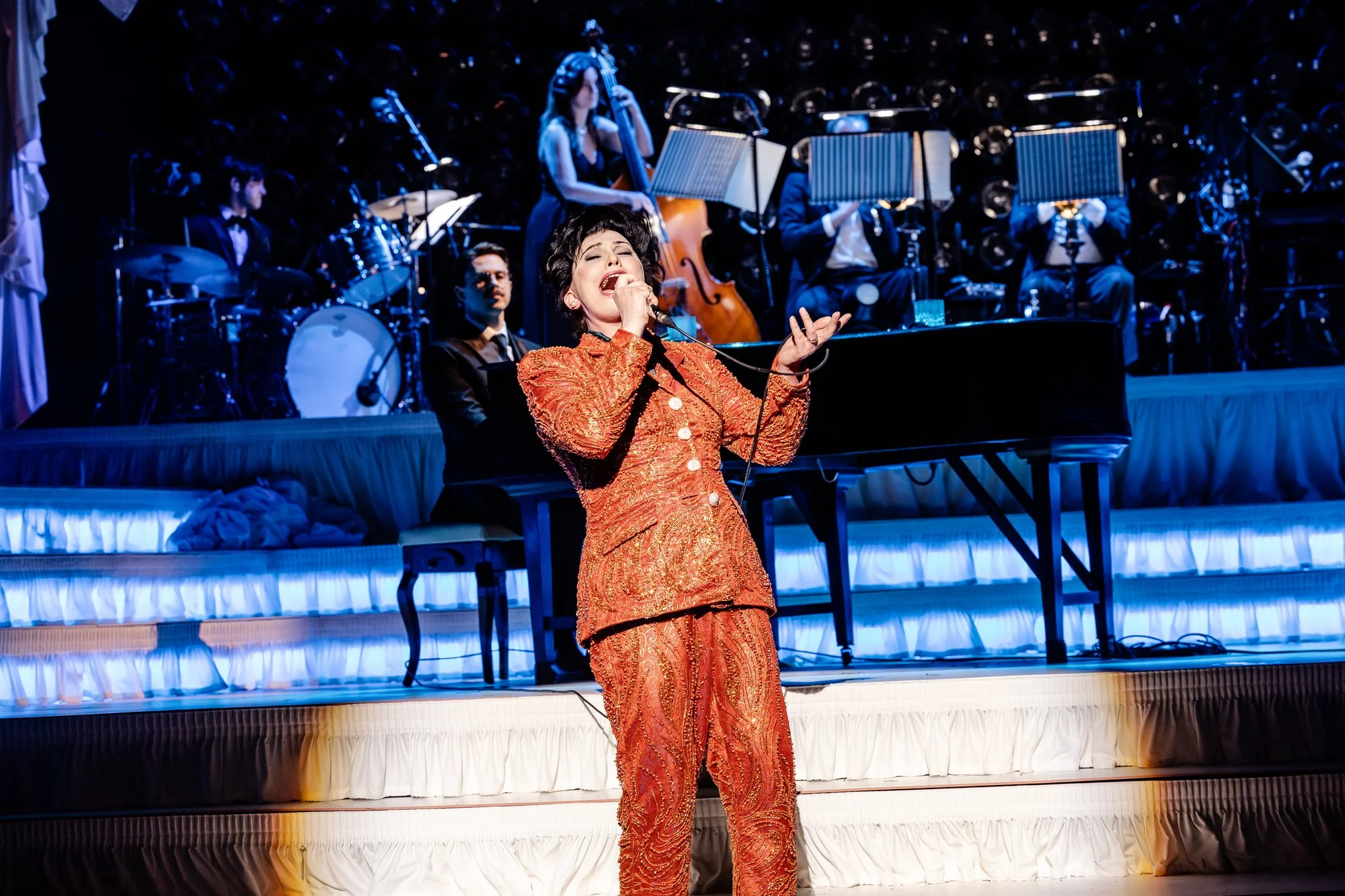
The entire play unfolds between Judy’s hotel suite and the Talk of the Town nightclub, centering on Judy, her fiancé Mickey (Jacob Dudman), and her pianist Anthony (Adam Filipe). Jasmine Swan’s set design cleverly transports us between these two worlds. The stage is draped in white, with a grand piano positioned between several tiers of steps. Whenever Judy begins performing at the nightclub, the curtains rise to reveal the band behind her. Yet even when the curtains are closed, it never truly feels as though she has stepped offstage. It is as if Judy was born to exist beneath lights and before an audience — a reflection of how performance seems to have consumed every moment of her life. When she stands at the edge of the steps and looks downward, it appears as if she is really standing beside the hotel window. And when Judy drifts into a drug-induced haze, a sudden wash of green light (Prema Mehta) falls over her, instantly evoking the Emerald City of The Wizard of Oz.
The production includes many of Garland’s iconic songs, including “The Man That Got Away,” “Get Happy/When You’re Smiling,” “Come Rain or Come Shine,” and of course “Over the Rainbow.” Whenever Jinkx Monsoon stepped beneath the spotlight and began to sing, I genuinely felt transported back to a live performance in 1968. Monsoon captures Judy’s magnetic charisma with astonishing precision — even the smallest glance or spontaneous reaction toward the audience feels charming and alive. The way the songs painfully mirror Garland’s own life makes these performances deeply moving.
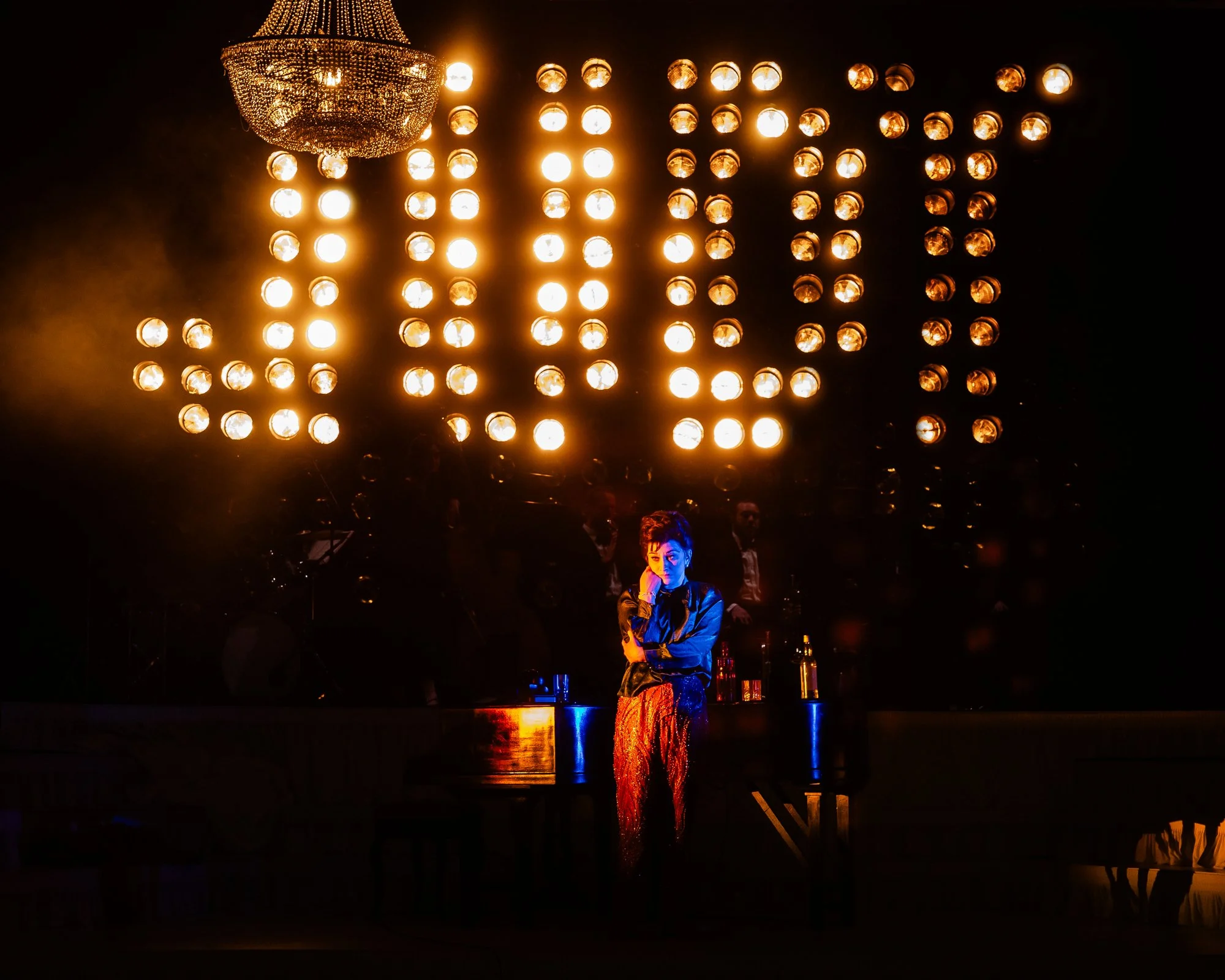
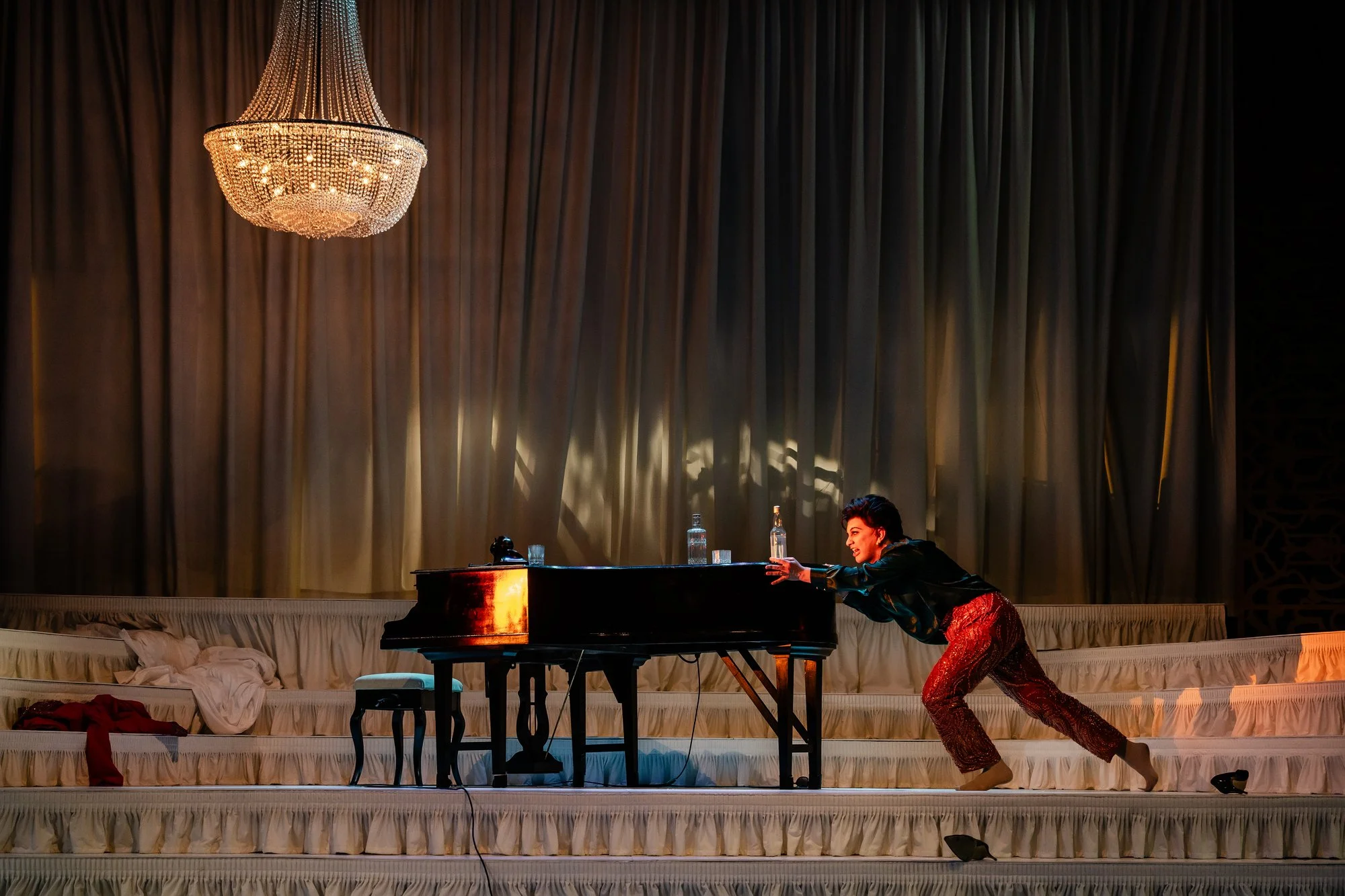
When the language of a play feels vivid and truthful, the audience naturally follows the characters, and End of the Rainbow achieves exactly that. Judy casually references other actresses of her era, jokes about the amount of medication she takes, and repeatedly brings up her former husband Sid Luft. Through these seemingly offhand remarks, we sense her lingering attachment to him, her desperate need for security, and the suffering caused by addiction. The play charts her dependence with devastating clarity: from the very beginning, when she sweetly begs Mickey for more pills, to later moments when she swears to Anthony — and to herself — that she will stop taking them altogether, only to find herself unable to escape them in the end. Her relationship with drugs, alcohol, and cigarettes is rendered here with painful honesty.
Monsoon’s portrayal of Judy is exquisitely detailed. Most of the time she speaks slowly and softly, but the moment Judy becomes emotional, words pour out of her in frantic torrents, as though her nerves are perpetually stretched to breaking point. The way she walks and places her hands on her hips is very distinctive, and I found myself noticing her habitual gestures of touching her cheek, adjusting her earrings, and anxiously fiddling with her fingers. Monsoon captures Judy’s passion, childish impulsiveness, theatricality, vulnerability, and deeply ingrained self-destructive tendencies all at once. She radiates enormous charm while simultaneously inspiring frustration and heartbreak. When Judy becomes too disoriented by drugs to remember which song she is meant to sing, her eyes lose focus, her thoughts fracture, and even the microphone cord seems to confuse her. I found myself genuinely worried for her, terrified she might collapse onstage at any moment.
It is only in Judy’s quieter moments alone with Anthony that the play finds genuine stillness and tenderness. Filipe’s Anthony is emotionally restrained yet deeply full-hearted, gentleness forms the core of his performance. When he carefully helps Judy apply her makeup as though soothing a child, or sits beside her by the window imagining an impossible future together, Judy is finally able to rest for a moment. Yet even within this fleeting happiness there lingers an even deeper sadness. Still, for a brief time, they truly do save one another.
Judy’s relationship with Mickey is complicated — something tangled together from consumption and dependency, addiction, loneliness, and perhaps a small amount of love. Dudman’s portrayal of Mickey still feels slightly underdeveloped at this stage. His controlling nature comes across strongly, but the other layers of the character feel slightly muted. Much of his response to Judy is expressed through frustration and exhaustion, and I found myself wanting to see more of those conflicting emotions colliding beneath the surface.
The very first melody heard in the play is “Over the Rainbow” played softly on the piano, and it is also the final song. Monsoon deliberately sings it with a slight instability beneath her rich, beautiful voice. As she sings, red rose petals begin falling from above. She turns upward, reaching out with trembling hands to catch one. Even after a life consumed by the entertainment industry, standing at the edge of destruction, she still glows. It is a heartbreaking story, yet one filled with tremendous vitality. And it is a story that deserves to be told — especially when it is told this well.
End of the Rainbow plays at Soho Theatre Walthamstow until 21st June 2026.
★ ★ ★ ★ ★