
End of the World and Hard-Boiled Wonderland at Barbican Theatre Review
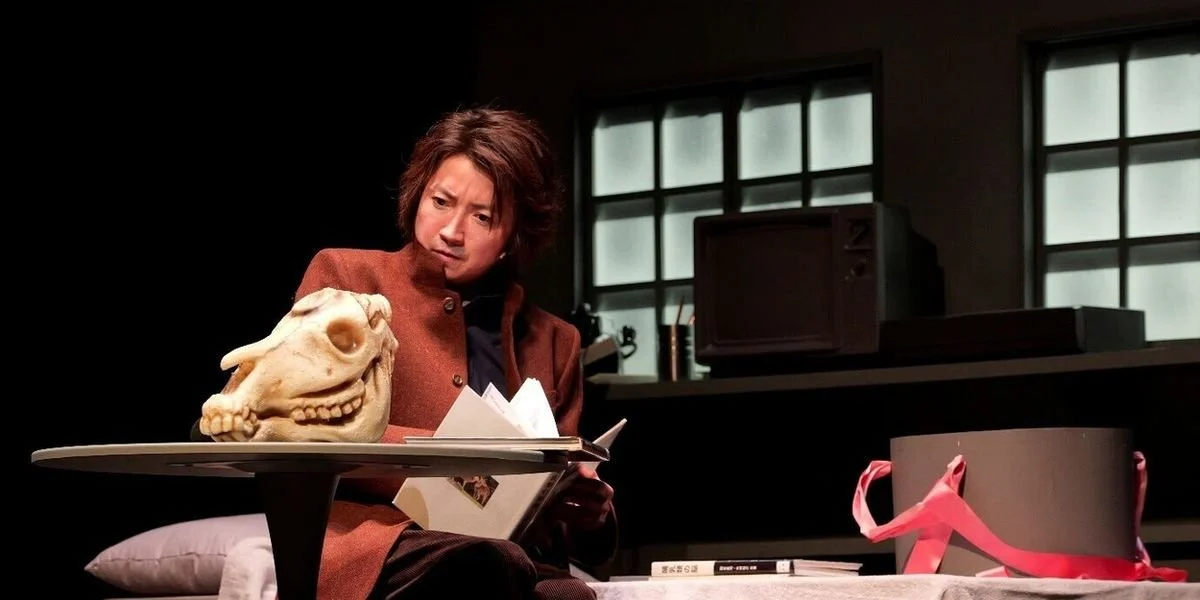
Golden unicorns, enormous musical instruments warped into strange yet beautiful forms, trees with twisted trunks, glowing unicorn skulls, and a vast, open stage filled with expanses of pure colour (K Ishihara), accompanied by the melancholy piano music performed live by Mayu Gonto. Every moment of End of the World and Hard-Boiled Wonderland is imbued with a profound sense of wonder and solitude.
End of the World and Hard-Boiled Wonderland is one of the best-known novels by Japanese author Haruki Murakami. First published in 1985, it won the Tanizaki Prize that same year. In 2026, the novel received its first stage adaptation, adapted by Ako Takahashi and directed and choreographed by Philippe Decouflé, with Tatsuya Fujiwara in the lead role. Following its premiere in Japan and subsequent performances in Singapore, the production arrived in London. Although there remains considerable scope for the adaptation to develop and explore the novel’s themes more fully, it succeeds in bringing much of Murakami’s distinctive atmosphere to the stage.
One of the novel’s most intriguing features is its two parallel storylines, and the stage adaptation, much like the original, allows them to unfold in alternation. As the title suggests, the stories take place in two distinct worlds: Hard-Boiled Wonderland and the End of the World. The former is set in a near-future Tokyo, where the protagonist, Watashi, works as a Calcutec, a specialist who processes and encrypts information through his own consciousness. After accepting a commission from a mysterious old scientist, he becomes entangled in a conflict between rival organisations. The latter story begins in a seemingly perfect town enclosed by high walls. Everyone who arrives there is forced to part with their shadow, gradually losing their heart in the process. As the story progresses, Watashi discovers an astonishing secret hidden within his own mind, one that is closely connected to the world of the End of the World. While Watashi must confront questions about consciousness and the end of life, Boku, the protagonist of the other storyline, must decide whether to leave the town or remain.
Adapting a novel of this length for the stage is no easy task, and time seems to have been one of the major challenges facing the creative team. Even with numerous plotlines cut and the characters’ dialogue considerably condensed, the actors often deliver their lines at a rapid pace. This can leave too little room for the relationships between the characters to develop naturally, making their world feel less convincing. Much of the unhurried everyday life that gives the original novel its distinctive rhythm has also been omitted. The ice cream Watashi brings to the Librarian and the elaborate meal he prepares for her, for instance, are absent from the production. With these small, everyday details, some of the novel’s more subtle emotions and intimate exchanges are also lost. Moreover, some of the deliberately comic moments make the characters seem less attuned to the world they inhabit, while certain dance sequences, which do little to advance the narrative, interrupt the flow of the scenes and risk drawing the audience out of the dreamlike atmosphere rather than deeper into it.
And yet, the production also creates moments that the novel itself could never quite achieve. When “She” from the End of the World (Misato Morita) is lifted into the air by the other characters and then gently lowered onto the bed in Watashi’s room in Hard-Boiled Wonderland, the connection between “She” and “the Librarian” becomes more tangible than it is in the novel. “She” herself begins to seem like a creation of Watashi’s mind. When Watashi realises that the End of the World is a world he has fashioned himself, it is no longer the somewhat bewildered young man (played by Kiita Komagine during this performance) who is followed by the shadow, but Watashi himself. The Bob Dylan songs drifting from the record player in the protagonist’s room also lend the production a recurring undercurrent of loneliness and romance.
When Watashi learns that he has only a few hours left to live, he spends those remaining hours doing the simplest of things. He shares a beer with the Librarian and makes one final phone call to Woman in Pink (Miu Tomita). As the pace of the story slows, the actors have more room to let their emotions emerge, no longer swept along by the relentless pace of the dialogue. Instead, these feelings surface through scenes that might otherwise seem unremarkable, revealing a quiet, understated beauty tinged with hope.
When I first began reading End of the World and Hard-Boiled Wonderland, much of the story felt abstract and elusive. Yet as I read on, I gradually came to embrace its strangeness and find my way into its world. A stage adaptation has the potential to bring the novel’s power to life in a different way. Beneath its fantastical surface lies a world of deeply recognisable human experience, and both Watashi and Boku are characters with whom audiences can readily empathise. If the production could find a more effective rhythm and give the emotional bonds between its characters sufficient time to develop, the fantastical elements and delicate emotional textures of Murakami’s novel could resonate far more deeply, drawing audiences fully into the world of End of the World and Hard-Boiled Wonderland.
End of the World and Hard-Boiled Wonderland plays at Barbican Centre until 11th October 2026.
★★★★
Written by ZiWen for Theatre and Tonic, October 2026.