
Franz and Marie at Charing Cross Theatre Review
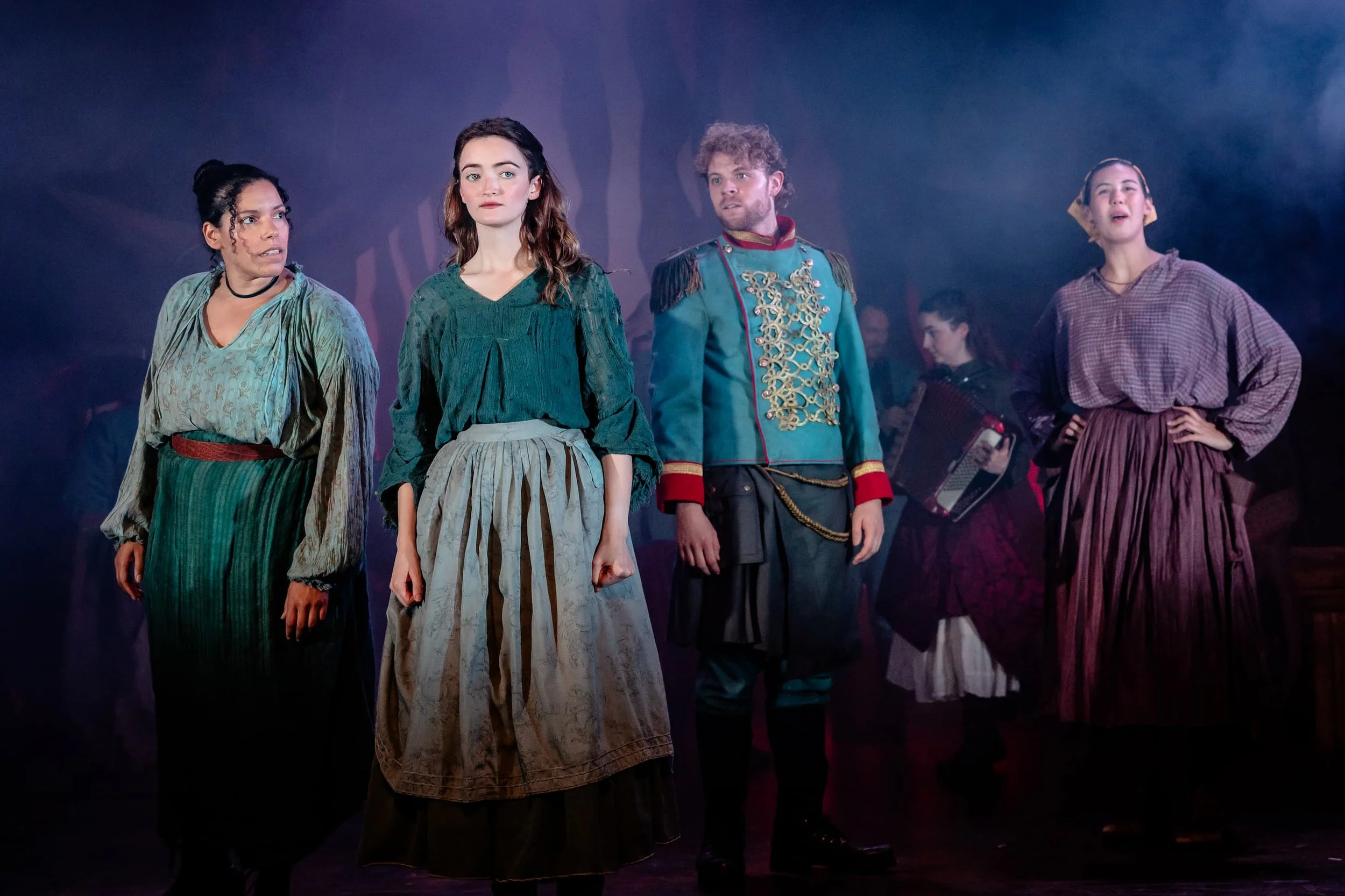
Image: Danny Kaan
‘Woyzeck’, the 1836 play by Georg Büchner is regarded by many scholars as the first ‘modern’ stage play. The play first appeared in 1877 but its first performance was not until 1913. Since then, Woyzeck has become one of the most influential and most often-performed German plays. Due to its unfinished nature, the play has inspired many diverging adaptations.
It has been adapted as a ballet, two operas (one by Alban Berg), a number of films and even a puppet show. Now it has come, via South Korea to the Charing Cross Theatre as a musical. I do not think that this, by any means, is the most distinguished iteration of the original but it is certainly interesting and in parts, moving.
The drama is cloaked in a serviceable book and lyrics by the late Chris Broderick as adapted by Teresa Howard and with music by Broderick and Rob Shepherd. The latter are/were members of The Singing Loins, an English alternative/trash-folk band from Rochester in the Medway Delta, Kent and so the style of composition is folk-inspired with traditional instruments like fiddles and banjos though the talented fourteen strong cast of actor musicians play a much wider range of instruments (under Steve Edis’s musical supervision) including accordion, guitar, percussion and drums, reeds and bass, and never better than when they all play as an ensemble.
The original play explores how extreme poverty, social oppression, and institutional cruelty can dehumanise an individual and is based on a true historical case in which Johann Christian Woyzeck, a Leipzig wigmaker and soldier murdered his mistress in a fit of jealousy and was publicly executed.
In this production, set in an indeterminate Slavic country in the late 19th. Century, a platoon of soldiers who have returned from an unspecified war in a desert, are posted to a folkloric fairy tale forest. Franz Woyzeck (Brenock O’Conner) and his lover Marie (Jade Oswald) have a child. They are unmarried. They are impoverished and Franz sells his body to the platoon’s doctor for medical experimentation including electrification and mental torture. His bodily and mental health decline rapidly after months of dietary restrictions. Meanwhile the arrogant, bullying Drum Major Varg, (Matthew Heywood) the conceited son of the Colonel, has his eyes on Marie and uses his influence to absent Franz while he makes his move. It doesn’t end well for either. Franz, in declining health is tortured with stories of his lover’s infidelity leading to Othello-like tragic consequences.
Franz is depicted as an ‘ordinary Joe’, a regular, unremarkable man, once a brave and courageous soldier driven to flashbacks, recurring nightmares, and distressing thoughts about ‘the desert’ and exploited by both the medical profession in the shape of Dr. Simian (Richard Emerson Gould) and his senior officer, the disdainful and scornful hypochondriacal Captain Peccary (Mark Meadows).
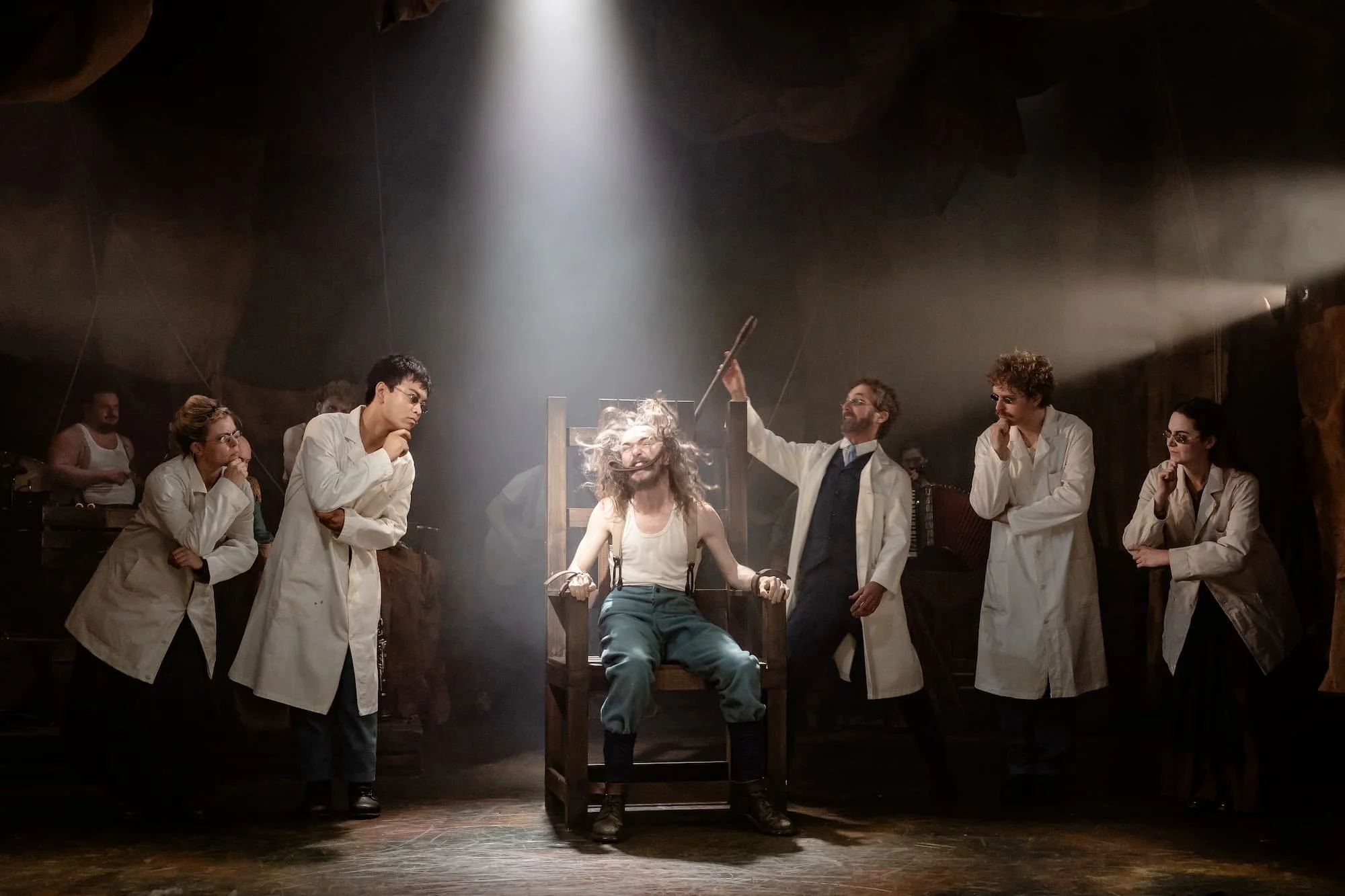
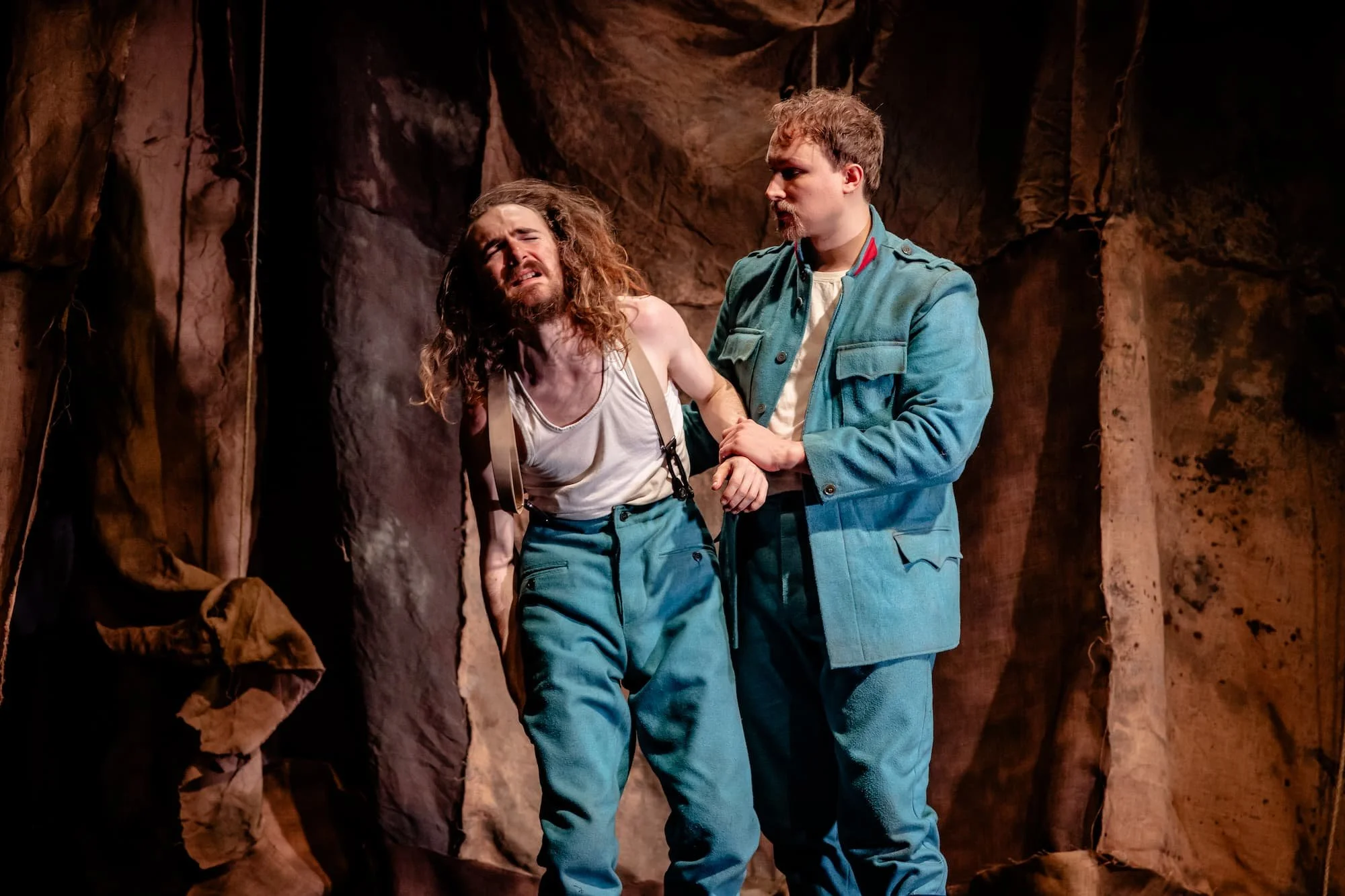
Frustratingly, there are parts of this production, directed by Michael Oakley, and with choreography by Ben Wright, which are very good indeed, but others much less so. The music, in its twenty-seven numbers, is often very good, but sometimes repetitive, the staging, particularly in the ensemble numbers, exciting, but on occasion a little dull.
There is a mystical element to the story led by the excellent Eve Polycarpou as Vashti, a sort of Shaman/Greek Chorus and whose singing voice in the numbers which she leads, is the best of the evening. The other voices are often patchy and a little rough and ready. The book and lyrics are blunt and at times inelegant ("this machete killed a yeti") and the insertion of dark humour into the tragedy, broad and obvious, often seems out of keeping with the main thrust of the piece.
I enjoyed the costuming, (production design by Bretta Gereke) the soldiers in smart azure blue tunics, the village folk in brown pastel and the creepy fairground troupe in colourful, eccentrically designed apparel. Polycarpou’s Vashti is dressed in multicoloured garb, reminiscent of an American Indian ritualist.
The show was set against three battens from which are hung patchwork sacking drapes which are furled and unfurled in various combinations to suggest, effectively, an eerie forest.
The lead performers, O’Connor and Oswald, I found to be a little underpowered though O’Connor’s anguish and breakdown is well and sensitively handled but the supporting players did well.
I enjoyed this show which is intriguing, often interesting and with a powerful message and I believe has a future. I do think however that it still requires work in order to reach and be appreciated by a wider audience.
Franz and Marie plays at Charing Cross Theatre until 14th November.
★★★
Written by Stephen Gilchrist for Theatre and Tonic, October 2026.