
Herstory in History at Rich Mix London Review
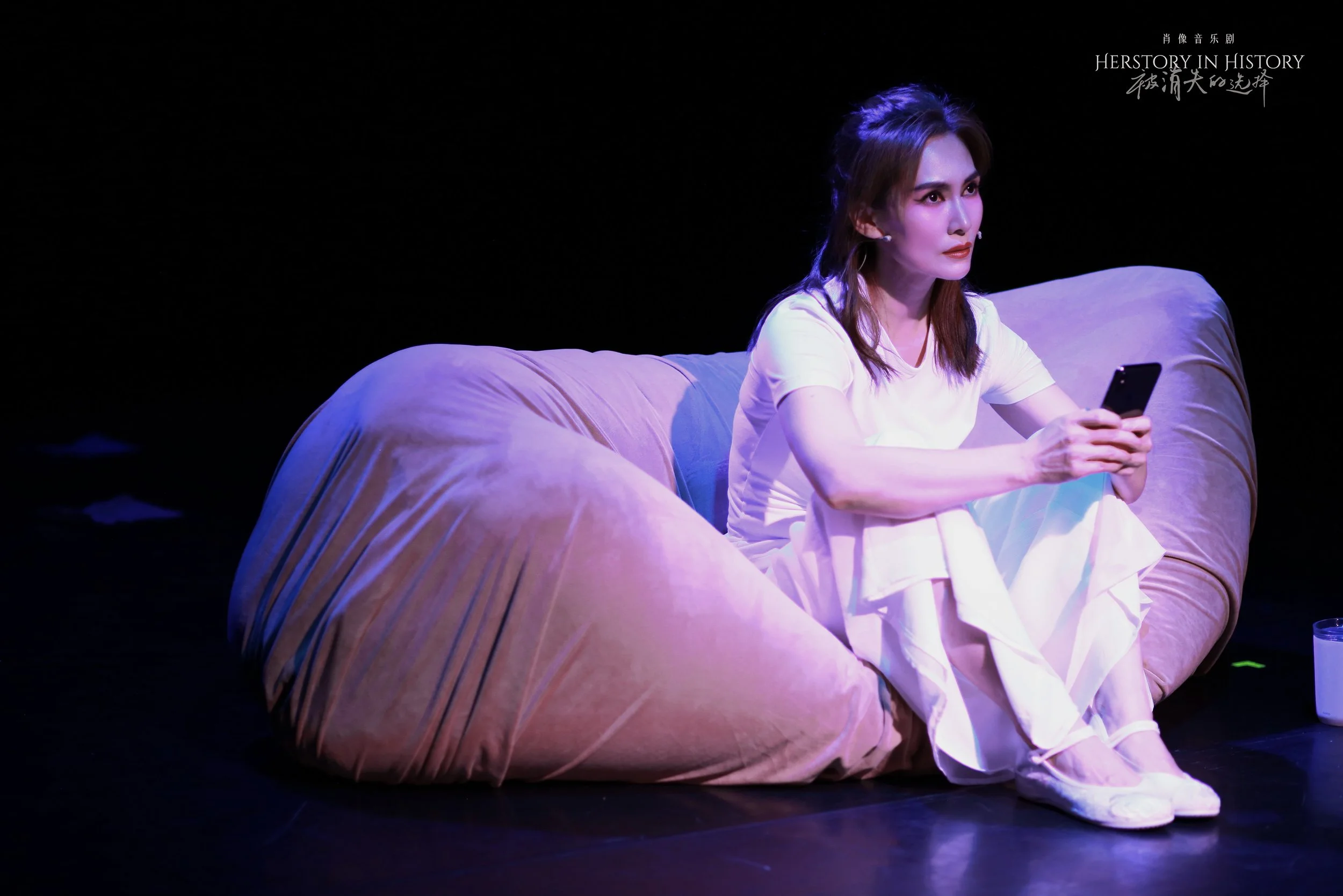
There was something inherently intriguing about watching a semi-autobiographical musical in London that was performed in Chinese with English surtitles. Herstory in History, co-written and co-directed by Fiona Zhu and Keyuan Zhang, with Zhu also taking the lead role, is a solo musical with considerable potential still waiting to be realised.
The story begins on a rainy night. The protagonist has just finished yet another performance of The Orphan of Zhao, when a question from a girl in the audience lingers in her mind: “Did Zhuangji Zhao have any choice other than dying?” As the question keeps resurfacing, the protagonist suddenly realises that it has been a long time since she last truly examined the psychology of the character she plays. She settles down and begins researching everything she can find about Zhuangji. Only then does she discover how little history has preserved about this woman, just a handful of words, some of them even openly critical. She feels a sense of injustice, and her connection with the character grows increasingly strong.
Zhuangji Zhao was an important woman of the Zhao clan in the State of Jin during the Spring and Autumn period, and is best known as the mother of Wu Zhao in the later-famous story The Orphan of Zhao. Like the protagonist of the play, Zhu herself has also played Zhuangji in a musical, repeatedly tracing the character’s journey onstage. There is no doubt that her performance here is passionate and compelling. Yet I could not help wondering whether the musical’s central ideas are truly connected to what is actually being presented on stage.
For much of the performance, Zhu talks about how Zhuangji has been fixed and defined by history, and about how she herself understands the character. Yet both Zhuangji and Zhu seem strangely distant from the audience. Why Zhuangji? Why not any other historical figure or character? The play never quite provides an answer, even by the end. Combined with a somewhat sluggish narrative rhythm that gives the impression of moving forward whilst actually remaining static, as well as a reluctance to dig deeper into its themes, much of the piece feels more like a speech than a story. As a result, it never quite develops a compelling sense of narrative, making the ending feel abrupt.
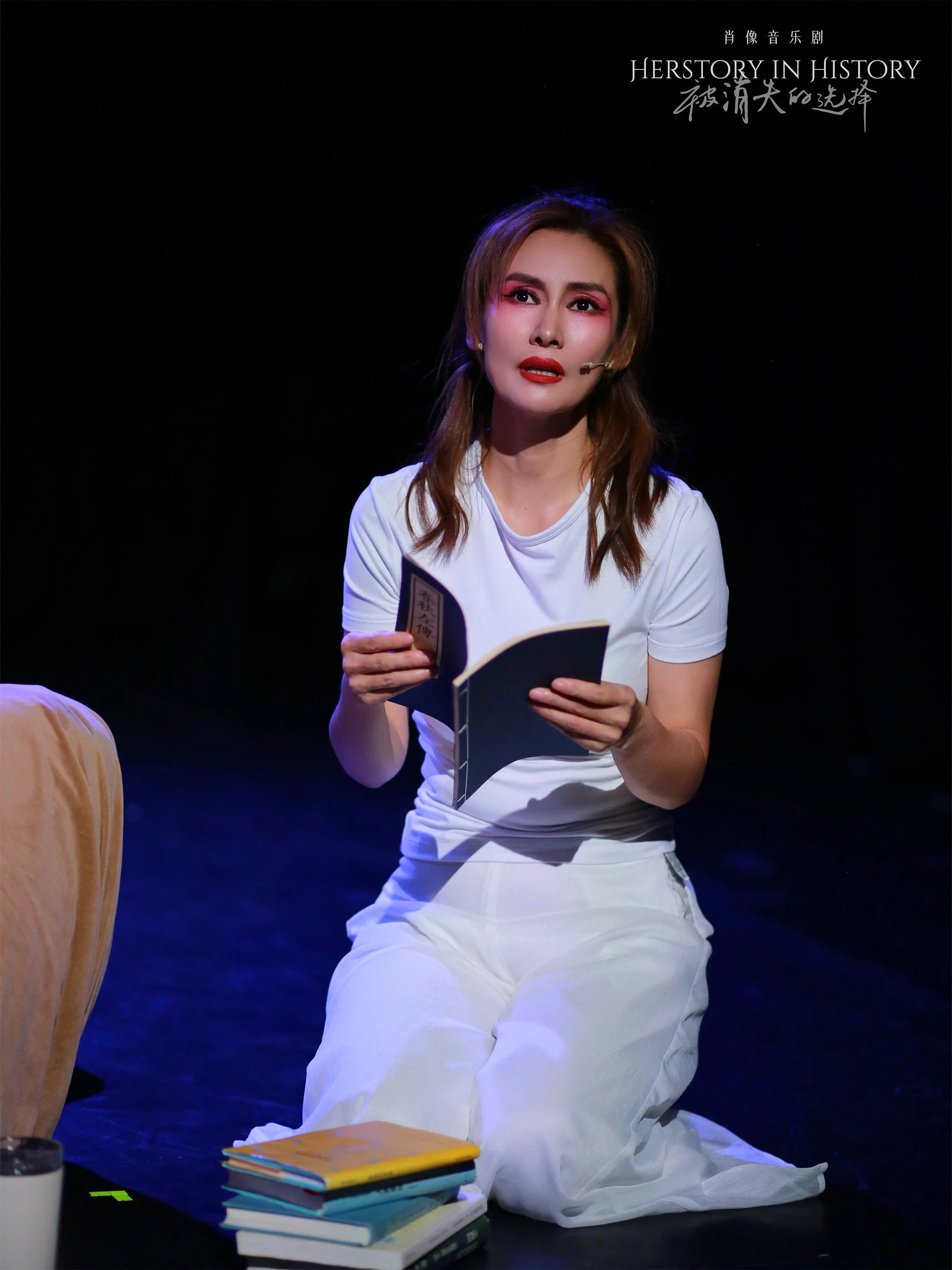
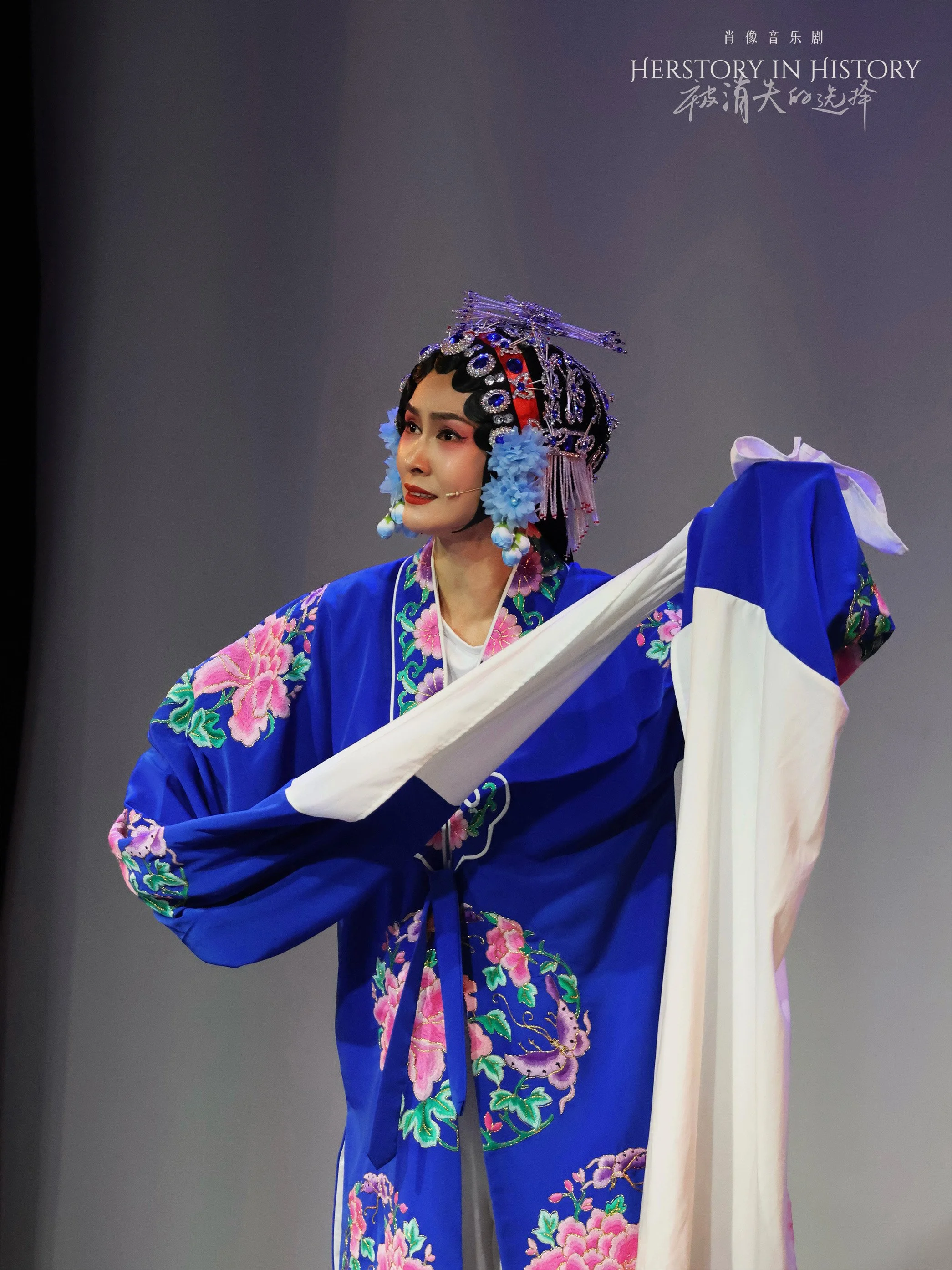
The melodies by Johannes Grosz are beautiful, but at times they feel disconnected from the dramatic progression. On many occasions, the emotional intensity of the scene has not yet reached a point where singing feels necessary, yet the actor has already stopped speaking and is waiting for the song to begin.
In fact, rather than the broader theme of being overlooked by history, I found Zhu’s own stories far more engaging whenever she began talking about herself. Yet after watching the current version of Herstory in History, I still feel that I know very little about Fiona Zhu as an actress or as a person. For a semi-autobiographical work, the person at its centre should be one of its most interesting and distinctive elements. However, because the production offers relatively little in the way of detailed and deeply personal material, the role could almost be inhabited by any female performer, which feels like a missed opportunity.
The set design by Shupin Liu and video design by Jade Cao and Wanbo Li are among the production’s highlights. A shimmering silver ribbon is coiled into a circle, resembling a path that has already been written, leading towards a small stool at its centre and a length of white silk suspended above it. Beneath the clothes rack lies a pile of crumpled, sometimes torn pieces of paper, resembling fragments of historical records. In one particularly striking sequence, the large screen behind the protagonist shows no faces of her relatives. Instead, we hear their voices, tinged with a local accent, passing judgement on her, accompanied by the sound and movement of mahjong tiles in their hands. The sense of pressure is immediate and palpable.
In fact, the production already contains many organic and promising elements. What it needs most now is to identify what it ultimately wants to say, and to find the clearest path through which the actress, the protagonist and the story can become tightly intertwined. Once these elements begin to speak to one another, the narrative will become more fluid and, more importantly, more emotionally engaging. In that process, when the audience can see a clear part of the performer’s own inner world through the central character, the distinctive appeal of a semi-autobiographical work will emerge naturally.
Herstory in History runs at theSpace @ Niddry Street at the Edinburgh Festival Fringe from 25th August to 29th August 2026.
★★★
Written by Ziwen for Theatre and Tonic, August 2026.