Twelve Angry Men at Birmingham Rep Review
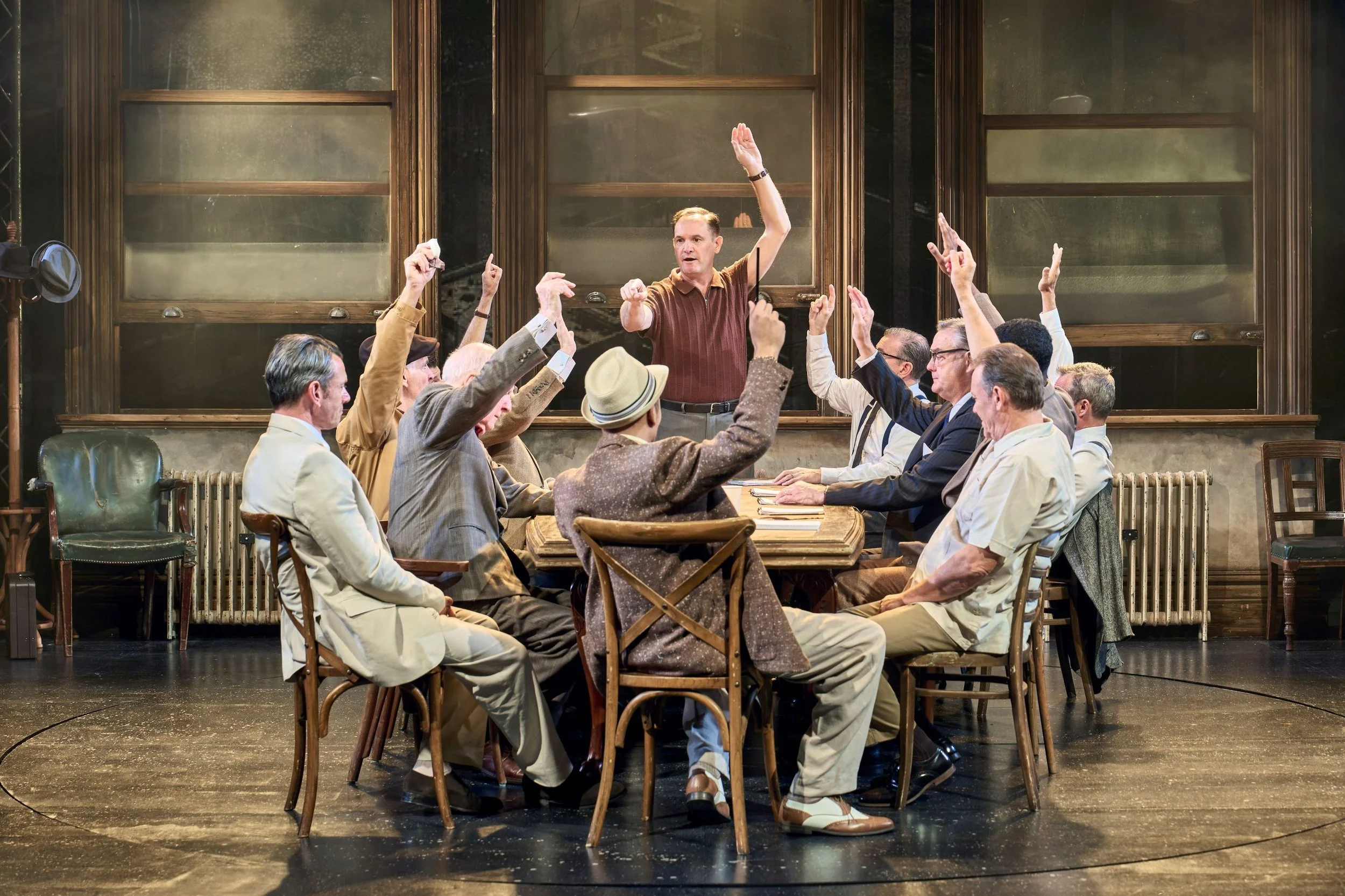
12 Angry Men is currently making its way on a tour of the UK, with a stellar cast of familiar TV faces and a message to impart on its audiences. Despite the story being 70 years old, there is still a reluctant relevance within this script that audiences may find familiar. Can a two hour play set in one room still effectively capture our attention and our emotions?
Reginald Rose’s 1954 drama, subsequently made famous by Sidney Lumet’s 1957 film, begins with an apparently straightforward case; a sixteen year old boy accused of murdering his father, with two supposed witnesses and no solid alibi. Eleven jurors are convinced of the defendants guilt. Only Juror 8, played with a quiet authority by Gray O’ Brien, refuses to accept that the evidence is quite as conclusive as it first appears. What follows is not so much a search for the truth, but a commentary on the human psyche, and an examination of how the truth is constructed, challenged and distorted by those charged with judging it.
Michael Pavelka’s set design is particularly effective. The jury room feels oppressive from the outset: brown, enclosed and stifling, with a broken fan providing an apt metaphor for the increasingly heated deliberations. Most strikingly, the central table rotates almost imperceptibly throughout the performance. This is a simple yet ingenious device, subtly shifting the audience’s perception while marking the slow, agonising movement of the jury towards its eventual decision. The clever creation of a thunderstorm in the second act also acts as a fitting mirror for the deteriorating atmosphere within the room. The premise of the show is stripped back and simple: this does not mean it is any less impactful than if it had all the bells and whistles attached. There is a danger with a play so familiar, that its arguments can feel predetermined and staged. Director Christopher Hayden largely avoids that trap. The evidence is revealed retrospectively, allowing the audience to experience the same process of reassessment as the jurors. Even knowing where the story is heading, the accumulating pressure remains compelling.
The productions strength lies in its ensemble. The twelve jurors are not presented as twelve interchangeable voices, but as distinct personalities whose histories and prejudices gradually emerge. Bill Ward brings considerable force to Juror 3, before bringing a surprising softer side at the eleventh hour, while Ricky Norwood’s Juror 7 provides a different kind of volatility. Tristan Gemmill is particularly unsettling as Juror 10, his particular anger and bigotry feeling uncomfortably relevant in the current climate. O’Brien’s Juror 8 is an appropriately restrained centre of gravity; far from being a traditional heroic protagonist, he portrays that reasonable doubt is not a grand act of rebellion, but sometimes simply the courage to say ‘I’m not sure’.
Overall, this is a wonderfully slow burner of a show that despite its simplicity still packs a punch with the audience. It provides an insightful commentary on the justice system, social dynamics and prejudice that feel just as apt in today’s society as they did 70 years ago. This is theatre at its most basic, yet it remains gripping and compelling all the same, something not to be sniffed at in a world of extravagance and exaggeration.
Twelve Angry Men plays at Birmingham Rep until 26th September.
★★★★★
Written by Roni for Theatre and Tonic, September 2026.