The Last Ship at Theatre Royal Drury Lane Review
Concluding its world tour, Sting’s The Last Ship makes its London debut at the Theatre Royal Drury Lane — a suitably imposing home for a musical of such epic ambition. Inspired by Sting’s childhood in Wallsend, it tells the story of a close-knit industrial community fighting to save the shipyard on which its identity and livelihood depend. With an extremely limited London run, performances continue only until the end of next week.
Set against the industrial collapse of the 1980s, The Last Ship centres on a close-knit community of shipbuilders forced to confront the impending closure of their shipyard. As their livelihoods—and their sense of identity—hang in the balance, the community must decide whether to accept its fate or fight for survival.
Across the first act, several storylines unfold simultaneously. Gideon Fletcher returns home after 17 years away, ostensibly to tie up loose ends following his father’s death, only to discover that his past has been waiting for him. His former love, bar owner Meg Dawson, delivers a life-altering revelation that forces Gideon to confront the consequences of his absence. Alongside this, shipyard foreman Jackie White, his wife Peggy and union representative Billy struggle against manager Freddy Newlands and government minister Baroness Tynedale as well as the wider forces of government as they plan to close the shipyard. Jackie is also battling deteriorating health and increasingly encounters the enigmatic Ferryman.
Eventually, these threads converge, but it takes considerable time to reach that point. For much of the first act, the narratives feel more adjacent than interconnected, leaving the production waiting for the moment when its various currents finally meet.
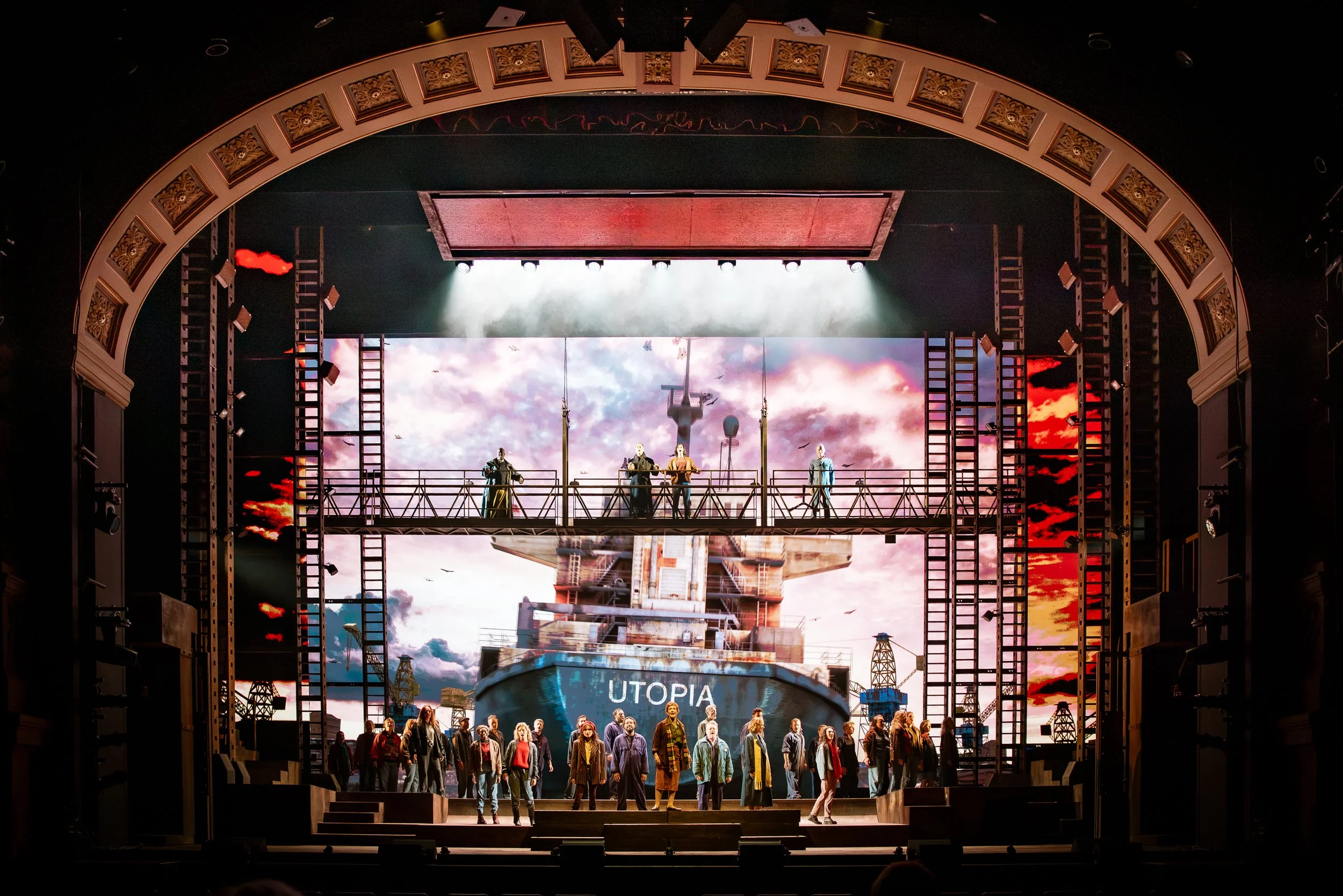
This is an epic in every sense of the word; grand, bold and imposing, appropriately befitting the Theatre Royal Drury Lane and the scale of the story being told. Yet the staging does not always match that ambition. The direction can feel surprisingly static, with much of the action positioned far upstage. On a stage as vast as Drury Lane’s, this sometimes creates a sense of distance between the audience and the community we are supposed to feel so intimately connected to.
The 59 Studios design work is particularly striking. Benjamin Pearcy’s superb video design, alongside Matt Taylor’s animation, places the hulking hull of a ship at the heart of the production for much of the evening. It transforms according to the demands of each scene while remaining an ever-present, unwavering presence. More than simply a visual spectacle, the ship becomes a reminder of precisely what these characters are fighting to preserve: their work, their community and a way of life that is rapidly disappearing.
There is something almost spiritual about its constant presence, too, connecting beautifully with the production’s more religious and mythological elements. It becomes a stoic, almost sacred entity looming over the action. It is, quite simply, beautiful.
Life, death, love and community are enormous themes throughout The Last Ship, and the story ultimately reaches beyond individual relationships. This is a musical about a town and its people; about collective identity and the painful necessity of moving into the next chapter of a community’s history.

The cast is exceptionally strong. Declan Bennett’s Gideon is every bit as compelling as one might expect: warm, charismatic and emotionally open, with a vulnerability that makes his journey particularly affecting. He wears his heart firmly on his sleeve, and Bennett makes his emotional reckoning a pleasure to watch.
Frances McNamee is wonderfully feisty as Meg. She brings power and tenacity to the role without ever losing its warmth, and her chemistry with Bennett is palpable. Together, they make a convincing pair, both dramatically and vocally.
Hannah Richardson is a particular delight as Meg’s daughter, Ellen. She fizzes with energy and lights up the stage, while her Act Two number is an undeniable knockout. Across the cast, there is a welcome rawness and authenticity to the performances; these characters feel like people rather than simply vessels for the plot.
Sting’s partnership with Jackie Morrison as Jackie and Peggy White is equally affecting. Morrison brings warmth and tenderness to Peggy, while Sting gives Jackie a commanding presence and a sense of authority befitting the shipyard foreman. There are some genuinely lovely moments between them, although Sting’s performance is not always entirely convincing dramatically. Shaggy, meanwhile, makes a welcome appearance as the Ferryman, bringing a different energy to the production.
The book, by Barney Norris, is itself a revision of a revision, and there are moments when that history is evident. It does its job of establishing the characters and advancing the narrative, but the storytelling can feel somewhat clunky and overextended. The production takes its time arriving at the emotional and dramatic destination it ultimately wants to reach.
The same can be said, to an extent, of Sting’s music and lyrics. There are undoubtedly some strong numbers, many of them powerful and poignant, but surprisingly few that remain with you once you leave the theatre. They are moving monuments to the world the musical is trying to preserve, yet they rarely feel as though they reach their full potential. When so many songs are reaching for the same emotional register, the individual numbers can struggle to distinguish themselves.
There is also an occasional disconnect between song and story. Some numbers feel as though they arrive before the dramatic moment has fully earned them, while others seem to sit slightly outside the momentum of the narrative. The result is a score that contains moments of real beauty without always functioning as seamlessly as a piece of musical theatre.
Perhaps the greatest issue is one of momentum. The Last Ship never quite gathers the pace or urgency its subject matter demands. Even as the world around these characters begins to crumble, the production continues to trundle along, with its principal storylines remaining largely separate until well into the second act. When the various strands finally converge, the power and urgency that have been missing suddenly arrive—but by then, it feels as though the moment has come too late.
There is a remarkable musical hiding within The Last Ship. The story is powerful, the performances are frequently excellent, and the production design is genuinely magnificent. There is beautifully haunting music and a wealth of rich thematic material concerning love, loss, faith, family and the fate of communities left behind by industrial change.
Yet for all its scale, The Last Ship never quite becomes the theatrical powerhouse it ought to be. It is a monumental epic in search of its final ingredient: momentum. The ambition is enormous, the canvas is vast, and there is much to admire—but ultimately, the ship never quite reaches full steam, leaving you, fittingly enough, feeling a little adrift.
The Last Ship plays at the Theatre Royal Drury Lane until Saturday 3rd October.
★★★
Written by Philip for Theatre and Tonic, September 2026.