
Unsinkable at Hope Street Theatre Review
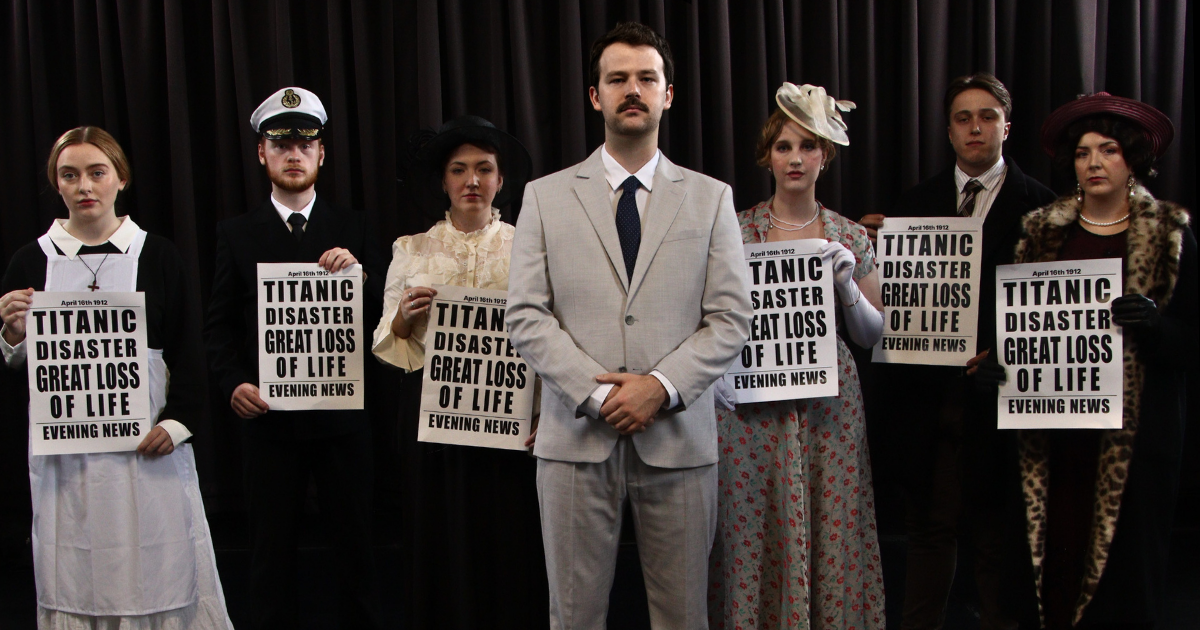
The word “Unsinkable” is one famously associated with history’s most talked about sinking disasters: the R.M.S Titanic on April 15th 1912. It’s a word said so often, and so ironically, that the origin of the word is just another thing that went down with the ship.
Written by Matthew Reynolds in 2024, Unsinkable is a new play premiering this week following the aftermath of the Titanic disaster and features five survivors, including her most controversial: J Bruce Ismay, Chairman and Managing Director of the White Star Line. Reynolds also acts as director for the production - his longtime fascination with Liverpool’s maritime history is apparent throughout as great-grandson to one of White Star Line’s employees.
Ismay was a Crosby-born businessman, taking over as Chairman of White Star in 1899. Now portrayed by Joseph Winder, who also took on the role as producer, he takes to the homely stage of Liverpool’s Hope Street Theatre to explain his case. The rest of the company have been recruited locally to Liverpool, creating a sense of hands-on involvement and a strong feeling of community.
Before the performance begins, you’re met with a tribute of names rolling on the curtain and the sound of sombre violins tugging on your heartstrings before you’ve even taken your seat. While it’s not disclosed, one could note this as a moment of respect to the lives involved, before an interpretation of them would be presented onstage.
Ismay appears alongside four other survivors, passengers and crew alike, and is forced to answer to The Inquirer (Christopher Forrest) on how the incident took place. Before he can return home to his wife Florence (Rosabelle Bennet), he must explain what drove him to take his place on the final lifeboat- and how his fate can be justified while most other officials sacrificed themselves.
Second to him, Officer Lightoller was the most senior member of the crew to survive - portrayed ruthlessly by Charlie Forrest, who commanded the strict “women and children” policy, despite Ismay’s and his own survival. Reynolds also includes the stories of other notable survivors, including the philanthropist Margaret Brown - a.k.a. the Unsinkable Molly Brown (Alice McKillop) and Violet Jessop (Lorna Jane Ryan), who survived three major maritime disasters within her lifetime.
A standout among the performances to me was Emily Guilfoyle as Marion Thayer- an American Socialite and first-class passenger who lost her husband John, but managed to escape with her son Jack. While first appearing as something of a snobbish lady of First Class, Guilfoyle portrays a heartfelt humanity in the character- attempting to navigate life after survival, for her son and partly for Ismay, all the while feeling as though she’s drowning herself.
I was fascinated by a sort of mirroring between Marion and Florence’s characters, one softens and the other hardens as the play goes on- while I might have expected the opposite to ensue.
Reynolds’ writing was beautiful, it was theatrical dialogue as it should be: poetic, romantic ,and unmistakably written to be performed. In this case, the writing is also incredibly informative - without too much elucidation, holding the effect of a verbal page turner. This partnered with elegant music felt reminiscent of something like Tennessee Williams’ writing for Streetcar Named Desire- and despite being new writing, I could have mistaken this play for an established classic.
The black box staging feels intimate, and apart from an “old film” reel of projections, requires minimal set throughout- completed by two flats of jumbled maritime memorabilia. I thought these may have been a bit unnecessary, as they weren’t used or even referred to, and at times cluttered the small space as performers moved on and off.
A black box space is a challenge for a cast of seven performing a full length play, with a disadvantage of small space, and some scenes with the full cast onstage. That being said, a standout part of the entire performance for me was the blocking of the newspaper sequence- a hilarious montage of exaggerated and bizarre scenarios as the press speculate how Ismay came to survive.
As a new Liverpool production on a short run, I would love to see the full production return in the future- especially on a bigger scale. I strongly commend the costumes (particularly Maraget Brown’s!) direction, performances and lighting designs, and I’d be curious to see a potential set that could better facilitate these.
Whilst the Titanic sinking is often interpreted through fictional stories, like James Cameron’s Oscar-Winning 1997 picture, it’s both refreshing and poignant to have a piece of theatre dedicated to notable lives associated with the ship, who they were before even boarding, and how they continued to live in the aftermath of the tragedy. Growing up visiting the Titanic Museum in Belfast where the ship was built, I felt like I’d found another side of the same coin in Liverpool - which I’ve now learned was her homeport. This sinking might be the most fascinating in history, and people are never going to stop being interested, especially as Liverpool, Belfast and even New York audiences have a claim to the history.
Inviting conversation and debate on what should have happened differently, or what the right thing to do is - Unsinkable brings a sense of learning back to the Titanic, a tale many of us might think we already know about.
Unsinkable runs at the Hope Street Theatre September 30th- October 3rd.