War Horse at National Theatre (Olivier) Review

Written by Ziwen for Theatre and Tonic
Disclaimer: Gifted tickets in exchange for an honest review. All views are our own
Among the growing number of theatre productions that incorporate puppetry, War Horse is undoubtedly one of the first titles that comes to mind. Adapted from Michael Morpurgo’s 1982 children’s novel, the production premiered at the National Theatre in 2007. Since then, Joey the horse has appeared in more than 7,500 performances worldwide, met the late Queen Elizabeth II, and become one of the most iconic figures in contemporary theatre. Now, after just about twenty years, Joey has returned to where it all began, in a new production directed by Tom Morris and revival director Katie Henry.
Set in Devon in the 1910s, the story begins when Joey, a spirited young foal, is bought at auction by Ted Narracott, a farmer with a weakness for drink and gambling. Ted’s son Albert immediately forms a bond with the horse, patiently training him to plough, ride, and respond to commands. Little by little, a profound connection develops between boy and horse. Their happiness is short-lived, however. With the outbreak of the First World War, the British Army begins requisitioning horses on a massive scale. Burdened by debt, Ted secretly sells Joey to the cavalry. By the time Albert learns what has happened, it is too late. All he can do is promise that they will meet again.
Joey is first assigned to Captain Nicholls of the British cavalry, where he befriends another military horse, Topthorn. Together they are captured by German forces and pull ambulance wagons to and from the front line; together they spend time on the farm of a young French girl named Emilie; and eventually they are conscripted into the German artillery, hauling heavy guns across the battlefield. It is during this brutal period that Topthorn finally succumbs to exhaustion. Meanwhile, Albert has enlisted himself, determined to search for Joey.
“Essentially putting a non-speaking central character on the Olivier stage was going against everything that everyone understood about that space,” Morris has said. “The design is for epic theatre in which text makes the space come alive. In this show, it’s movement, it’s puppetry.” After only a few minutes, it becomes clear that puppetry is indeed the soul of this production. Created by Handspring Puppet Company, the horses are constructed from cane and bamboo, forming a skeletal frame covered with mesh and fabric. Each horse is operated by three puppeteers: one controlling the head and neck, while the other two support the body and animate the front and hind legs.
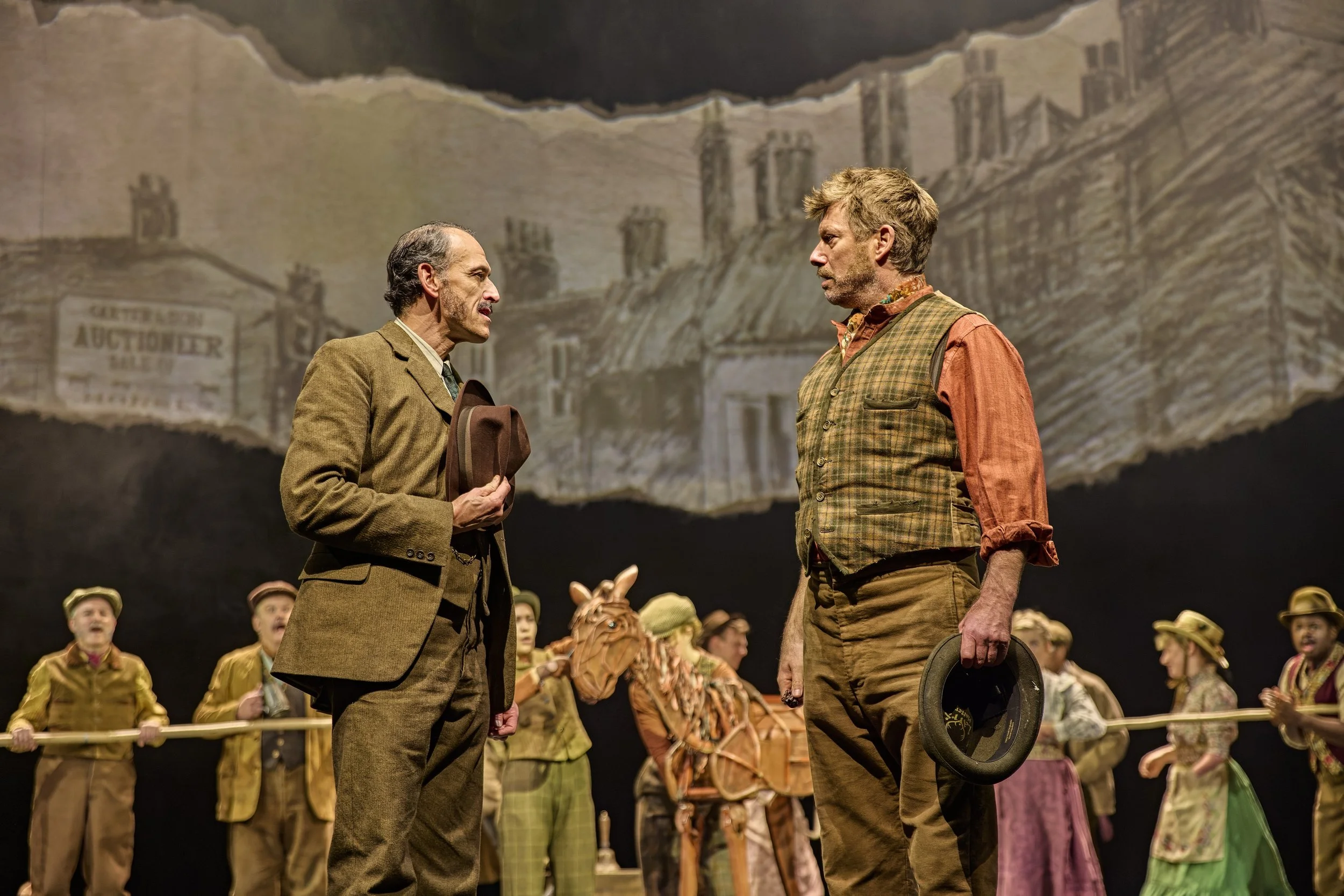
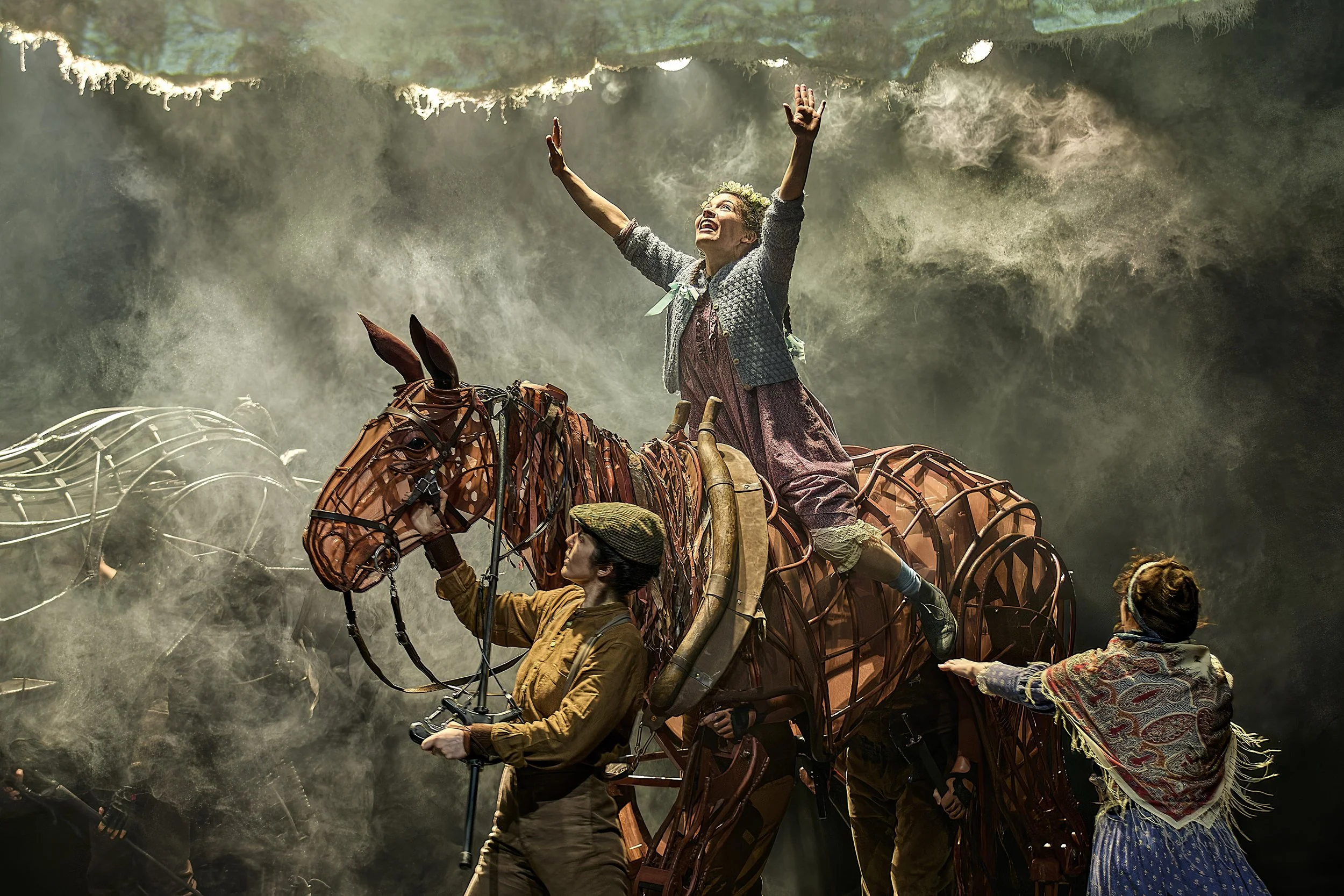
Under their guidance, Joey (Head – Wade Lewin, Heart – Niko Wirachman, Hind – Sam Goodchild) and Topthorn (Head – Alexander Donnachie, Heart – Chris Milford, Hind – Andrew Keay) flick their ears, swish their tails, and release deep, rhythmic breaths. Their melancholy eyes seem almost capable of speech. The two horses possess distinct personalities: Joey is curious, spirited and stubborn, while Topthorn is steady, dependable and dignified. Remarkably, the same puppets convey an entire emotional journey, from youthful vitality to physical suffering and decline. When Topthorn dies and the three puppeteers step away from his body, the puppet appears to revert to what it truly is: a collection of materials lying motionless on the stage. In that moment, one becomes acutely aware of how completely the performers have endowed these creations with life. Indeed, they often feel more vividly alive than many of the human characters around them.
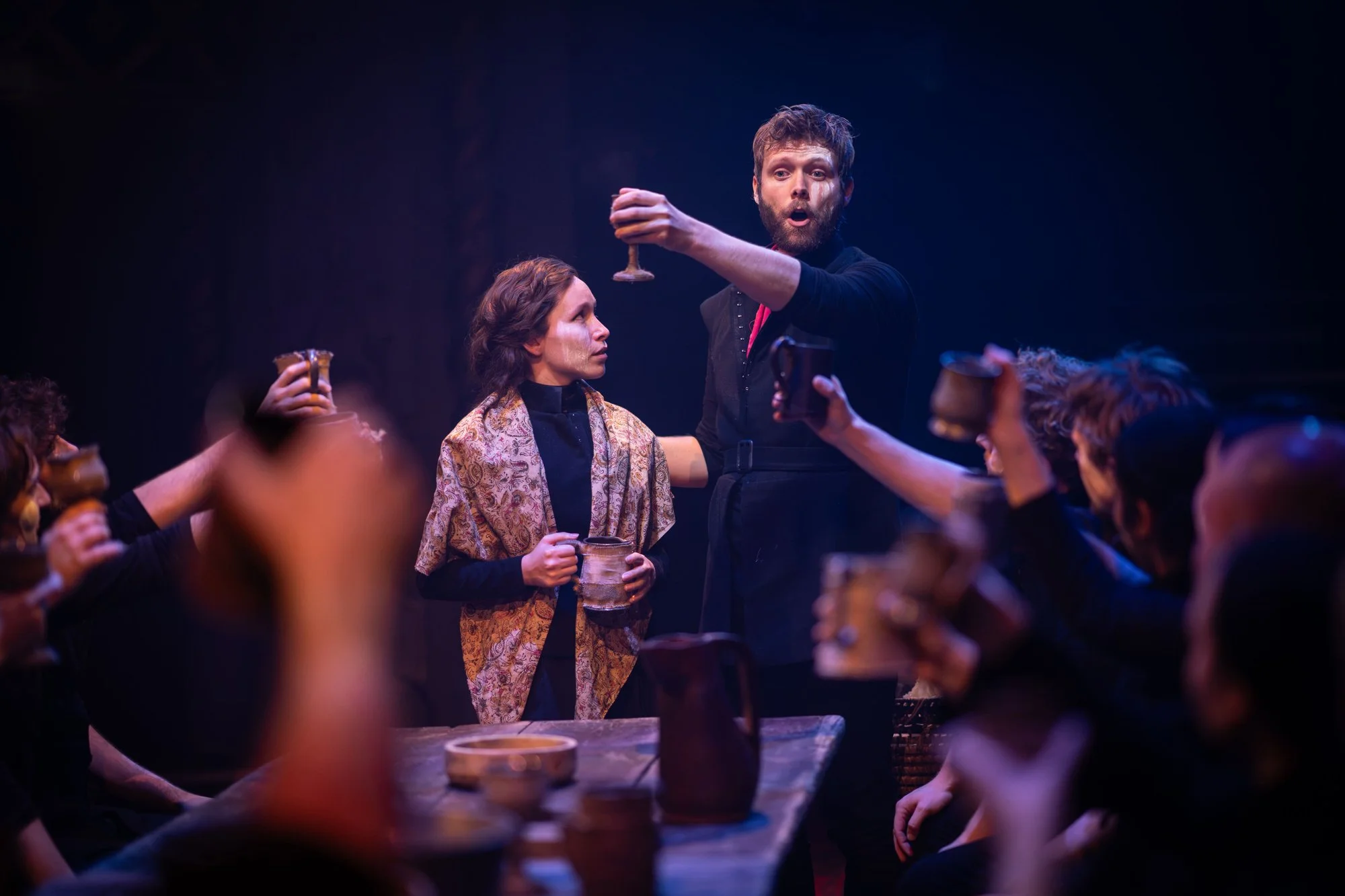
In most puppet-based productions, achieving a convincing sense of life is one of the greatest challenges. In War Horse, however, the puppets already possess extraordinary vitality. It is the script and some of the performances that pull the production back toward the framework of a fable. The pure-hearted and determined Albert (played in this performance by Owen Dagnall), his blustering alcoholic father Ted (Stephen Beckett), the compassionate Rose (Jo Castleton), and the lively French girl Emilie (Lucy Thorburn) are all defined primarily by a single dominant trait. Combined with a generally heightened emotional style of acting, this limits their sense of psychological realism. Friedrich, the German cavalry officer portrayed by Manuel Klein, offers moments of genuine emotional conflict that capture the audience’s attention, yet he too remains underdeveloped.
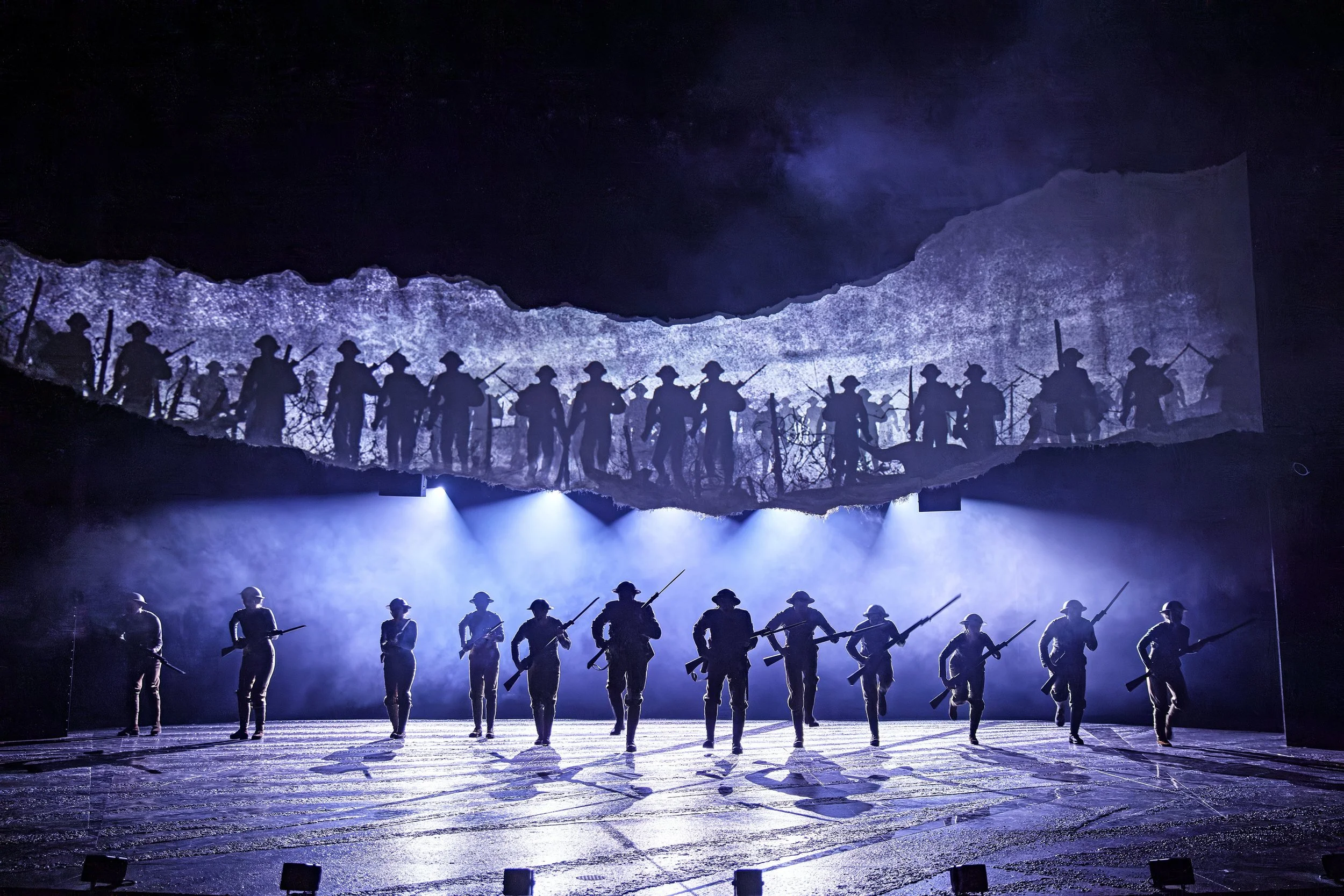
Rae Smith’s set design and Rob Casey’s lighting are among the production’s most evocative achievements. Suspended above the stage is an irregularly shaped screen that resembles a torn page from Captain Nicholls’ sketchbook. Across it are projected images ranging from rural landscapes to shattered battlefields, sometimes rendered as sketches and at other times in a more realistic style. When the action shifts to the front, the horses line up in formation. Aside from Joey and Topthorn, the other horses appear only as skeletal frames without legs, while the soldiers riding them are represented by expressionless mannequins. Together they create the impression of ghosts, as though both men and horses have become spectral casualties of war. When artillery shells strike, the stage occasionally plunges into darkness for several seconds. Later, when a tank advances toward Joey, the audience sees only the tracks, and the silhouette projected onto the screen, yet the image carries a suffocating sense of threat that is enough to make one hold our breath.
Music is another essential component of the production. In contrast to the brutality of war, there are times when the Singer (Sally Swanson) accompanies herself on accordion and performs traditional folk songs. Through these moments emerges a sense of hope, infused with rural tranquillity, peace, and gentle nostalgia. This spirit seems to take root within Joey himself, driving him again and again toward the possibility of something better.
One of the most moving scenes comes when Joey becomes trapped in the barbed wire of No Man’s Land. British and German soldiers alike wave white flags and work together to free him, sharing a brief moment of peace amid the conflict. Equally touching is the reunion between Albert and Joey, witnessed by everyone around them. Though war is cruel, War Horse reminds us that kindness exists on all sides. Through Joey’s eyes, we encounter good-hearted British, German, and French people alike. By the story’s conclusion, Joey finally returns home, but many of those who helped him along the way have been gone in the war. Although War Horse appears to be the story of a horse, it is ultimately a story about people. War itself is vast and overwhelming, but the production wisely chooses to explore it through a single life, creating an intimate perspective that is both emotionally resonant and deeply humane.
I first saw another-language production of War Horse many years ago. What remained in my memory were not the battles, but Joey, Topthorn, and even the goose that lives with Albert’s family. If War Horse could give its human characters the same depth of life that it grants its puppets, its emotional impact would be even more profound, leaving behind an even richer sense of sorrow and beauty.
War Horse runs at Olivier Theatre at National Theatre until 30th July 2026.
★★★★