Yentl at Marylebone Theatre Review
Written by Ziwen for Theatre and Tonic.
Disclaimer: Tickets were gifted in return for an honest review. All views are my own
This is the first time I have seen a work quite like this in London. Following its award-winning run at the Sydney Opera House, Yentl has arrived here. Originally a short story published in Yiddish in 1952 by Nobel laureate Isaac Bashevis Singer (titled Yentl, the Yeshiva Boy), the tale is set in a late 19th-century Polish Jewish town. In this era, only men possessed the right to an education, and their highest life's pursuit was to study the Torah and the Talmud in a Yeshiva (theological seminary). Women, on the other hand, were expected only to manage household chores and bear children. Our protagonist, Yentl, has absolutely no interest in these so-called duties. Her father recognises this and secretly teaches her the sacred texts. After his death, unwilling to accept such a restrictive path, Yentl puts on her father's old clothes, adopts the name Anshel, and enters a Yeshiva in a new town under the guise of a young man.
When discussing the creation of this story, one must inevitably mention Singer's older sister, Hinde Esther Singer Kreitman. Much like Yentl, Esther was highly intelligent and possessed a fierce desire to learn. Lacking an open-minded father, however, she was forced to marry a man she did not love and spent the rest of her life in deep anguish. In many ways, this story serves as a poignant, illusory dream dedicated by Singer to his sister. Years before this stage adaptation, Barbra Streisand spent 15 years developing the famous film version. Yet, despite its massive box-office success, Singer was infuriated by the movie, feeling it strayed entirely from his original vision.
After arriving at the Yeshiva, "Anshel" meets Avigdor. Through their intense intellectual debates, they develop a profound connection, and "Anshel" unknowingly falls in love with him. Avigdor, however, is in love with the beautiful and gentle Hodes, who seems the picture of the "perfect wife." When Avigdor's engagement falls through and he is forced to marry a different girl he does not love, he is left devastated. To keep Hodes in Avigdor's life, "Anshel" makes the drastic decision to marry Hodes herself. But things are not as simple as imagined; as time passes, Yentl's panic and anxiety mount daily, leading her to finally confess the truth to Avigdor. In Singer's original work, the story does not end happily in the traditional sense. Yentl does not revert to being a woman to live happily ever after with Avigdor; instead, she chooses to remain in men's clothing and walks toward the next Yeshiva. While Streisand’s film ends with Yentl shedding her disguise and sailing to America singing a sunny hymn to freedom—a far cry from what the author intended—this stage production completely preserves the dark, authentic tones of Singer's original work.
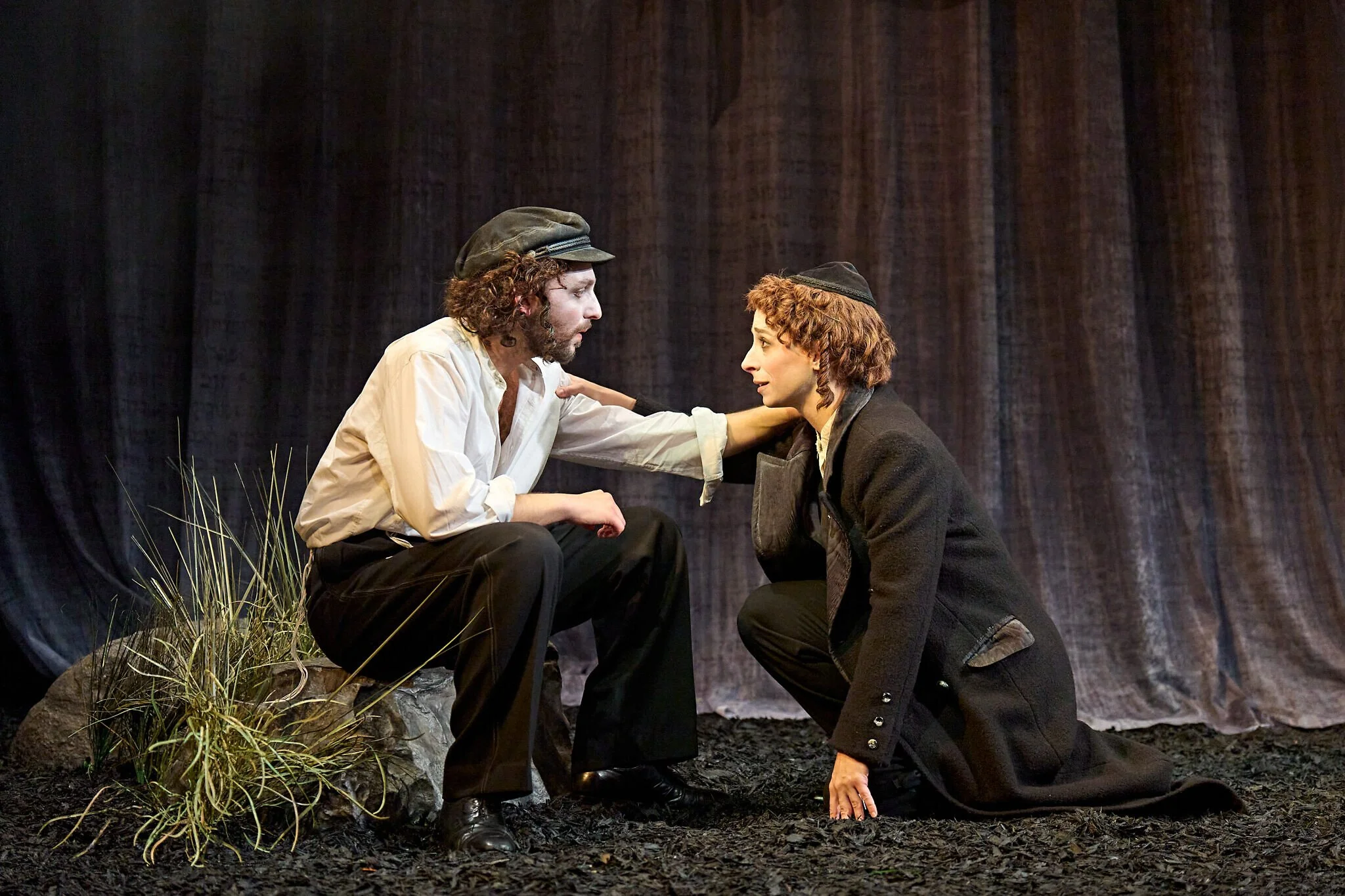
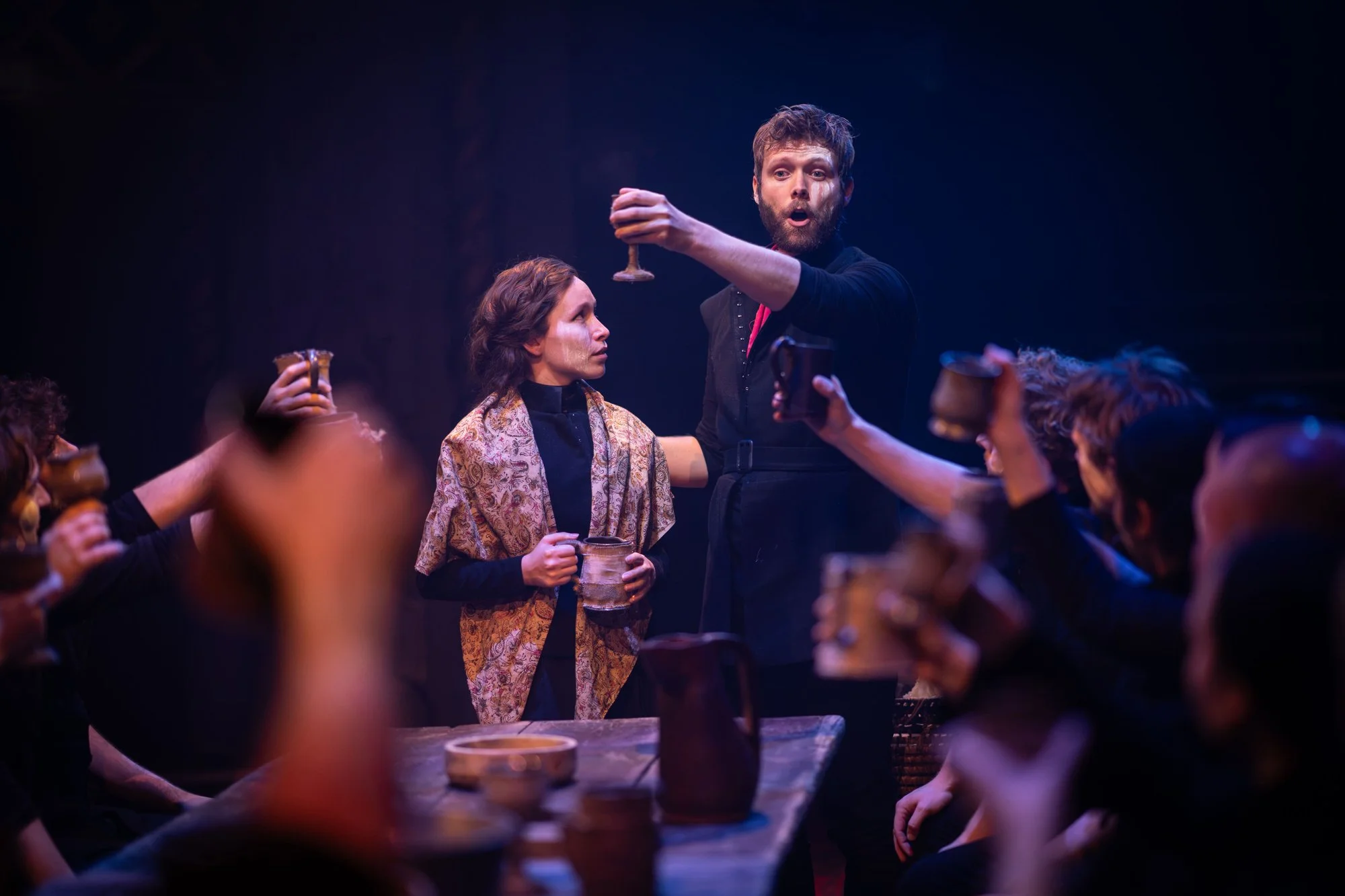
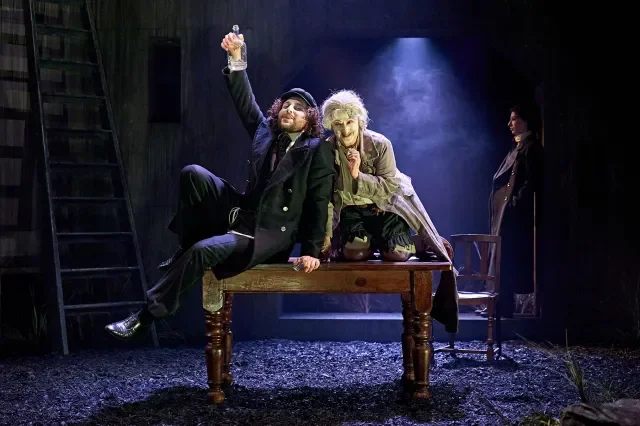
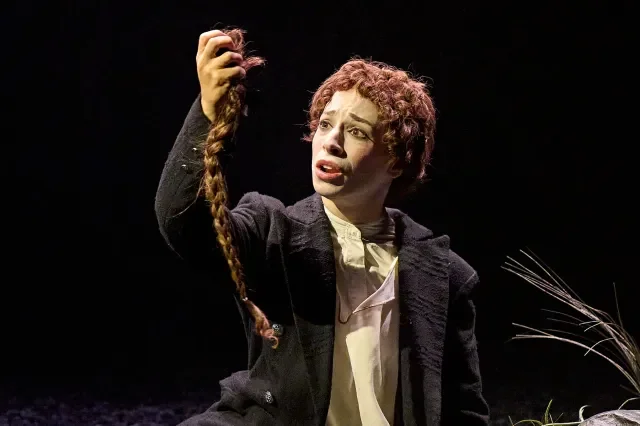
Dan Barber's stage design is strikingly evocative. The actors appear to walk on real earth, scattered with large stones and tangled weeds. At the back of the stage stands a dilapidated, towering wooden wall, featuring uneven, window-like alcoves embedded with small, illuminating lights. Most striking is a long wooden ladder leading to nowhere, while ordinary household furniture—tables, chairs, and a bed—grounds the space in domestic reality. Combined with Rachel Burke and Tom Turner’s dim lighting, the set carries a heavy, oppressive atmosphere. The actors' faces are painted with white powder, resembling masks, which heightens the theatricality and sense of the absurd.
The use of language is another unique feature of this production. Although the actors use English for most of their daily dialogue, they switch to Yiddish—the historical mother tongue of Eastern European Jews—when discussing matters of deeper, spiritual significance (a device heavily utilised by the character of The Figure). It is the language of the kitchen and the market, of lullabies and folklore: distinctly feminine, emotional, and secular. The linguistic transitions are incredibly natural; often, I did not even realise the language had shifted. When Yiddish is spoken, English subtitles are projected onto the wall in a way that feels engaging rather than intrusive. During these moments, it truly feels as though this is the characters' authentic voice.
With a cast of only four, every performance is outstanding. Amy Hack's Yentl is intelligent, bold, and driven by a fierce passion for learning. The absolute highlight is her confession to Avigdor; her emotions, though initially restrained, eventually pour out, making it impossible to watch without being gripped. Ashley Margolis's Avigdor is sincere, humorous, and wonderfully grounded. Genevieve Kingsford's Hodes is sweet and lovely, yet beneath her docile exterior, one senses a sharp mind, even if she never dares to dream beyond societal confines. The chemistry among the trio is palpable, making their dynamic utterly compelling. Finally, Evelyn Krape's The Figure exudes a distinct otherworldly presence; her eerie humor commands attention.
While the play may not be utterly gripping from start to finish—the exposition-heavy first act feels somewhat flat compared to the far more shocking and powerful second act—it still offers a deeply worthwhile experience. It is bold, impactful, and steeped in a distinct cultural atmosphere while brimming with universal human emotions. Whether capturing the anxiety of Yentl and Hodes's wedding night or the surging emotions of Yentl's confession, the production draws the audience instantly into the characters' inner lives. If there is room for improvement, the Figure currently functions a bit too much like a standard narrator. I would have loved to see her take on a more profound, integrated role with stronger ties to the characters, leaving a more lingering impact. Even so, I deeply appreciated Yentl's ultimate choice at the play's conclusion: choosing the path she has always championed over traditional romance. I believe this is exactly what Singer intended to express.
Yentl plays at Marylebone Theatre until 12th April 2026.
★ ★ ★ ★