A Midsummer Night’s Dream at Regent’s Park Open Air Theatre Review
Written by Liam Arnold for Theatre and Tonic
Disclaimer: Gifted tickets in exchange for an honest review. All views are our own
There are few plays more perfectly matched to Regent’s Park Open Air Theatre than A Midsummer Night’s Dream. As dusk settles over the trees and birdsong mingles with Shakespeare’s verse, the venue itself does much of the heavy lifting, inviting audiences into a world where reality and fantasy naturally blur. It makes for an enchanting beginning, and raises expectations that this production will fully embrace the magic of its surroundings.
Atri Banerjee’s staging, however, takes a surprisingly different path. Rather than allowing the park to become the forest, Naomi Dawson’s design places almost all of the action upon a vast, stepped wooden structure bearing the words “This Green Plot”. The decision feels intentionally theatrical rather than naturalistic, but it comes at a cost. Much of the greenery that makes Regent’s Park such a singular venue is obscured, replacing one of London’s most evocative stages with a set that recalls Jamie Lloyd’s Evita more than an enchanted woodland. It is a concept that never quite justifies itself.
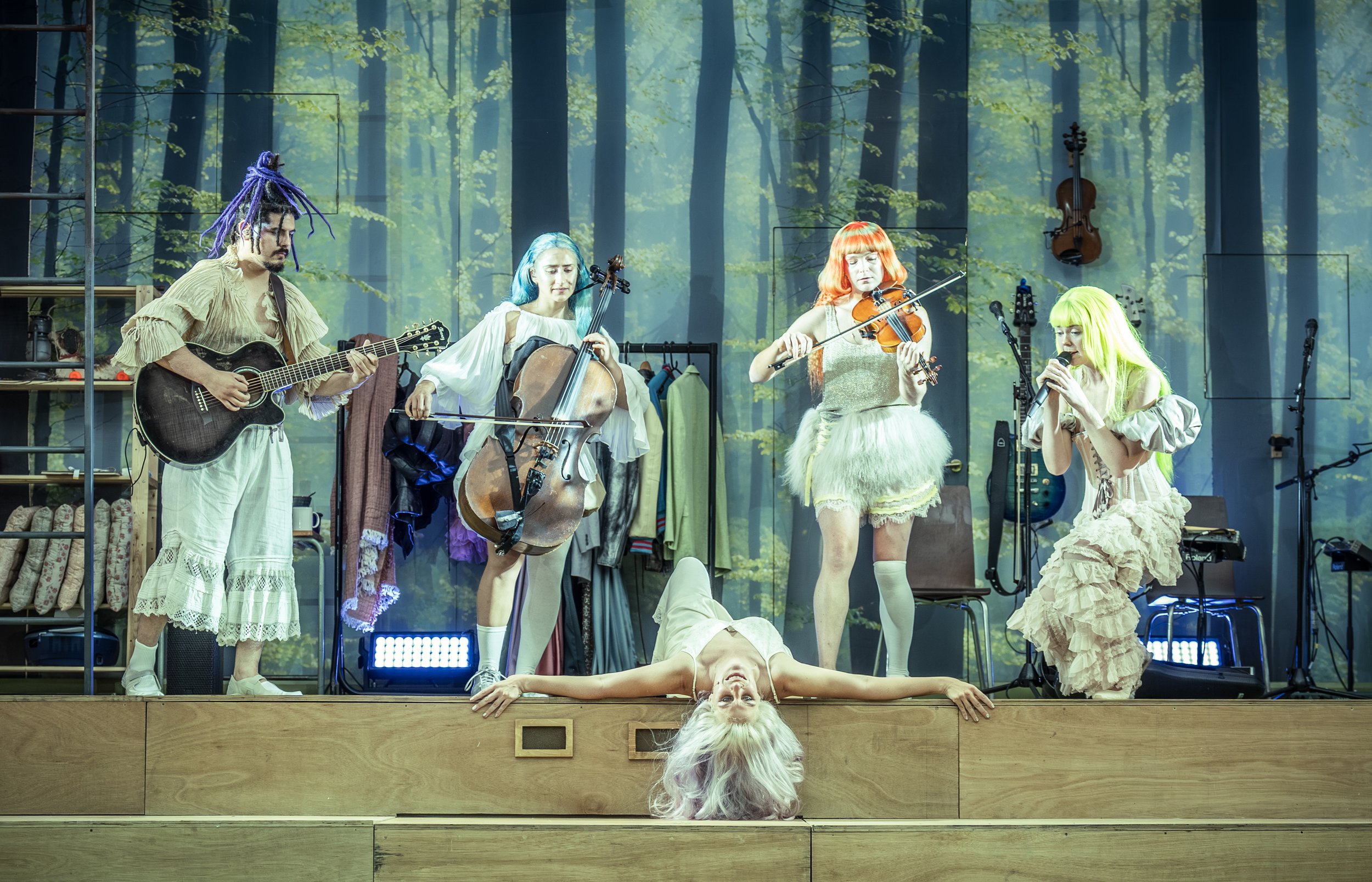
Where the production finds its strongest identity is in its music. Maimuna Memon’s folk-inflected score lends the evening a hazy 1970s rock sensibility, with Titania’s fairy entourage transformed into an onstage band whose live performances frequently blur the line between play and gig. The music is atmospheric and beautifully performed, particularly by Amelia Gabriel’s ethereal Mustardseed, while Max Pappenheim’s sound design cleverly allows the theatre’s natural birdsong to merge with the production’s own soundscape. Yet the musical interludes are sometimes so extended that they interrupt rather than deepen the dramatic momentum.
The performances are similarly uneven. Nadeem Islam brings enormous warmth and physical precision to Bottom, using British Sign Language alongside speech to create a richly expressive performance full of generosity and humour. His comic instincts are impeccable, and the production is at its most engaging whenever the Mechanicals take centre stage. Mary Malone is equally memorable as Helena, mining genuine comedy from the character’s desperation without ever reducing her to caricature.


Elsewhere, though, the production struggles to distinguish its many overlapping worlds. The lovers, royals and fairies often share a similar contemporary energy, leaving little sense of hierarchy or transformation once the action moves into the forest. Tomás Palmer’s costumes intentionally blend period flourishes with modern dress, but without a clear visual language, the different groups frequently blur together. Shakespeare’s carefully constructed web of mistaken identities becomes more confusing than delightfully chaotic.
Banerjee introduces contemporary asides and fourth-wall-breaking moments that often raise a smile, but they occasionally undercut the dreamlike atmosphere the production is trying to cultivate. Likewise, the choice to incorporate BSL selectively feels less fully integrated than it might have been, making an otherwise thoughtful piece of inclusive casting feel isolated rather than foundational to the production’s language.
What ultimately proves elusive is the sense of enchantment. A Midsummer Night’s Dream can survive bold reinterpretation provided it retains its emotional and comic clarity. Here, despite strong individual performances, an inventive musical palette and the incomparable setting of Regent’s Park itself, the production never quite casts its spell. There is plenty to admire, particularly in its commitment to accessibility and live music, but the evening remains more intellectually interesting than emotionally transporting.
When the sun dips behind the trees, and the final applause rings through the park, it is the venue that lingers longest in the memory rather than the dream that unfolded upon its stage.
A Midsummer Night’s Dream plays at Regent’s Park Open Air Theatre until 18 July.
★★★



![Smalltown Boy [Workshop Presentation] @sohoplace review ](https://images.squarespace-cdn.com/content/v1/63734f8309e2800b55c9fc71/1773502586939-V5TN2WXJEBOUJNADRRLD/smalltown_boy_workshop_performance.jpg)