Cable Street at Marylebone Theatre Review
Written by Ziwen for Theatre & Tonic
Disclaimer: Gifted tickets in exchange for an honest review
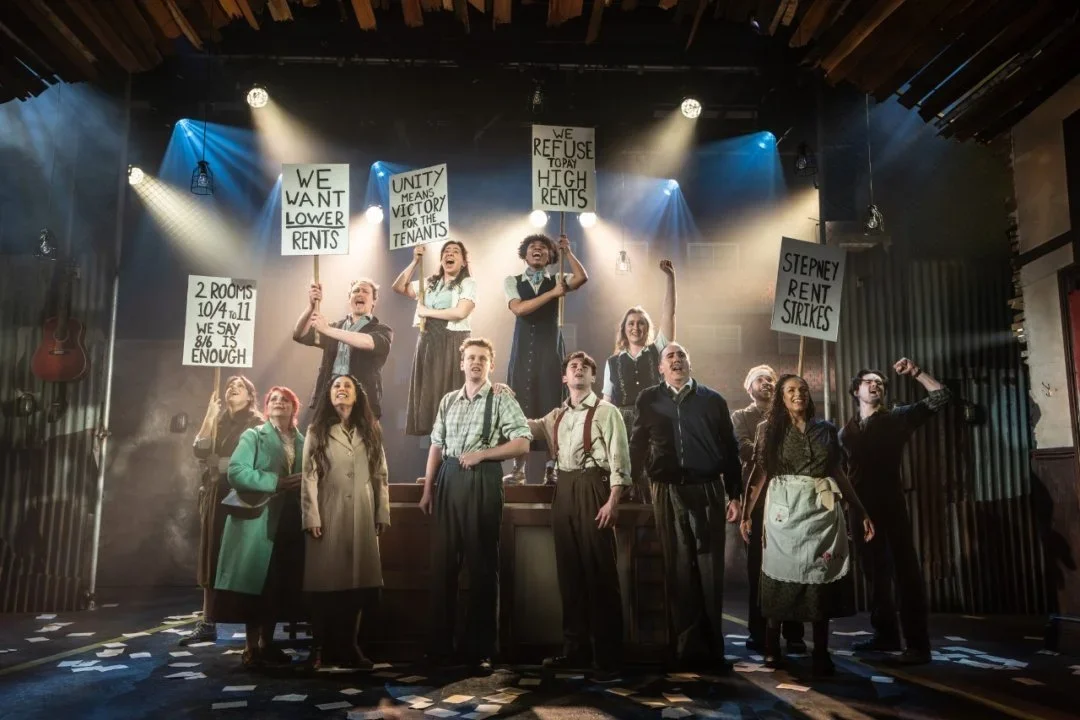
On October 4, 1936, as the British Union of Fascists began to march in East London, people, one after another, stood up and built street barricades. The Jewish youth Sammy, who possesses strong convictions (played by Michali Dantes during this performance date); the Irish girl Mairead, who works in a bakery and wants to become a poet (Lizzy-Rose Esin Kelly); and the confused young Englishman Ron, who cannot find a job (Barney Wilkinson), all face their own choices. This is the story told by the musical Cable Street. After two rounds of performances at Southwark Playhouse last year that were completely sold out, it has once again returned to London. This musical is adapted from real events, with Music and Lyrics by Tim Gilvin, Book by Alex Kanefsky, and direction by Adam Lenson. However, the current Cable Street may not yet have brought out its full potential.
Yoav Segal’s stage design is very well suited to the background of Cable Street. Most of the items on stage are made of wood. At the top of the stage are uneven, broken old wooden planks inlaid together, resembling a roof. At the back of the stage there is a building which windows and doors can be clearly seen, and further in the distance, one can also see the silhouette of another wooden house. On each side of the stage there is a wooden door, and the tables and chairs placed on the stage are also all made of wood. The lighting throughout the performance (Sam Waddington / Ben Jacobs) is quite cool in tone, carrying a faint sense of history. Throughout the entire performance, there is a piece of design that I especially like. Two or three actors hold the head, neck, front body, and two front legs of a wooden puppet horse. And when an actor stands on a raised position behind the horse, it really looks as if he is riding it, running toward the crowd.
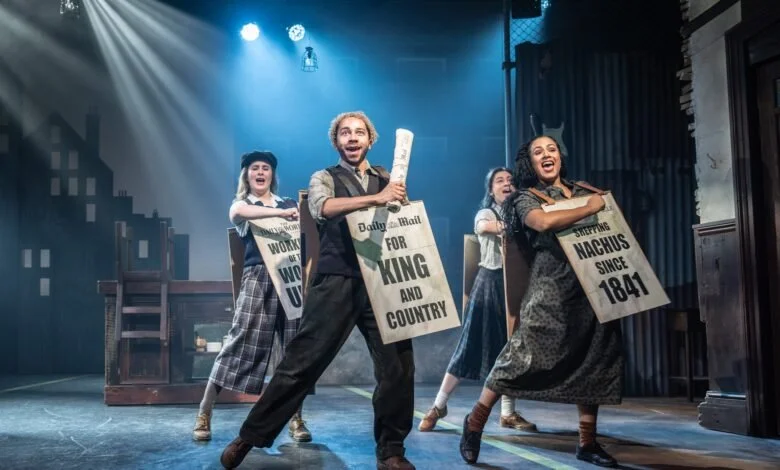
However, no matter how outstanding the stage design may be, the core of a theatrical work is still its story, and the story of Cable Street is somewhat weak. Although choosing three characters in different circumstances as simultaneous protagonists is an interesting decision, none of the characters is developed in sufficient depth. The motivations behind their actions are either unclear or overly thin. For example, Ron’s suffering is mainly expressed through repeated lines stating that he cannot find a job, while Mairead, who wants to become a poet, only allows the audience to learn about a single poem she has written from beginning to end. The families of the three characters also seem to exist merely for the sake of existing, making it difficult to clearly describe what each of their family backgrounds is actually like. Moreover, an excessive amount of modern narration is inserted into an already insufficiently clear storyline, disrupting the rhythm of the story.
There is, in fact, quite a lot of good music in this show that can draw the audience along with the characters, such as “Let Me In”, “No Pasaran”, “Only Words”, and “Stranger / Sister”. However, much of the time these songs feel disconnected from the plot. One important aspect of musical theatre is allowing characters to begin singing when emotions overflow from them and can almost no longer be expressed through words alone. Yet in this production, many times before a song begins, the characters’ emotions have not actually reached a point that calls for singing. As a result, the actors have to move directly into a singing emotional state, which makes it very likely that the audience cannot keep up in time with the characters’ sudden emotional shifts.
Read more: Interview with the cast of Cable Street at Marylebone Theatre
There are only thirteen actors in total in this production, two of them also serve as musicians on stage. Michali Dantes is very likely performing the role of Sammy for the first time. Under these circumstances, he has already done quite well, but he may need more time to find the distinctive personality of Sammy that belongs to him. Lizzy-Rose Esin Kelly’s Mairead is passionate and surging with energy at all times. Among the three protagonists, the most outstanding is Barney Wilkinson’s Ron. He is simple, gentle, and appears to be nothing more than a young man who has lost his way and does not know what to do. His performance in the scene on the rooftop is especially worth paying attention to. In addition to the three protagonists, Jez Unwin’s performance is also prominent in the show. He plays the tour guide Steve, the leader of the British Union of Fascists, and Sammy’s father at the same time, and each of these three roles is very clearly differentiated. However, it does need to be pointed out that at times in the production, one can feel that the director may not have given the actors sufficient guidance. Many times, when actors are not in the central line of the plot, they resemble background scenery rather than truly existing characters. Moreover, the actors could also try to engage in more independent thought, digging deeper into their roles within the constraints of the story, in order to make the narrative feel more real and substantial.
Cable Street has great potential to become an excellent musical, and stopping at this point would almost be a waste of such a meaningful subject that can be explored in much greater depth. The creative team should consider streamlining the existing material and then pushing the most important parts further and deeper. First of all, in order to make the story cleaner, they could choose a single central character—most likely Sammy, since he is the person who has strong connections with both Mairead and Ron—and then organically reorganise the other characters and storylines around him. From the previous press junket, it can already be felt that this creative team is made up of people who are passionate and willing to refine the story. With appropriate revisions, the next time Cable Street is seen, it will certainly be more moving, because this story contains so many elements that people can still deeply resonate with today.
Cable Street runs at Marylebone Theatre from 16th January 2026 until 28th February 2026.
★★★