John Proctor is the Villain at Royal Court Theatre Review
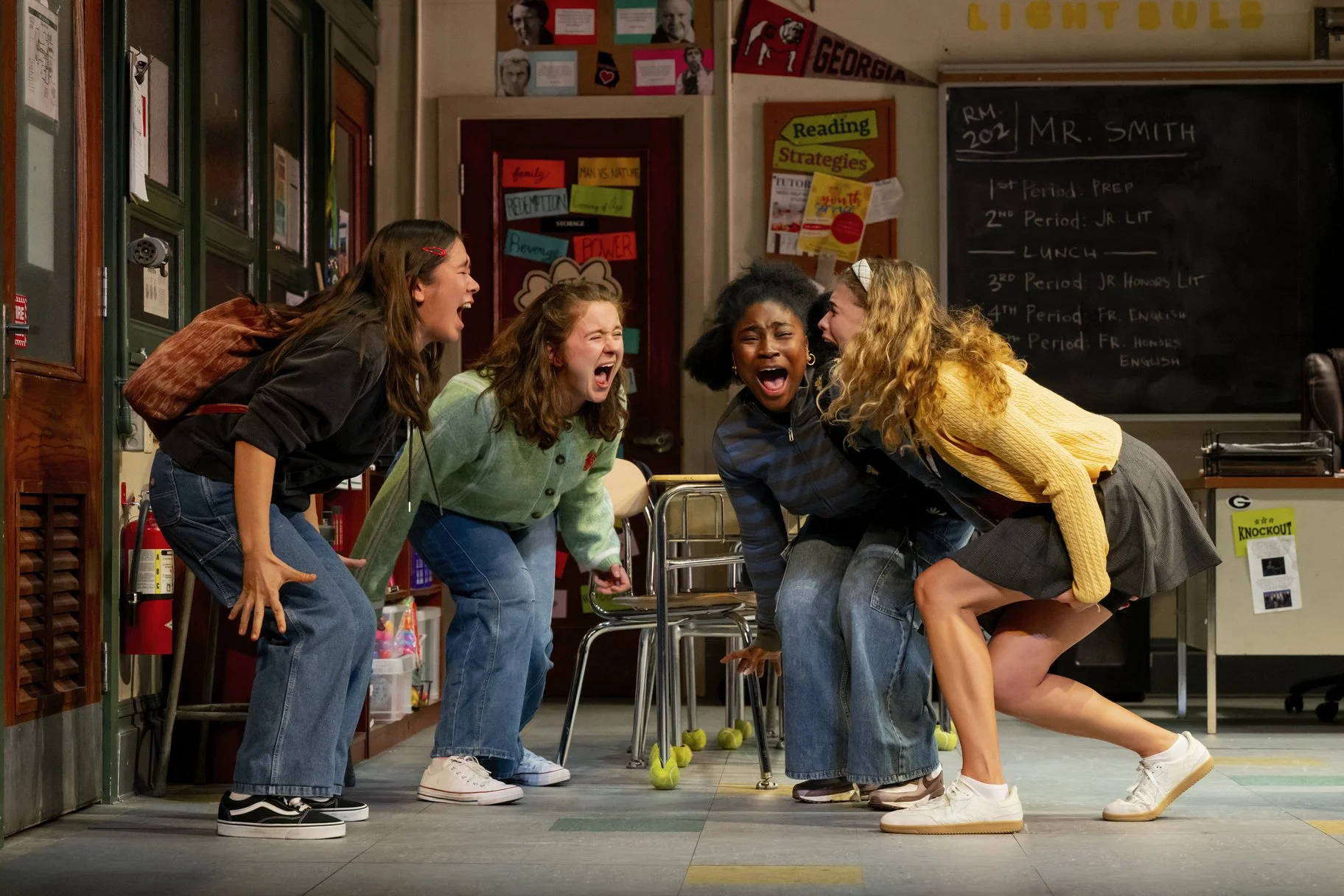
John Proctor is the Villain production image. Photo by Camilla Greenwell
Written by Ziwen for Theatre and Tonic.
Disclaimer: Tickets were gifted in return for an honest review. All views are our own
This show contains flashing lights, strobe lights, a moment of complete blackout and loud music.
The show has sensitive content including depictions of grooming and abusive relationship dynamics, descriptions of sexual assault, the depiction of a forced kiss, and racist and sexist microaggressions.
John Proctor is the Villain is a contemporary play written by Kimberly Belflower, which received 7 Tony Award nominations. Now, directed by Danya Taymor, it has arrived at the Royal Court Theatre. This story, featuring a cast of six women and three men, is absolutely not just a tribute to The Crucible. Rather, it is a feminist deconstruction and reshaping, and this process is profoundly beautiful, gentle, yet full of power.
John Proctor is the male protagonist in the American playwright Arthur Miller's The Crucible. In traditional literary interpretations, he is usually seen as a tragic hero, even though he has obvious flaws. John Proctor is a farmer. Shortly after the story begins, the audience learns that he once had an affair with the 17-year-old servant girl, Abigail. And Abigail, in order to win him back, sets off a frenzy of accusing others of being witches in the town. At the end of the story, facing his own life and death, John tears up his confession to preserve his integrity and dignity, choosing death for the sake of truth.
This character also appears in an English literature classroom at a rural high school in Georgia. This is the story of John Proctor is the Villain. The year is 2018, when the #MeToo movement was in full swing. Here, the young, handsome, and seemingly very open-minded and understanding teacher, Mr. Smith (Dónal Finn), is leading his high school juniors in studying The Crucible. In this classroom, there is the smart and well-behaved Beth (Holly Howden Gilchrist), who is always habitually apologizing; the equally smart but more reserved and humorous transfer student Nell (Lauryn Ajufo); the pastor's daughter Raelynn (Miya James), who is beginning to explore who she wants to be but remains confused; the wealthy, popular, and sensitive Ivy (Clare Hughes); the narcissistic and violence-prone Lee (Charlie Borg) (who is also Raelynn's ex-boyfriend); and the goofy but good-natured Mason (Reece Braddock). At first, everything happening in this classroom is relatively peaceful, filled with the girls' everyday discussions and jokes, but the story gradually builds to a climax with the return of the absent Shelby (Sadie Soverall).


Shelby and Raelynn have been good friends for years; however, their relationship became awkward because Shelby slept with Raelynn's boyfriend. It was after this incident spread that Shelby began a long period of absence from school. After she returns to the classroom, it is hard for both of them not to admit how much they missed each other. Meanwhile, in the literature class, a new perspective is brought up: as a grown man in his 30s, John Proctor used his power and status to seduce the unprotected, underage girl Abigail, and later abandoned her to save his own reputation—isn't such a person a villain? During this heated discussion, Shelby also reveals that the hypocritical Mr. Smith has actually been emotionally manipulating and sexually assaulting her over the past year, which is the real reason she fled the campus.
When the curtain opened, I felt as if I had returned to my own high school. The chalkboard with the schedule and reading list written in chalk, the tennis balls fitted onto the legs of the desks and chairs, the slogans and posters taped to the walls and windows, the American flag on the wall, the fire extinguisher by the classroom door, the potted plant on the desk, the sticky notes on the cabinet doors... The modest-sized stage is filled with so many details; it looks exactly like a high school classroom (Teresa L. Williams). The lighting (Natasha Katz) is so natural that it seems as if it is truly coming from the sun, just shining through the windows into this room. What is quite different is that basically after every scene, a pale beam of light takes turns illuminating the girls' faces, making them look somewhat ashen and reflecting the emotional turmoil in each of their hearts.
The entire story is actually not complicated, but the language is exquisite and full of the breath of real life. The everyday chatter of these young girls contains a natural wisdom, and I easily found myself drawn into their conversations. Regardless of their individual personalities, every girl is lovely. Watching them suddenly scream together, jump for joy over a boy's attention, and grab onto each other laughing uncontrollably, I couldn't help but smile too, and the weight upon me had also become a little lighter. And when they danced vigorously with complete abandon, I just felt that such vitality was so beautiful. In less than two hours, each character is fleshed out quite fully. Shelby, who initially seems unforgiving in people's descriptions, is actually intelligent and direct, with a bit of endearing clumsiness—bold yet vulnerable. And the young guidance counsellor Bailey (Molly McFadden), who seems rigid and strict at first, actually has a little girl living in her heart too; she is also the only adult in the play who stands up to protect the girls.
Sometimes, what moves people isn't a highly complex work, but rather a story that contains the most sincere emotions and power within its simplicity. John Proctor is the Villainis exactly that. In this story, the girls are raw and youthful, imperfect, yet so authentic that the audience deeply empathizes with them. Looking at them, I was instantly pulled back to my own high school days, unable to help but marvel at how these young kids are so fragile, exposed, and yet brimming with sunny energy. Marvelling at this, I found myself laughing along with the characters, and as I laughed, my eyes grew a little wet. It is just such a tender piece of work.
John Proctor is the Villain runs at Royal Court Theatre until 25th April 2026. The show will transfer to the West End in 2027, playing at the Wyndam’s Theatre from 2 February - 24 April.
★★★★★