Quartet In Autumn at Arcola Theatre Review
Written by Wendy for Theatre and Tonic
Disclaimer: Gifted tickets in exchange for an honest review. All views are our own
Works with so little overt drama or major plot incident are relatively rare on the British stage. Quartet in Autumn is adapted from the novel of the same name by British writer Barbara Pym, whose work is known for its sharp social observation and gentle, understated irony. After years of neglect, her writing was finally rediscovered, and she has since come to be regarded as one of the most underrated novelists of the twentieth century. The work has recently received its first stage adaptation at Arcola Theatre, adapted by Booker Prize-winning novelist Samantha Harvey and directed by Dominic Dromgoole.
The play centres on four longtime colleagues working in a London office: Letty (Kate Duchêne), Marcia (Pooky Quesnel), Edwin (Anthony Calf), and Norman (Paul Rider). As the two women approach retirement, the four continue to spend their final working days chatting over tea while sorting paperwork at their desks, yet once retirement begins, their lives seem to grow only more uncertain and directionless. In this adaptation, although we are given glimpses into the characters’ lives within the office, the production perhaps falls short of capturing them with greater emotional and psychological depth.
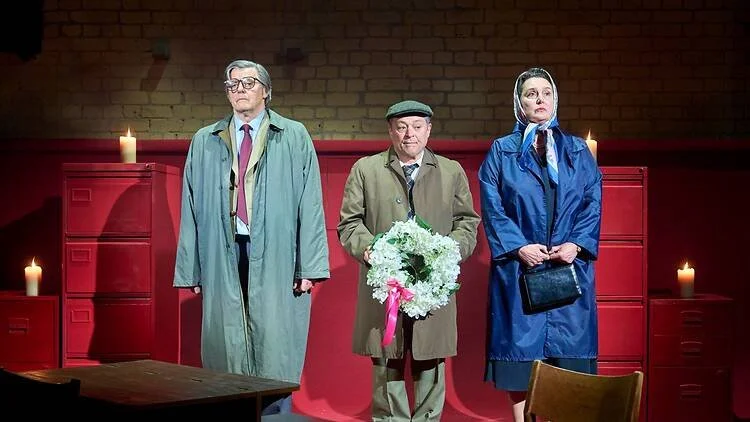
At the centre of Ellie Wintour’s red-carpeted set stand four office desks arranged neatly together. Each desk is piled with files and lit by the same dim red lamps. Against the wall sit two red filing cabinets filled with organised paperwork. Rather than creating warmth, the overwhelming redness lends the office an atmosphere that feels heavy, dated, and stagnant. A clock hangs on the wall without moving, as though suggesting that time itself has stopped for these characters. Between scenes, brief passages of violin music (Ella Wahlström) drift through the theatre, echoing the play’s title. Yet because the production is composed of many short, abruptly ending scenes accompanied by frequent blackouts, the rhythm occasionally interrupts the audience’s emotional engagement and train of thought.
Through the interactions between the characters, we gradually learn more about them. Edwin is the only one of the four who has been married, though his wife is no longer alive, and outside work he spends most of his time attending church services. Norman appears sharp-tongued and sarcastic, but this cruelty functions largely as a shield for his real emotions. Letty has planned to retire to the countryside with a friend, only to discover shortly before retirement that this friend suddenly is going to get married. Marcia has lived alone for years; her cat has died, and there are hints that her mother was severe with her during childhood. At work she dresses in carefully neat but characterless clothes, however, she is briefly glimpsed in a very different dress in private. She harbours a quiet attachment to the surgeon who performed her mastectomy. Though she barely eats, she compulsively stores large quantities of canned food.
And yet, while we appear to learn certain facts about these people, these details remain only fragments of who they are. The same life experiences could produce many different personalities, and the characters here never fully develop into vivid, fully realised individuals; they remain somewhat on the surface. Even Marcia, the most distinctive figure in the play, still feels capable of far greater exploration. The cast work earnestly with the material provided, but at times it is the actors’ own personal qualities and stage presence that fill in dimensions the script itself leaves unexplored. There are hints in the dialogue that emotional currents do exist between the characters, but these connections are neither well developed nor made sufficiently tangible. As a result, Marcia’s decision to leave her house to Norman feels somewhat abrupt. I found myself wishing for more subtle yet intimate moments revealing the delicate emotional bond between them.
A large portion of the production relies on monologues. While these speeches communicate the characters’ inner feelings directly, there are moments when stepping suddenly into a spotlight to articulate private thoughts creates a sense of disconnection from the more naturalistic exchanges that define the office scenes. It also reduces the already limited opportunities for meaningful interaction between the characters. Near the end of the first act, the four sit at their desks speaking almost in relay: before one person finishes, the next begins, each launching into their own reflections. Initially the effect is compelling, but as the sequence continues it starts to feel repetitive. In a play built around such subtle interpersonal dynamics, it is often more interesting to glimpse the characters’ inner lives indirectly through their conversations with one another.
The production is at its most natural and affecting in the small moments of genuine shared rhythm between the characters. At one point, when one person begins humming softly, the others initially react with mild confusion before gradually joining in one by one, turning it into a strangely joyful collective tune. Another lovely moment comes when Marcia irritably knocks over the tea tin and Norman instinctively catches it with practised ease, as though this exact exchange has happened countless times before in the office.
I am especially drawn to works that reveal deeper emotional truths through the quiet details of ordinary life, but such restraint requires richly developed characters capable of sustaining the audience’s attention. In the current production, we still do not know these four people well enough, nor are we fully invested in their relationships and struggles. The script contains flashes of intelligence and wit, but not quite enough to fully sustain the play. Moreover, the office is almost constantly filled with conversation. Yet in any real workplace there are also moments when everyone simply lowers their heads and works in silence. It would be fascinating to see the production make fuller use of that silence.
There is something inherently compelling about the relationship between colleagues — people who spend every day together and yet are never entirely friends, who may never fully enter one another’s private lives and yet remain quietly embedded within them. If these characters were allowed to become more vivid and fully alive, the loneliness and understated tenderness that linger at the heart of Quartet in Autumn would resonate with far greater emotional force and leave the audience with even more to reflect upon.
Quartet in Autumn runs at Arcola Theatre until 20th June 2026.
★ ★ ★