Jack The Musical at Courtyard Theatre, London Review
Written by Penny for Theatre and Tonic
Disclaimer: Gifted tickets in exchange for an honest review
In 1888, a serial killer terrorised the East End of London, murdering at least five sex workers and tormenting the media and police with letters signed by “Jack the Ripper”. The culprit was never identified, and the grisly murders have long been a source of fascination for amateur sleuths as well as the inspiration for books, films, TV series, and stage dramas. Historically, the main emphasis has been on trying to identify the mysterious killer – with an artist, an academic and even Prince Albert, son of King Edward VII, named as suspects. But more recent accounts like historian Hallie Rubenhold’s The Five have focused on the victims.
This new musical, which premiered last summer at the Edinburgh Fringe, looks at the Ripper murders from the perspective of his final acknowledged victim, Mary Kelly, aiming to shine a light on the mistreatment of women against the brutality of the murders.
As his true identity is still not known, the case of Jack the Ripper is very open to creative interpretation, and this production offers an interesting premise and an original and creative take on the Ripper murders. The play goes some way towards highlighting the fact that an anonymous killer was just one of the many dangers facing women who lived in poverty in Victorian London, but the script and delivery are not strong enough for the vision from book writer Sahar Malaika and composer/lyricist Sam Phillips to make a real impact.
In a promising start, the set design from Ted Fussel is simple but striking – the floor is printed with discarded newspapers and red ribbons form a matrix backdrop, reminiscent of both crime scene tape and the blood from the Ripper’s knife. Three rostra are used to set the various scenes, although they don’t serve much purpose – cast members climb up onto them only to jump off again for no evident reason.
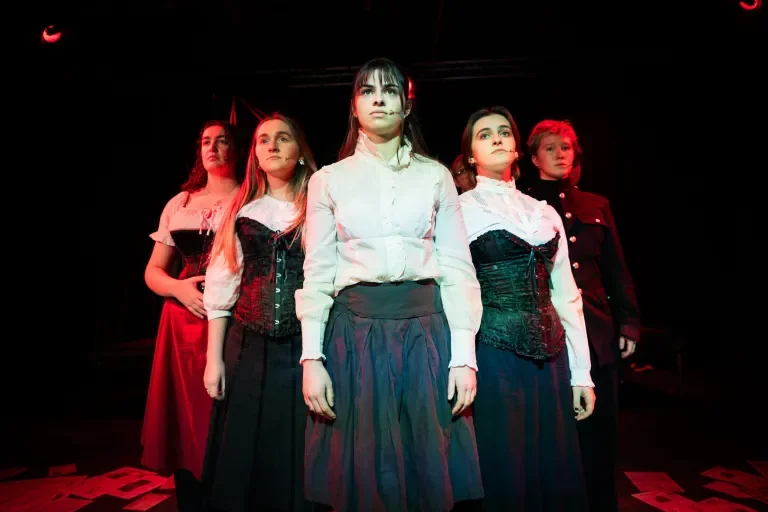
The script aims to give the Ripper’s victims a voice and does achieve this to a certain extent, with a chorus of “Unfortunates” (the Ripper’s previous victims) acting as narrators to set the scene and move the action along. They rail against the media and society’s dismissal of them as “whores”, pointing out that this is just a lazy assumption just because they live in poverty. Authority is represented by the men – a journalist, police officers and Mary Kelly’s partner, Joe, a violent drunk who falls under suspicion. The male characters are all stereotypes, they are arrogant, incompetent or aggressive. There’s no subtlety in the writing or performance and this is no bad thing as it certainly hammers the message home that the odds were very much against working class women.
The music does not add much to the production – we start with a number that sets the scene which is very clearly influenced by the hip hop juggernaut Hamilton, but with none of Lin Manuel Miranda’s sharp wit or clear narrative. The strongest musical numbers are solos or duets – not particularly moving the plot along, but offering a little more insight into some of the characters.
The biggest problem at this performance was presented by the sound balance – there are some decent singers in the company but, even with radio mics, they all struggled to be heard over an overpowering backing track with a heavy bassline and uncomfortably loud, often discordant melodies. Rather than offering light and shade in duets and ensemble numbers, the performers had to resort to bellowing in each other’s faces, in an attempt to be heard. In the slightly softer numbers, some of the singers had beautiful tone but diction was often still poor so it was difficult to hear what was being sung, meaning a lot of the narrative was lost.
Co-directed by Rosie Sutton and Sasha Ranawake, the scenes are not clearly defined, characters often feel rather one-dimensional and the simple choreography could do with more commitment and intent if it is to have an impact. However, the young cast works hard and they do the best they can with the material. There are some good performances, notably Nicole Palka, who gives a conflicted and passionate portrayal of Mary Kelly, Sorcha Ní Mheachair who, as vulnerable young Nell, has the stand out vocals in the piece well showcased in her plaintive solo, and Orla Wyatt, who shows confidence, strength and resolve as DI Alfie Foster.
As the drama reaches its shocking conclusion, the names of the Ripper’s victims are projected onto the back wall, followed by newspaper clippings and names of other women who have died over the years as victims of male violence. It’s a thought-provoking conclusion – over 100 years on from Jack the Ripper’s reign of terror, has anything really changed?
Despite its strong premise and compelling subject-matter, JACK does not deliver. It is let down by a script that simultaneously aims to take a feminist stand but also incorporates cheap laughs at the expense of the women it claims to champion. The score lacks a stand-out number and poor sound and diction makes the story difficult to follow. There is a very good idea in JACK, but it needs more development if it is to reach its potential.
JACK runs at the Courtyard Theatre until Sunday 11th January. Find out more and book here.
★★