Jane Eyre A Musical at Southwark Playhouse Elephant Review

“Do you think, because I am poor, obscure, plain, and little, I am soulless and heartless? You think wrong! I have as much soul as you, and full as much heart!” Even those who have never read Jane Eyre are likely to recognise this famous line. Written by Charlotte Brontë and first published in 1847, the novel follows the orphan Jane Eyre from a childhood spent dependent on relatives and a harsh education at Lowood School to her adult life as a governess. After arriving at Thornfield Hall to teach, she falls in love with its master, Edward Rochester. On the eve of their wedding, however, she discovers that he is already married. Though she loves him deeply, Jane chooses to leave, refusing to compromise her dignity and independence. The line above comes from the moment when, having discovered the truth, she resolves to leave Rochester and asserts her equality with him. After a long separation and a series of upheavals, the two eventually reunite and marry on more equal terms.
In 2000, John Caird and Paul Gordon brought the novel to the musical stage, with their adaptation opening on Broadway and receiving five Tony Award nominations. Twenty-six years later, the production has finally arrived in the UK for the first time, directed by John Caird and Megan McGinnis. It does not take long to sense the strong presence of the original novel throughout this production.
Upon entering the theatre, the most striking feature is the enormous, thorn-like vine curling around the edge of the stage (Morgan Large). It evokes Rochester’s confinement and the cage-like world surrounding him. Above the stage, a line is carved into the stone: “I am no bird, and no net ensnares me, I am a free human being with an independent will.” This, too, is taken from Jane’s words shortly before she leaves Rochester. Like the earlier quotation, it immediately conveys Jane’s resilience and strength of character. At the same time, it reminds us that everything taking place on stage is a reflection of the book rather than a reality unto itself. Indeed, in this production, every actor seems to function almost like a piece of the text that makes up the novel.
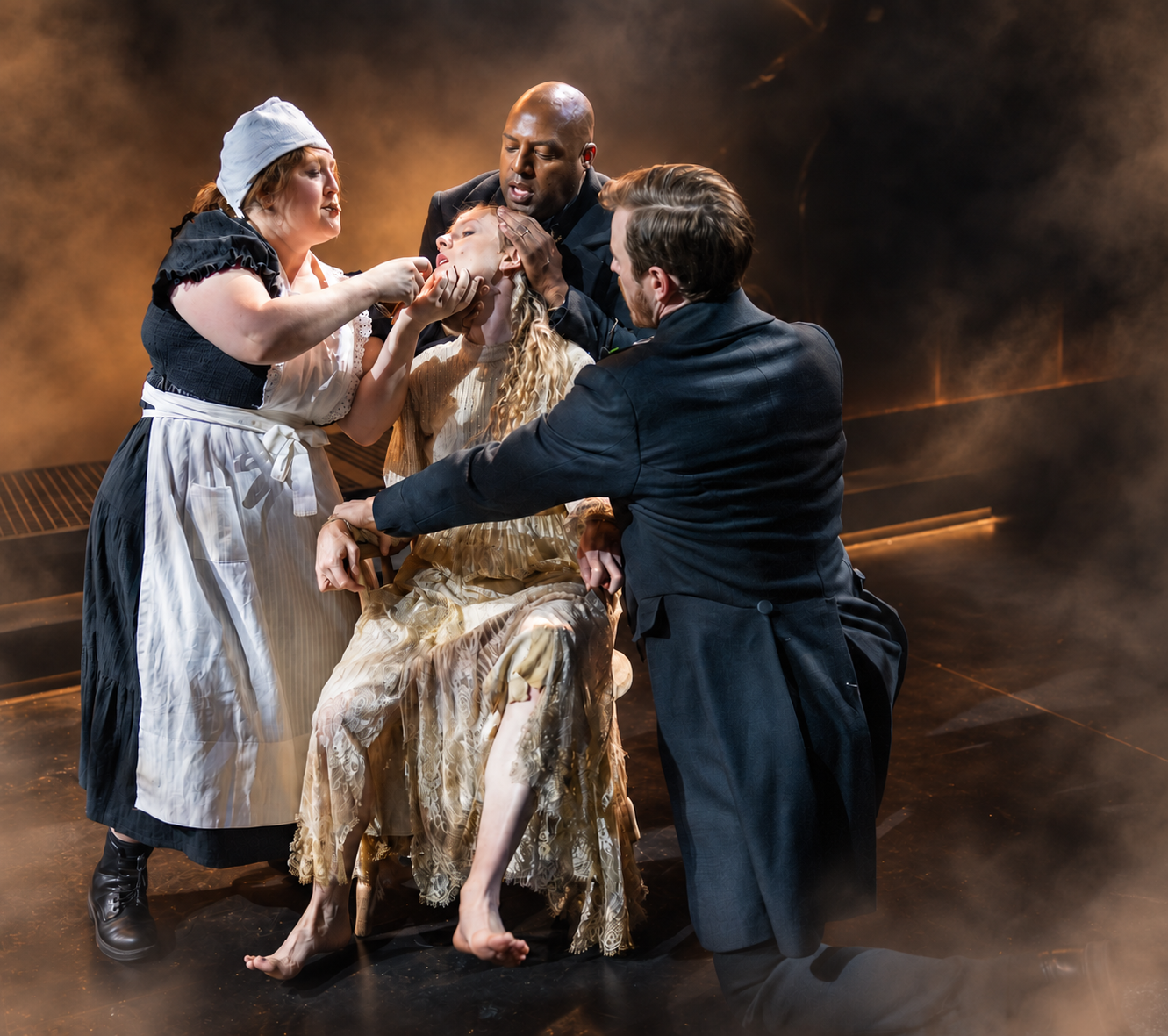
The descriptions of the book are transformed into dialogue, while Jane’s thoughts are also channelled through the people around her, together forming a complete voice. With the exception of Adèle (Emily-Rose Samuel) in a white dress, Jane (Charlie Burn) and the other ten actors are dressed in black Gothic costumes, again designed by Morgan Large. When the ensemble members take on different characters, they add ornaments in different colours to their costumes. This creates an exceptionally cohesive visual palette and reinforces the sense of the ensemble as a collective whole. It also makes Rochester’s horse, physically embodied by the actors, more convincing. Yet this visual unity also comes at a cost: Jane, the central figure of the story, is at times submerged within the ensemble rather than emphasised by it.
The timing of the adult Jane’s appearance creates a similar effect. From the very beginning of the production, we see the adult Jane already present on stage. For roughly the next twenty minutes, she watches her younger self as she endures her aunt’s cruelty, makes her closest friend at school, and then loses her. Connecting a character’s past and future can create an extremely moving theatrical moment. Yet when this period is extended and little happens between the two versions of Jane, that emotional energy begins to dissipate. Rather than having the adult Jane constantly accompany her younger self, identifying the moments when the connection between them is strongest might make those encounters more memorable. When the adult Jane appears beside her dying aunt, for example, the image of young Jane emerging in her aunt’s mind gives the scene a much greater sense of meaning.
The songs are one of the production’s greatest strengths. I particularly enjoyed the conversational quality of the writing and the delicacy with which it handles emotion. Among the many lyrical and beautiful melodies, Painting Her Portrait and My Hope of Heaven stood out to me. The former captures Jane’s insecurity, her harshness towards herself, and her pain with remarkable clarity. The latter expresses Rochester’s passionate, turbulent, forceful, and at times tender love in remarkably simple and direct language.

Given the limitations of a musical’s running time, it is understandable that some aspects of the supporting characters have had to be omitted or condensed. But when the story places so much emphasis on the central romance, the connection between its two protagonists becomes all the more important. Both performers possess beautiful voices, and neither lacks emotional intensity. Yet there remains a slight distance between their portrayals and the Jane and Rochester of the novel. Charlie Burn’s Jane is pure and innocent. Her eyes are constantly bright with curiosity and hope as she looks at the world around her. It is difficult to find in her Jane the traces of someone who endured a difficult childhood. She is a little less headstrong, a little less stubborn, and a little less accustomed to using sharpness as a means of self-protection.
Ashley Gilmour captures Rochester’s wit, passion, and tenderness very well. Near the end of the story, when he regains his sight and sees the colour of his child’s eyes, the tears that fall from him are deeply affecting. Yet his Rochester is also somewhat less troubled and conflicted. He lacks some of the pride born of self-protection, as well as the volatility and emotional unpredictability that make Rochester such a difficult and fascinating character in the novel. The subtle push and pull between Jane and Rochester is also somewhat diminished, leaving their relationship with slightly less of the ambiguity and tension that make it so compelling.
In this performance, both young Jane and Adèle are played by Emily-Rose Samuel, and her work is another highlight of the production. Her young Jane is intelligent and stubborn, while her Adèle is lively, innocent, and charming. The two girls could hardly be more different, yet Samuel brings both of them vividly to life, giving each a distinct sense of energy and presence.
Another minor reservation about this performance is that the storytelling could occasionally use a little more room to breathe. One event follows another in quick succession, and often, before a character has had time to settle emotionally into a moment, the next song or piece of narration has already begun. This makes it difficult for the audience to follow the subtler shifts in the characters’ emotional states. Much of the information contained within the songs and dialogue risks being lost amid the continuous flow of music and words. On the other hand, when the production allows a moment of silence and reflection, it becomes considerably more absorbing.
Overall, it is a genuine pleasure to see the story of Jane Eyre brought to the London musical stage. Although it is a story born nearly two centuries ago, its emotions and struggles still feel remarkably close to our own, reflected in Rochester, whose heart is caught in the vines, and Jane, who reaches towards freedom. While the production has not yet quite reached its full potential, the delicate emotional world of the original novel is already there within it. With only a few light touches, these words from the page could become much more vivid and alive on stage.
Jane Eyre plays at Southwark Playhouse until 24th October 2026.
★★★★
Written by Ziwen for Theatre and Tonic, September 2026.