Tom at the Farm at Barbican Centre, London Review
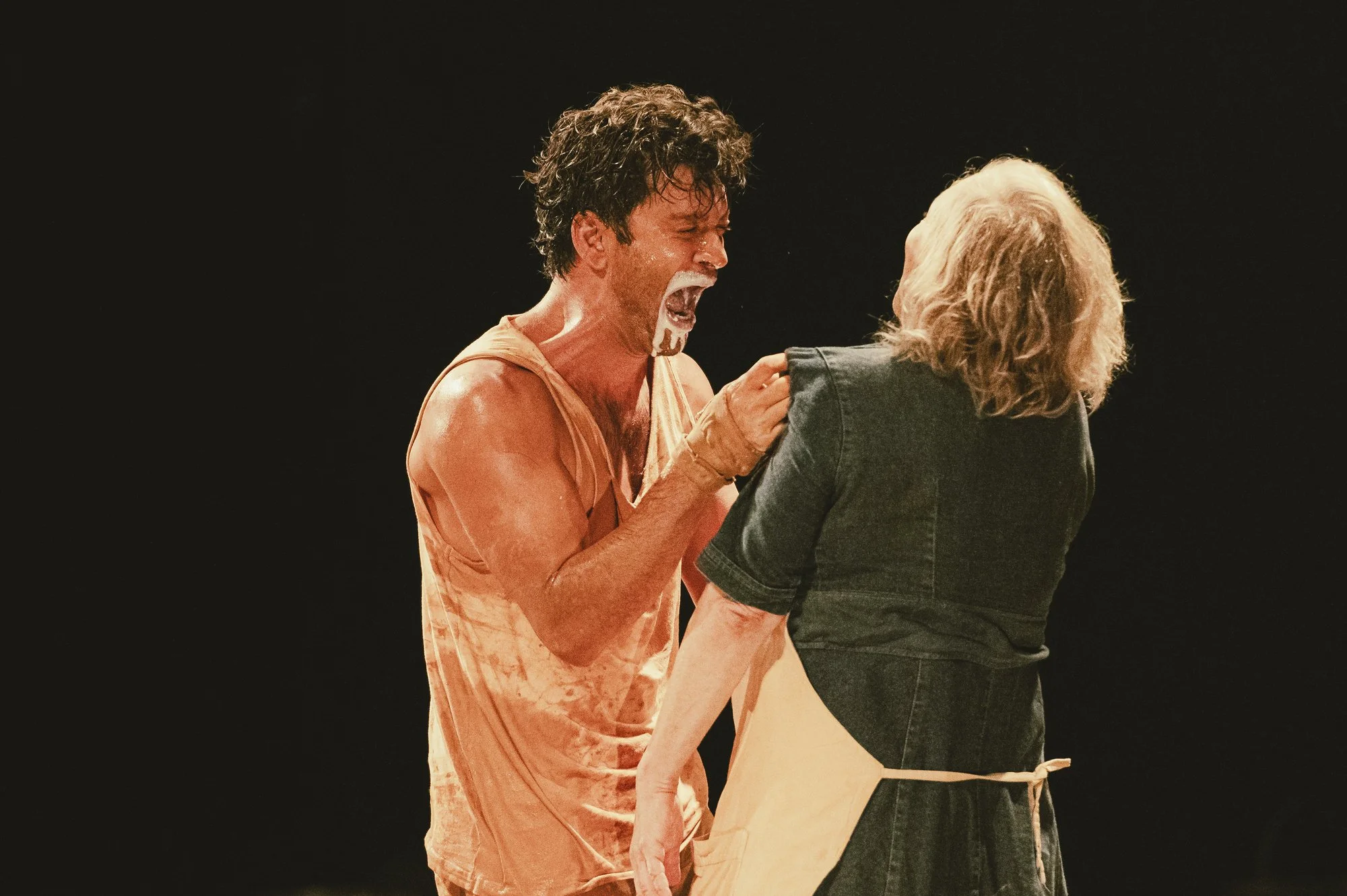
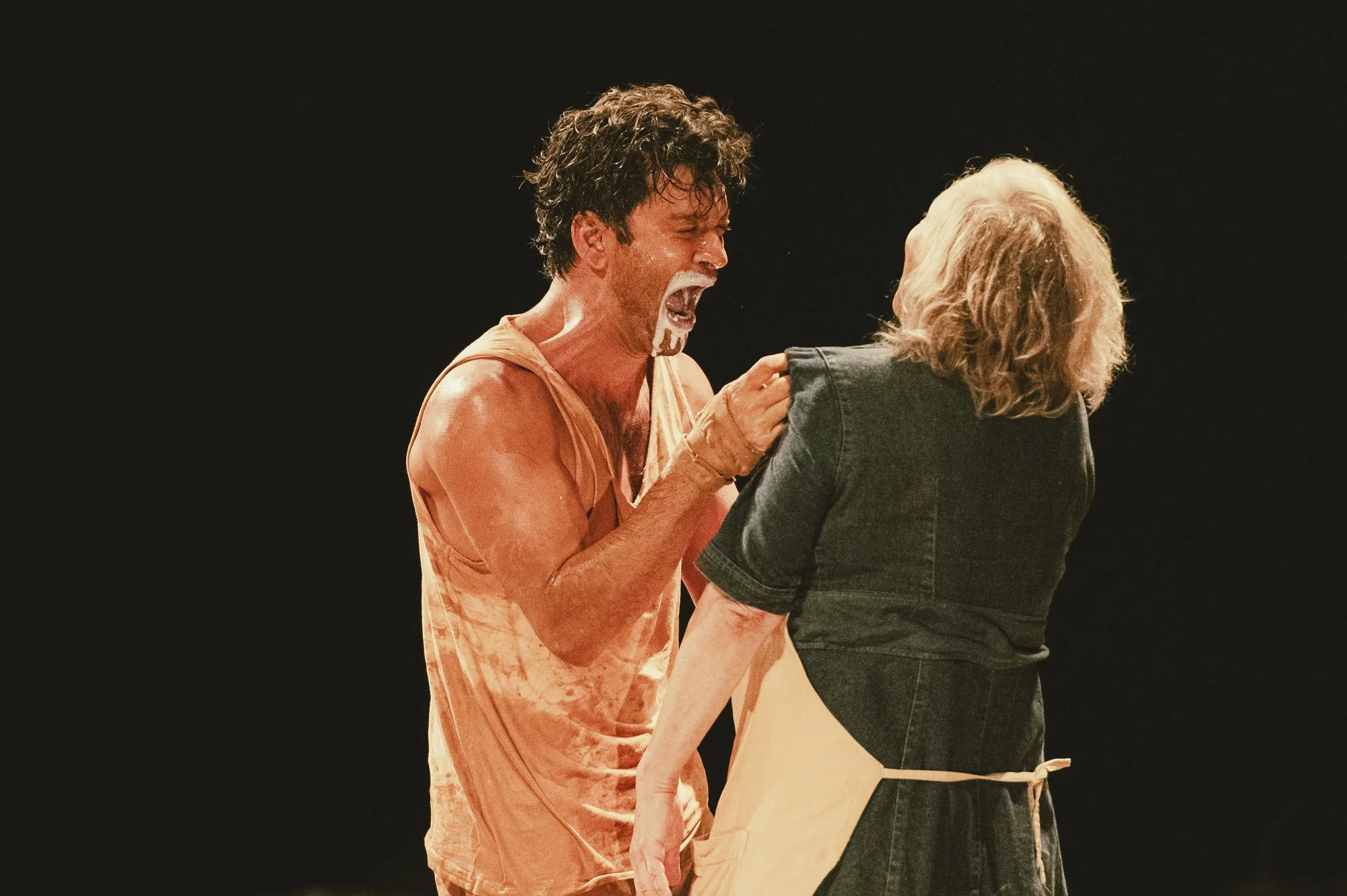
Armando Babaioff and Denise Del Vecchio in Tom at the Farm. Photo by Alex Woloch
Many people know Tom at the Farm through Xavier Dolan’s 2013 film adaptation, which he directed and starred in. Yet the work began life on the Montreal stage. Written by Michel Marc Bouchard, the play premiered in 2011. The Brazilian production currently at the Barbican Centre is adapted by Armando Babaioff, who also plays Tom, and directed by Rodrigo Portella. In an interview, Babaioff spoke of his desire to unsettle audiences, explaining, “I want to make people confused. I like to see people’s brains shaking.” While the work still has considerable potential to be explored, this production has clearly succeeded in unsettling its audience.
The story begins with Tom arriving at a remote farm to attend his boyfriend’s funeral. There, he discovers that his boyfriend’s mother knows nothing about her son’s sexuality, let alone Tom’s existence. She has always believed that her son had a girlfriend, a fiction sustained by his older brother, Francis. Keen to spare the mother’s feelings, yet under threat from Francis, Tom is forced to play along with the deception. As the days pass, Francis’s intimidation and psychological manipulation become increasingly severe. Yet Tom finds himself unable to break away from Francis. His resemblance to Tom’s deceased boyfriend draws Tom ever deeper into their fraught relationship and into the claustrophobic world of the farm.
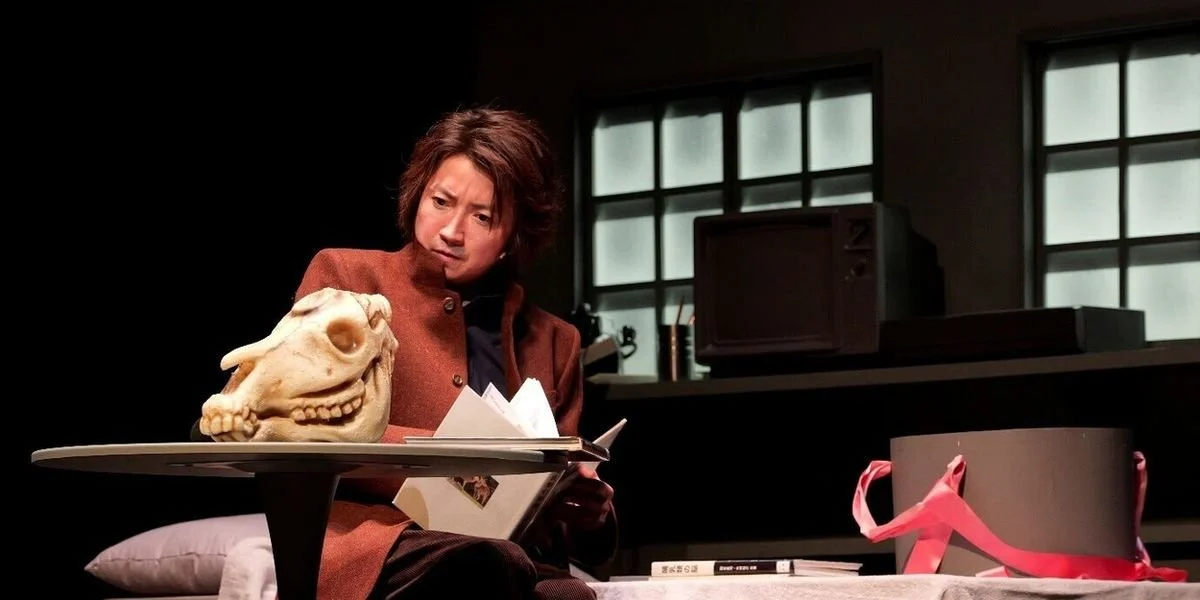
It has been a long time since I encountered a work with such pronounced strengths and limitations. The set (Aurora dos Campos) seems to possess a life of its own. A vast plastic sheet covers the otherwise bare stage, with a layer of soil spread across it. The characters wash their faces and wipe down their bodies with water from grimy buckets. The splashes darken the soil, leaving puddles of muddy water across the floor. When Tom and Francis grapple, they tumble into the dirt and roll around in the mud. The longer Tom stays on the farm, the more caked in mud he becomes, gradually merging with the landscape itself. When the red lighting (Tomás Ribas) falls on him, the mud coating his body takes on the appearance of blood. Later, even after the mud has dried, the slightest slap against their bodies sends dust rising into the air. The characters seem to have regressed to a more primal state. Armando Babaioff, Denise Del Vecchio, Iano Salomão and Camila Nhary throw themselves into their physical and emotional performances without restraint. Their cries reverberate with an almost contagious intensity.

Yet for all the production’s powerful atmosphere, its characters feel somewhat less fully realised. Their personalities could be more clearly defined, leaving some of their decisions seeming almost inevitable, as though shaped primarily by the circumstances in which they find themselves. As a result, some of their complexity and appeal feels lost. There are several moments of clever humour, though at times the comedy feels a little contrived, occasionally interrupting the emotional continuity of the characters and detracting from the story’s sense of authenticity. In a production this forceful, I found myself wishing for more distinctive characterisation, a deeper exploration of the tangled emotions between the characters, moments of intimacy that feel almost uncomfortably personal, and a richer sense of the texture of everyday life.
I watched the film before seeing the play. During the performance, I often found myself waiting for lines I remembered from the film, only to find that their delivery and timing felt quite different. Afterwards, however, I realised that perhaps I should have approached the two versions on their own terms from the outset, appreciating the distinct expressive possibilities of each medium. The film’s restraint allows anguish to simmer beneath the silences, while the stage production gives that anguish a raw, unrestrained voice. Where the film draws its power from what remains unspoken, the play finds its force in the immediacy of bodies and voices in a shared space. If the production could build on this visceral intensity while developing its characters with greater depth, it might leave audiences even more profoundly shaken.
Tom at the Farm plays at Barbican Centre until 17th October 2026.
★ ★★ ★
Written by Ziwen for Theatre and Tonic, October 2026.