Atlantis at Chichester Festival Theatre Review
Written by Stephen Gilchrist for Theatre and Tonic
Disclaimer: Gifted tickets in exchange for an honest review. All views are our own
As I write this review of 'Atlantis', a play about the prospective apocalyptic consequences of climate change, more than 300,000 people have been displaced by unprecedented, climate-driven wildfires tearing through southwestern France and central Spain.
‘Atlantis’ is a play by Emily White, as directed by Guy Jones, of, and for, our time. My generation, those of the baby boom, have been treated throughout our lives to a frightening series of potential real life catastrophes, and fictional artistic reflections of these, either warning us, or satirising world-shaking events. Think of accidental or deliberate nuclear war, (Dr.Strangelove) space rocks colliding with Earth (Armageddon), the effects range from harmless shooting stars to global mass extinctions, and now the long-term shifts in global temperatures and weather patterns altering the climate and impacting on human activities—primarily the burning of fossil fuel (2012).
Remember "When the Wind Blows" Raymond Briggs’ 1982 British graphic novel and its critically acclaimed 1986 animated film following a sweet, elderly couple living in the rural English countryside. When they hear a radio announcement that a nuclear strike is imminent, they try to prepare by strictly adhering to outdated, real-life government pamphlets like the UK's Protect and Survive guidelines.
Forgive the long introduction to this review of a powerful piece of work in which, over three generations of a family in Wales, the threat of future flooding of their shoreline bungalow is explored, and their individual responses to the likelihood of having to evacuate without compensation in an identifiable future. But the play doesn’t just fall into the category of ‘worthy’, but otherwise not necessarily ‘noteworthy’, so to speak. It is a very fine piece of work.
The most interesting aspect of the play is the usefulness or effect of individual or group protest against the cavalier and lacklustre attitude of central and local governments responding to natural threats facing its citizens. Who deserves priority protection from rising sea levels, and where and how should funding be allocated?
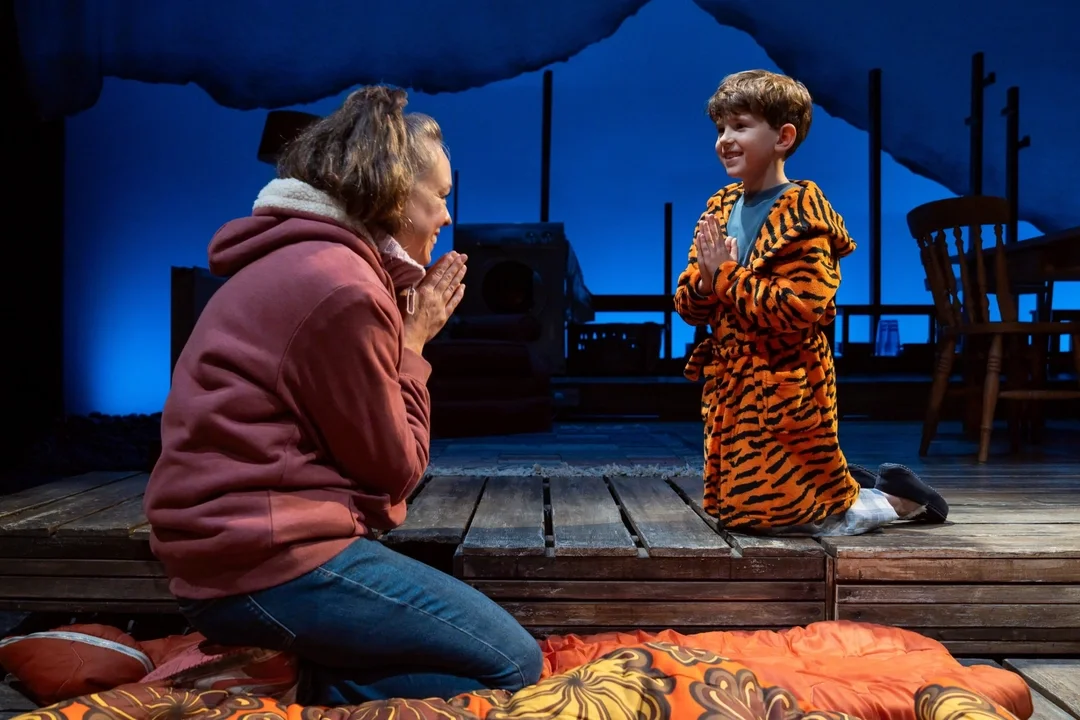
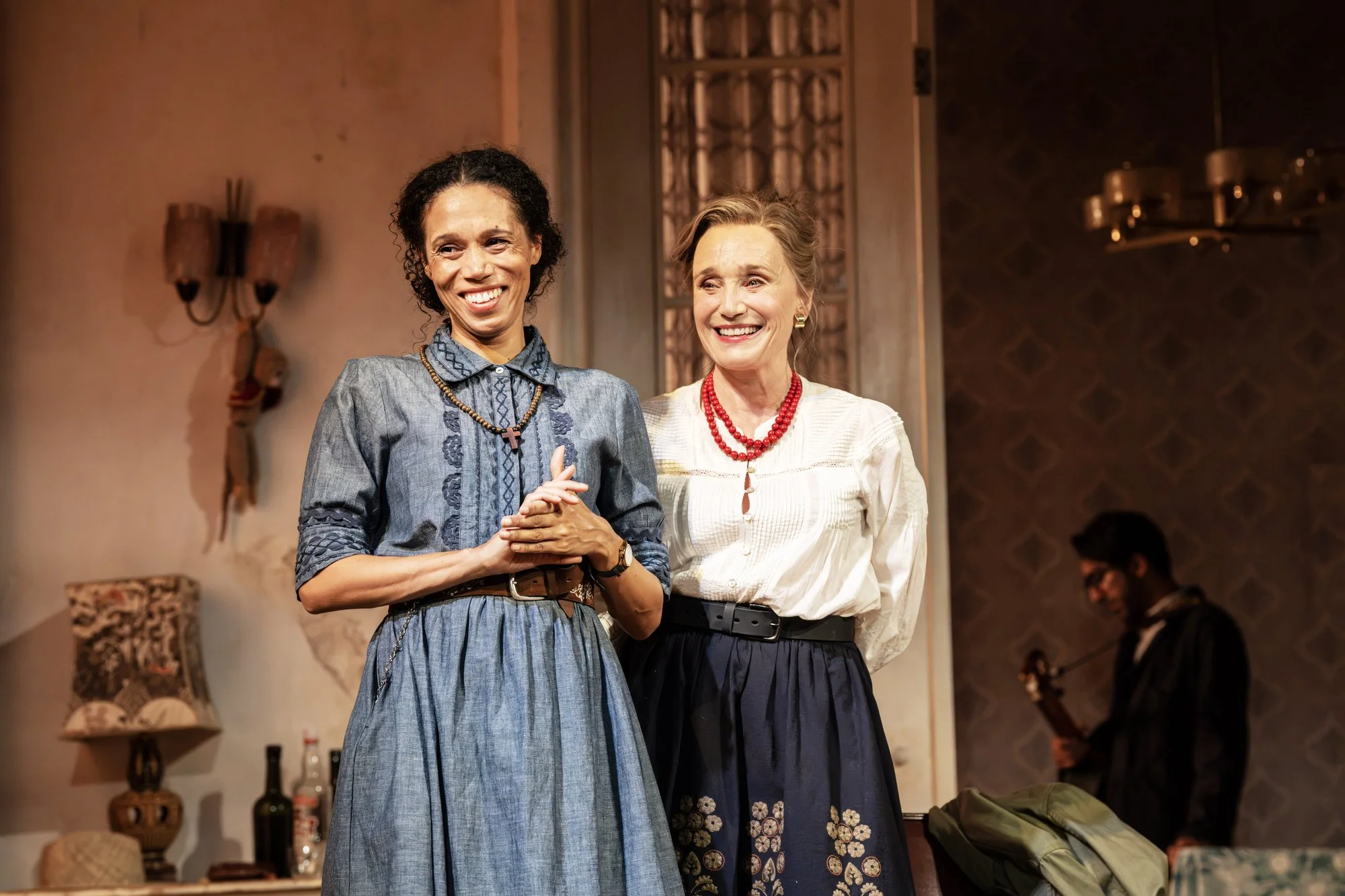
In a fine, remarkable performance, Vivien Parry is Gwen, a middle-aged hippie, at the start of the play in 2011 She is a mother and grandmother who cut her activist teeth as part of the Greenham Common Women’s Peace Camp, the legendary feminist, anti-nuclear protest that began in 1981 at RAF Greenham Common in Berkshire. Her fisherman husband, Bryn, in another excellent performance by Richard Eifyn is more pragmatic. He demands compensation and refuses to be evacuated but as the years pass becomes more and more agitated at Gwen’s yearly trek to London to go on hunger strike. By 2030, Bryn eventually collapses into a world of dementia and Gwen’s hunger strikes have a sad consequence. Meanwhile Claire (Catrin Aaron), their daughter, at the outset with young children and by the end being a grandmother herself tries to get on with her hard working life as a care worker on a minimum age without indulging herself in, as she sees it, useless protests.
Her daughter, Rhiannon, (Eirlys Lovell-Jones) becomes a crusading journalist publishing and speaking about climate change. Her lengthy absences from her family ultimately impact her relationship with them. Her brother, Phillip, (Alfie Llewellyn), settles down locally with his own son, David, and an increasingly hectoring wife, Astrid (Sara Otung.)
There is some excellent writing in this play, which opens with Gwen, wearing a long cardigan with patterns of stars and mystical signs, acting as a storyteller to her small grandchildren. The stories she tells concern the creation of the universe:
“Darkness. Look up. Look up there into the heavens, into the dark limitless expanse of space, and think back to four and half billion years ago, give or take like. Look out there in the dark at the spinning halos of cosmic dust. Do you see them?...We start in space just above the Kármán line; the official line where outer space begins, sixty-two miles above sea level … we are looking down on earth as it is now. A vast blue ocean and a familiar map of continents. Zero in on the continent of Europe, and just on its outskirts an island: the United Kingdom. And on the west coast of the island and down a bit, by here. Wales: the land of the gods …”
leading into Welsh legend:
“Cantre’r Gwaelod is the story of the lost Kingdom of Wales that lies under the sea. From where we’re sat right now, the land would have stretched another twenty miles out towards Ireland. The tree stumps of drowned forests and the stone walls of old villages, are still out there underneath the waves. When there’s an extreme low tide, you can go and see them.”
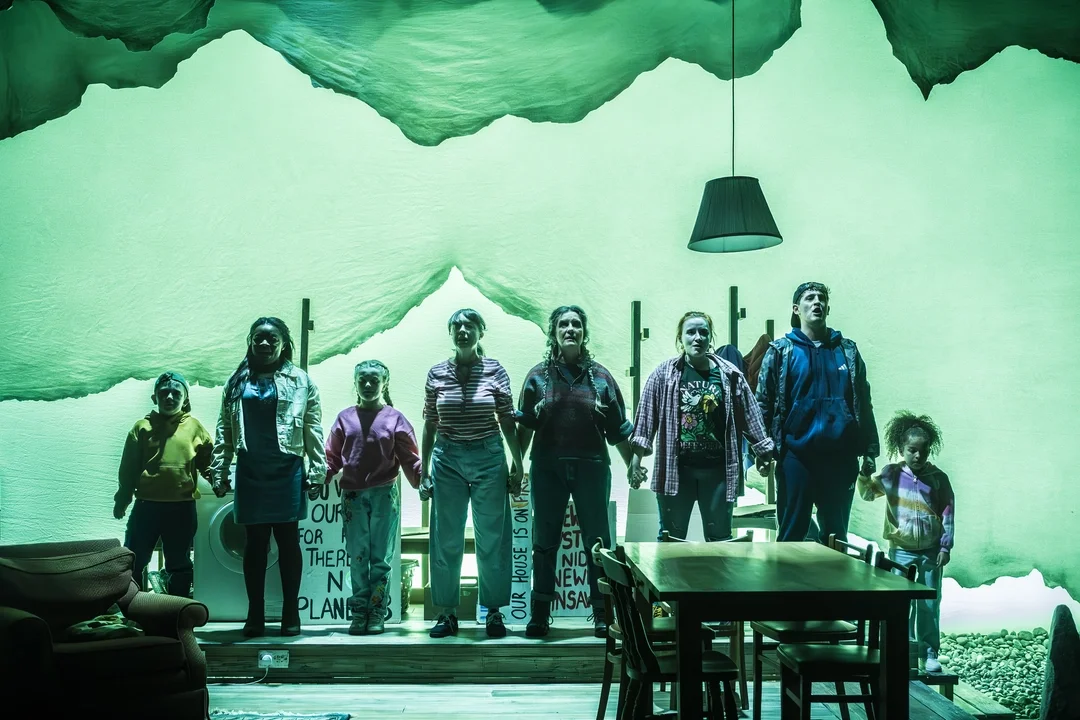
This is a wonderful and otherworldly, poetic, opening and immediately grabs the audience’s attention. There is an excellent setting By Frankie Bradshaw and some first class sound design by Holly Khan and Ate Harvey, There are occasional moments of folkloric song sung (beautifully) by the actors. It is also worth mentioning that young children are integral to the play and are performed delightfully and amusingly with a maturity beyond their years,
I cannot recommend this show too highly. Each character is sharply drawn, the plotting is tight and the author’s messaging communicated without condescension. It’s must see and a creative effort of enormous integrity.
Atlantis plays at the Chichester Festival Theatre until 15 August.
★ ★ ★ ★ ★