I’m Sorry, Prime Minister at Apollo Theatre Review
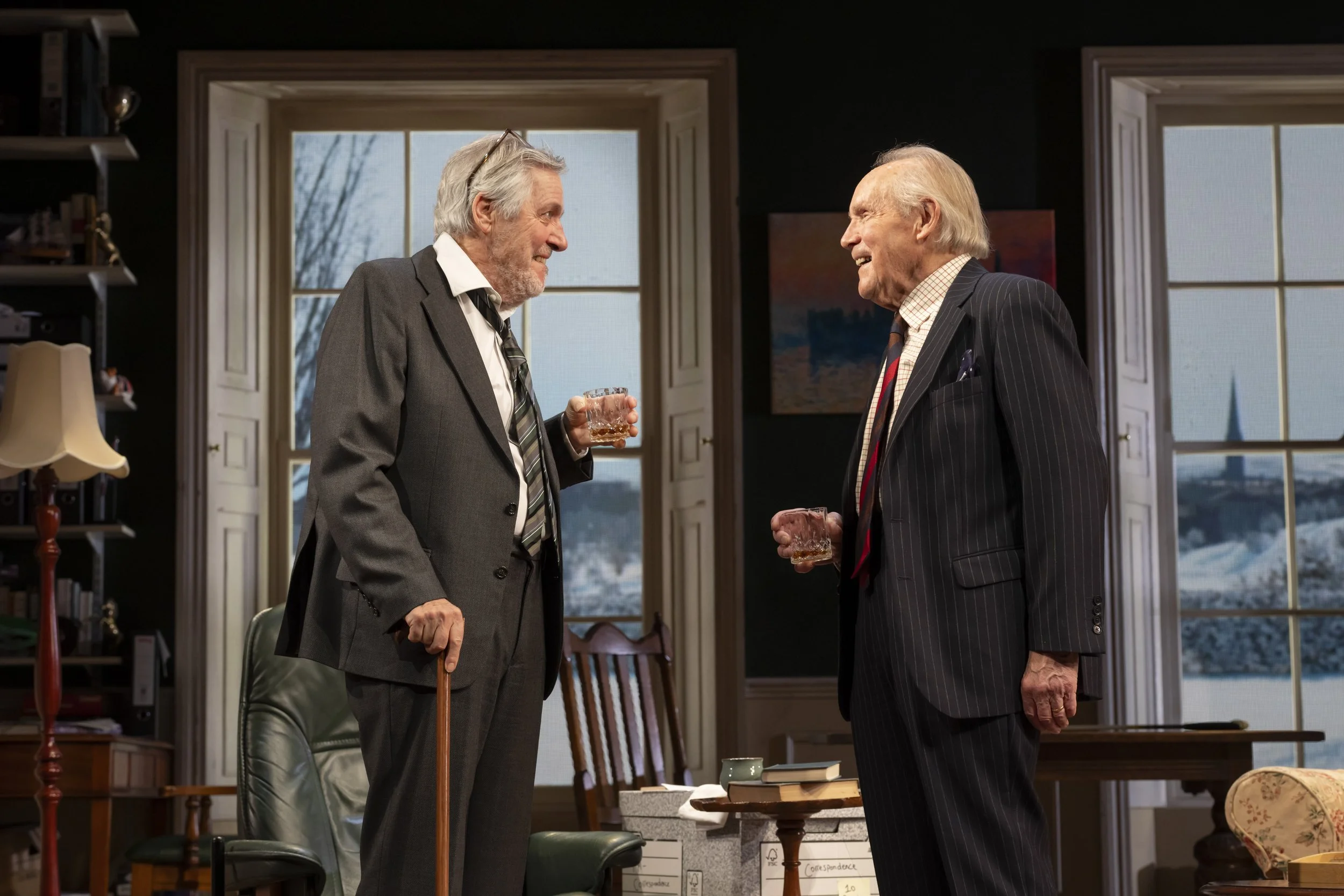
Griff Rhys Jones as Jim Hacker and Clive Francis as Sir Humphrey Appleby in I'm Sorry, Prime Minister. Photo by Johan Persson
Written by Cathie for Theatre & Tonic
Disclaimer: Gifted tickets in exchange for an honest review
The tales of Minister Jim Hacker and civil service maestro Sir Humphrey Appleby in their battles at Whitehall and later Number 10 were a defining British success of the 1980s across the 38 episodes of Yes Minister and its sequel Yes, Prime Minister. Four decades on, I’m Sorry, Prime Minister asks what becomes of these political titans in the winter of their lives, when institutional authority has faded, and legacy is all that remains.
As the curtain rises, we meet Jim Hacker as a Master of Hacker College Oxford, founded 13 years ago after dubious fundraising. He enjoys the comfort of the Master’s Lodge and the security of a job for life. Yet this privilege is under threat. His repeated misjudgements around political correctness and outdated views on empire and society have left the college eager for his resignation. So, of course, he calls his old frenemy Sir Humphrey Applebee to save the day and rescue his job from the furnace. Still razor sharp but no longer invincible, Sir Humphrey arrives with troubles of his own. His son and daughter in law, who have relieved him of home and savings in a calculated attempt to avoid inheritance tax. In contrast to these aging bureaucrats is Hacker’s care worker Sophie, a confidently capable black, married queer woman who shines in youth and quiet authority. Her moral character and strength of convictions embody a generational shift neither man fully comprehends.
The original television series, written by Antony Jay and Jonathan Lynn, is still a landmark of British political satire and so insightful that Prime Minister Margaret Thatcher permitted filming inside Number 10 itself. Its endurance lies in its precision, as the bureaucratic evasions and ministerial manoeuvrings it pinpointed in the 80s remain strikingly familiar. This new production, written solely by Jonathan Lynn following Jay’s death in 2016, honours his memory whilst reflecting on grief. The satire remains deft, but the focus shifts to the personal lives of these characters as frail old men who no longer have institutional power and titles to hide behind.
The writing is the production’s greatest triumph. There is never a dull moment, and its humour, even regarding the most sombre of occasions, including grief and loneliness, is profound and heartfelt. Retorts, witty insults and one liners land with precision, but beneath the absurdity lies genuine tenderness. Hacker and Appleby are portrayed as men grappling with fragile egos in a world that has moved on without them. They have lost their wives, their children’s respect and the authority that once defined them. What remains is fractured pride and the uneasy awareness that it may no longer be enough.
The play engages thoughtfully with contemporary politics including austerity, covid and Brexit. With the suggestion that the seeds of the 2016 referendum were sown during Hacker’s own tenure in office. Their nostalgia for the “golden years” of the twentieth century, and for Britain’s former relationship with Europe, is rendered with sympathy and irony in equal measure. Their bewilderment at shifting social values, particularly around gender, race and LGBTQIA+ rights, is observed with clarity rather than cruelty. The satire never feels reactionary; instead, it exposes the quiet panic of those left behind by the inexorable march of time. Much of this dynamic is best expressed with Sophie’s tender but exasperated reactions to the old men bickering and her adamant refusal to accept any less respect than she deserves.
This is such a powerful show because not only does it reflect a very specific point in time and our modern societal values, but it also feels timeless in its ability to connect both younger and older audiences in gales of laughter throughout. It’s two hours and fifteen minutes, are well paced across two acts and three key scenes, echoing the rhythm of the original series. Dialogue moves briskly, exchanges building with escalating absurdity before landing cleanly. The familiarity of structure is comforting, yet the emotional stakes feel newly vulnerable.
Griff Rhys Jones as Jim Hacker and Clive Francis as Sir Humphrey have large shoes to fill as the original actors have long passed, yet do so phenomenally. Both have every nuance and mannerism of the characters from the original show, yet also showcase their own subtle spin on the characters. Their chemistry together is exemplary and highly believable that they are colleagues of many decades. Griff Rhys Jones demonstrates with assured finesse, capturing the bluster and insecurity that define Hacker while allowing flashes of frailty to surface. Clive Francis delivers a superb Sir Humphrey, his labyrinthine justifications unfurling with effortless elegance and subtle condescension. Stephanie Levi-John’s Sophie provides an essential counterbalance, calm, intelligent and quietly assertive, grounding the production with modern perspectives as well as providing much of its heart. She is excellent as a mediator between the characters, much like the role of Bernard in the original series, and shines as a beautiful example of an empowered modern woman. William Chubb as Sir David “the visitor” provides excellent support and a layered presentation of modern university values.
The set and costumes designed by Lee Newby are another strength of this production. The spacious living room and disability aids add to the luxuriously comfortable retirement of Hacker and the contrast of suits and pyjamas throughout highlights the frailty of the characters well. Sound design by The Ringham Brothers and the lighting direction by Mark Henderson also work well to convey the passing of time and the general ennui of the characters.
I’m Sorry, Prime Minister is a beautiful swan song and a bittersweet farewell to two of Britain’s most enduring satirical creations. It honours their legacy while acknowledging the inevitability of change. As a gentle good night to these characters, it ends on a hopeful and uplifting message of companionship and compassion towards others. It is a perfect antidote to your winter blues and is a phenomenal satire. If you enjoy witty comedies, biting wit and heartfelt prose, then this is the show for you.
Plays until 9 May 2026
★★★★★