Last and First Men at The Coronet Theatre Review

Written by Jasmine for Theatre & Tonic
Disclaimer: Gifted tickets in exchange for an honest review
Neon Dance’s response to Johann Jóhannsson‘s 16mm black and white film ‘Last and First Men’ is a captivating example of how contemporary dance/movement can work in harmony with the material that inspires it.
This production pulls you deeper into the world of Johann Jóhannsson‘s film, through which he brought to life an unimaginable future human world. Jóhannsson’s film consists of lingering shots of post-WW2 memorials in Yugoslavia, a stunning score composed by Jóhannsson and Yair Elazar Gotman, and (perhaps best of all) Tilda Swinton’s narration of text from Olaf Stapledon’s visionary 1930 sci-fi novel that inspired the film. Neon Dance’s production amplifies the already dream like experience of watching this film; it is slow and thoughtful, which might not be everyone’s style, but which I found completely absorbing. I couldn’t look away. The sound, too, feels even more powerful - the deepest parts have you literally feeling the vibrations, and often the beauty of the score left me with goosebumps.
Adding another layer of collaboration through this dance production feels like a natural progression of the piece, and Adrienne Hart’s direction is forever sympathetic to its source material. The costume too, designed by Mikio Sakabe & Ana Rajcevic, is a stand out element of the show - it is not simply clothes to be worn whilst moving, it creates the movement, changes it, makes space for different movement languages to be created between the performers.
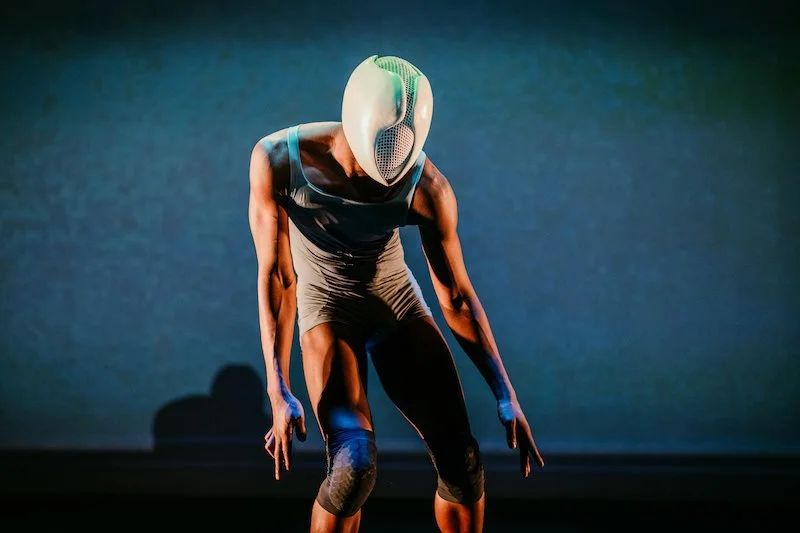
The dancers, Fukiko Takase, Aoi Nakamura, and Kelvin Kilonzo, did an amazing job of finding different ways to inhabit the human body in a piece that explores what an almost unrecognisable future version of the human species might look like. At every moment, they are focused and engaged all the way to their toes and fingertips; part of what made the dance so powerful was the way you could see this tension, and how the choreography played with pointing, with hands becoming points that direct their movements.
Hart’s collaborative choreography finds lots of ways to reimagine how we might walk, stand, move, and interact in what is ultimately a contribution to a speculative exercise. The dancers rarely touch, particularly toward the beginning, their costumes often serving as a means of interaction instead. As the story progresses and Tilda Swinton tells us their telepathic communication is falling apart, the moments where they do touch become really powerful, giving us something suddenly in common with these distant descendants. There are moments where this element movement could be taken further, as sometimes the more separate or understated moments leave you unsure who to look at or feel like they could be made more powerful through more contrast within the piece, or if the roles of the dancers were more closely linked. It doesn’t take away from it at all, only I would love to see even more of our more pronounced versions of what was already there.
I would highly recommend getting along to see this gorgeous production if you enjoy experimental dance, speculative writing, or indeed Tilda Swinton, as much as I do. I loved it; it introduced me to an incredible film and score that I didn’t know before, and completely took me out of myself. It was so easy to completely get wrapped up in their world and forget where you are. Plus, the Coronet Theatre is one of the most beautiful theatres in London, so what are you waiting for?
Neon Dance First and Last Man is at the Coronet 26 to 28 February
★★★★★