Who Killed Marilyn? at Emerald Theatre Review

Image: Pamela Raith
Marilyn Monroe is often remembered as a blonde bombshell, an actress renowned for her sex appeal and infamous photos; a tragic star whose overdose at just 36 shocked the world. Yet dig a little deeper and she becomes so much more than that, and her apparent suicide starts to look a little suspicious…
In Who Killed Marilyn?, author Sharleen Cooper Cohen mixes fact and fiction - not to say imagination - to consider what may have actually happened. It’s a brave and interesting concept that sadly falls short across the board, resulting in a show that feels low budget and low energy.
The script is fairly well researched - indeed the author read ‘more than 25 books’ during their writing process - but poorly written and fails to strike an impact. The same can be said about Philip WM. McKinley’s direction (or lack thereof) which is lethargic and odd. Set after the actress’s death, we are told the story by the ghost of Marilyn Monroe (Pixie Lott) who frequently breaks the fourth wall, but when she does the language feels very modern, which is jarring. The script features a lot of information and conjecture, along with one-dimensional characters and some very lengthy monologues, making this relatively short play drag on.
Lott shows moments of true vulnerability in her portrayal, but for the most part fails to capture the essence and vocal style of Monroe, choosing instead to pout and bend her knees continuously. Her monologue delivery varies, yet before some of Marilyn’s classic lines, Lott seems nervous, as if anticipating audience reaction. She also repeatedly falls out of character between scenes. Surprisingly there are no songs, except for Happy Birthday, and to her credit Lott performs this well. Disappointingly, Marilyn only has one costume throughout, but Jasmine Swan’s choice of sparkly white jumpsuit - although perhaps not the expected choice - does encapsulate Marilyn’s style, while the blonde curls by JJ Wigs are exceptional.
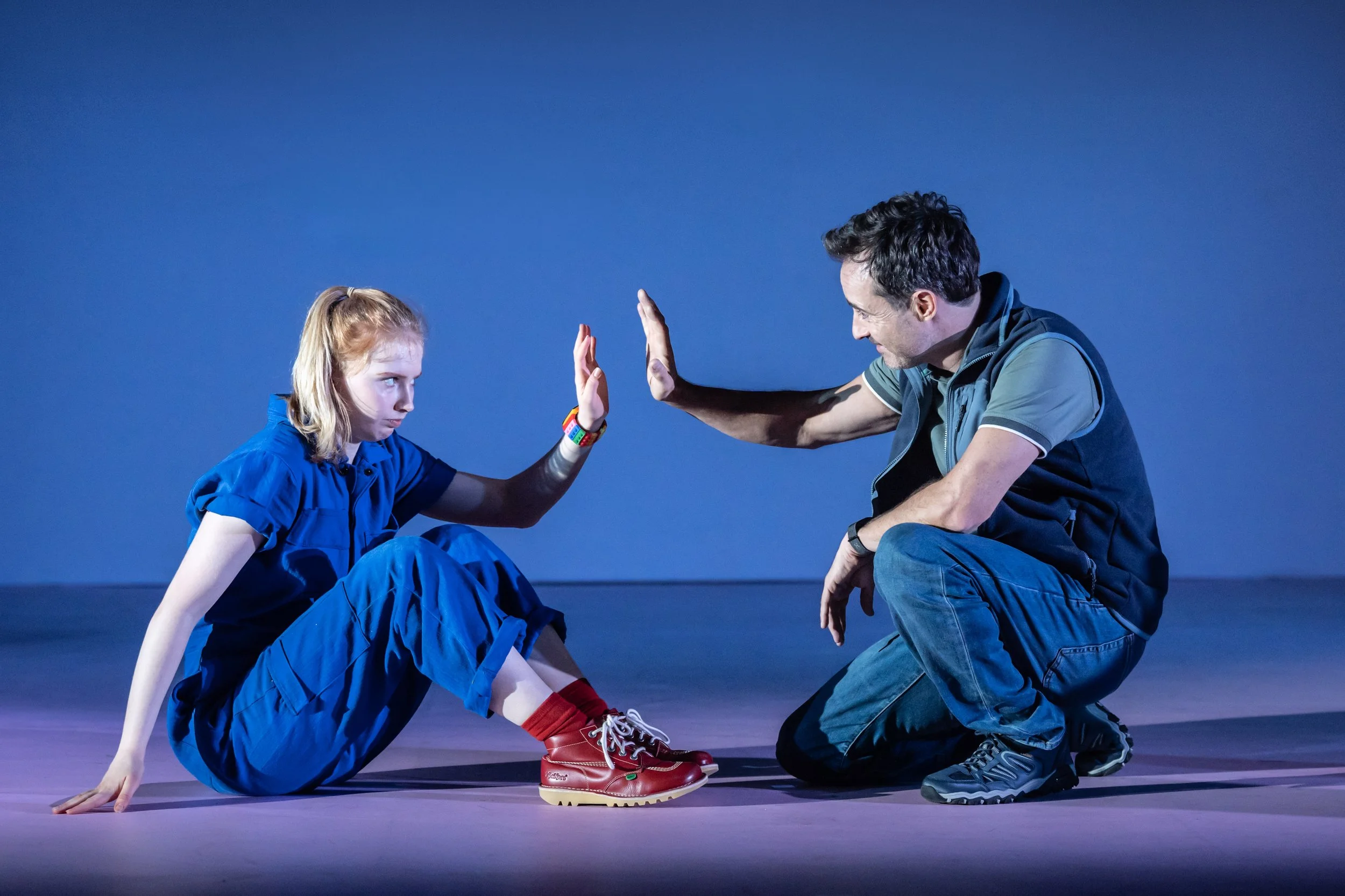
The ensemble cast is weak, with slipped accents, flat delivery and a lack of physicality. At times, the effect comes across like a GCSE performance, especially some of the montages and one of the slaps. It is also not immediately clear who is who, nor why the supporting actors have apparently rubbed against wet paint; one possible explanation is that Marilyn’s body was blue when it was discovered.
One of the stranger staging decisions is the constant flash of lighting to denote a scene change, which is distracting and irritating and serves no purpose, unless it is to provide blue spots in front of the audience’s eyes to match the paint-splashed characters. Another is the cringeworthy sex scene, which takes place fully clothed, complete with animalistic noises. Not only is this scene unnecessary, but it’s also laughable and a real low point of the performance.
The final scene is a brutal depiction of Marilyn’s alleged murder, which is almost exploitative and does little more than enhance the flawed plot and script. In its first moments, this play promises to show us a different side of Monroe; ultimately, it leaves us with the same caricature seen in pop culture and nothing of the bubbly, tenacious businesswoman she tried so hard to be.
No matter what your thoughts are on her life or death, Marilyn Monroe’s legacy will live on; this play will not.
Who Killed Marilyn Monroe plays at the Emerald Theatre until October 29th.
★
Written by Mia for Theatre and Tonic, August 2026.