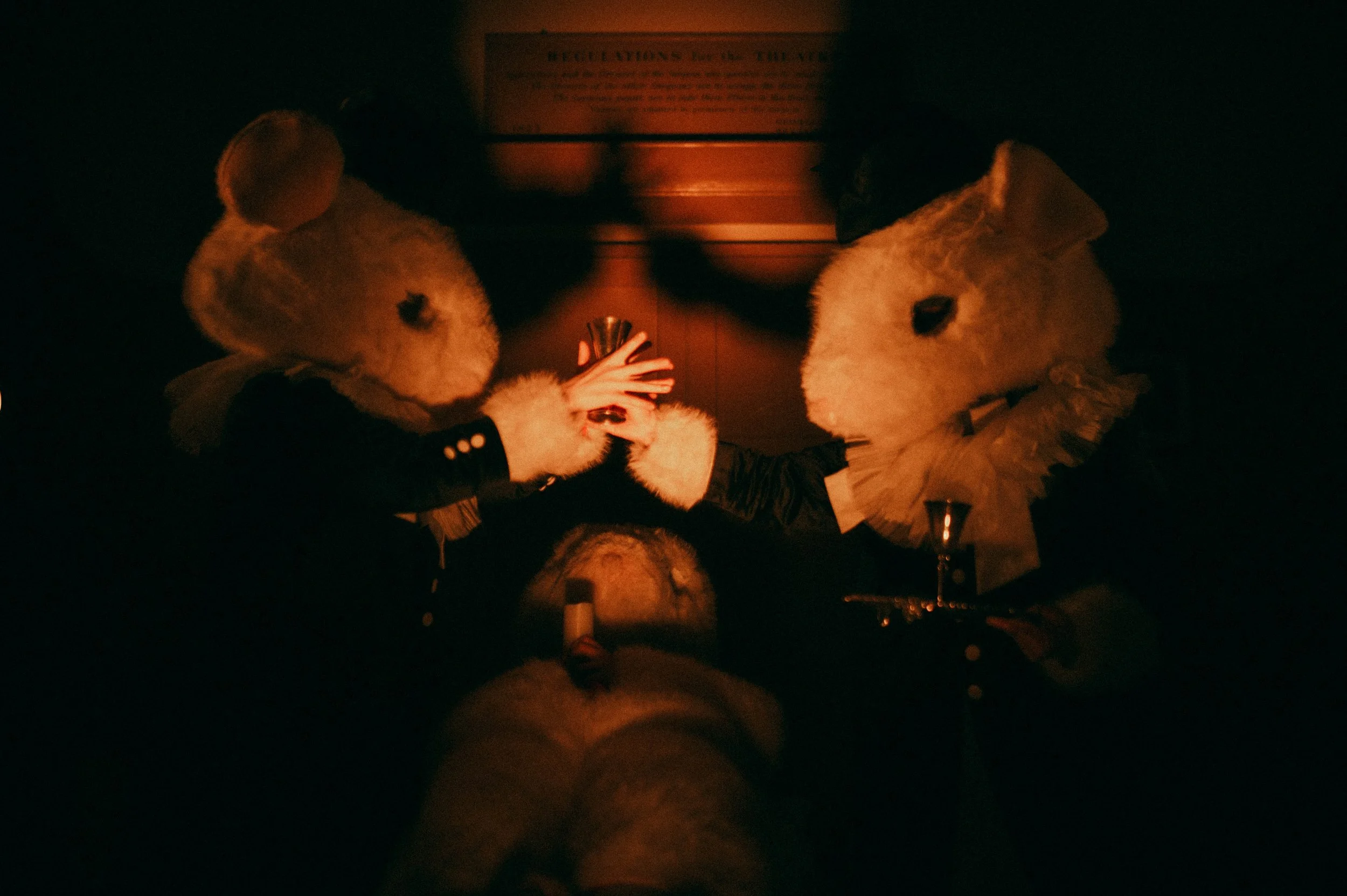
It is hard not to be drawn to Rat Rat Rat when you first catch sight of its fluffy white mouse costumes (Costume Designer: Freya Yuejie Li). Drawing on the history of animal experimentation and the atrocities committed by Unit 731 during the Second World War, the production combines puppetry and physical theatre to explore how institutional authority can normalise cruelty. The work brings together an international team of artists from East and Southeast Asia (ESEA), the UK and Germany. Produced by Yingying Xie and co-presented by EggGen and Selene Mingyue Hu, Rat Rat Rat returns to Camden People’s Theatre, directed by Yaqi Sun, following a sold-out first run. Having seen the production for a second time, I remain convinced that it has considerable potential to go even further.
In this latest iteration, the three rats emerge as much more clearly defined characters. Rat B, played by Tiffany Yeung, stands out in particular. Almost childlike in her exuberance, she is lively to the point of being a little unruly, clumsy yet eager to perform. She is also the most protective of the baby rat being used as an experimental subject. Rat A, played by Levenka Andrea, leads the group with an elegant, assured manner, carrying the ease of someone accustomed to power. Rat C, played by Rebecca Fangnan Zhao, looks after Rat B but ultimately remains subordinate to A.
For much of the performance, the rats are bathed in dim, amber light (Lighting Designer: Luka Xuan Ge), accompanied by eerie music and the sudden, jarring ring of a school bell (Composers and Sound Designers: Jade Leamcharaskul and Ganey Zhang). At times, thunder rumbles without warning, followed by flashes of white lightning that illuminate the rats from head to toe. In these moments, Rat B seems even more frightened.
There is no spoken dialogue throughout the production, making physical expression and the information conveyed through the theatrical environment all the more important. The rats' movements are graceful and endearing (Movement Director: Tutu Ching). However, beyond their charm, I would have liked to see the rats' distinctive physicality developed further to convey deeper meanings. When the other two rats single out Rat B as the next subject for dissection, the transition feels almost too natural, as though it were an inevitable outcome that everyone accepts without question. The moment would benefit from greater dramatic tension, giving the audience more reason to feel genuinely shocked.
I particularly like the decision to make use of the theatre's entire space, incorporating the basement into the world of the story. However, when a previously unseen figure steps onto the stage to draw back a curtain and reveal a projection, the intervention feels somewhat abrupt. Giving this figure a defined role within the production could make the moment feel more organic and intriguing. I also think the revelation that Rat B is, in fact, human would be more compelling and unsettling if it were foreshadowed through subtle details throughout the performance, rather than revealed solely through the final video. Allowing the audience to piece together the truth gradually would make the revelation more satisfying and powerful. Just as important is the revelation that the other two rats are human as well.
The production has many compelling qualities, but its most distinctive feature is undoubtedly its allusion to Unit 731. Established by the Imperial Japanese Army during the Second World War, Unit 731 was a secret organisation that ostensibly conducted research into infectious diseases and water supply sanitation. In reality, it was centrally involved in the development and testing of biological weapons, as well as conducting experiments on living human subjects. Choosing white rats, creatures so routinely used as experimental subjects, as the protagonists is an exceptionally astute decision. It would be a missed opportunity not to develop this metaphor more fully and make it the central thread of the narrative.
The previous run took place at the Old Operating Theatre Museum and Herb Garret in London. In the nineteenth century, surgery was performed here as a public demonstration for medical students. Patients lay at the centre of the operating theatre while students gathered around to observe the bloody and painful procedures. The venue itself became a character in the storytelling. Without the backdrop of this historic operating theatre, the production needs to convey more of its historical context and thematic meaning through its own content and theatrical language.
That said, I particularly enjoyed another small touch introduced in this run. Audience members wearing rat-themed clothing or accessories had the chance to receive an additional gift. Eager to discover these little surprises, many audience members willingly followed the “instructions” and, almost without realising it, found themselves becoming participants in the story. It was a playful yet effective way of drawing the audience into the world of the production.
Rat Rat Rat is an imaginative and distinctive work. If it could fully exploit the tension between its adorable exterior and the dark subject matter it seeks to explore, heightening the sense of unease and deepening the atmosphere of cruelty, I believe it could one day become a truly compelling production, capable of captivating audiences even without a site-specific setting.
Rat Rat Rat plays at Camden People’s Theatre until 31st November 2026.
★ ★ ★
Written by Ziwen for Theatre and Tonic, October 2026.